

Pakistan’s government has ‘nothing to do’ with rejection, acceptance of nomination papers — minister 

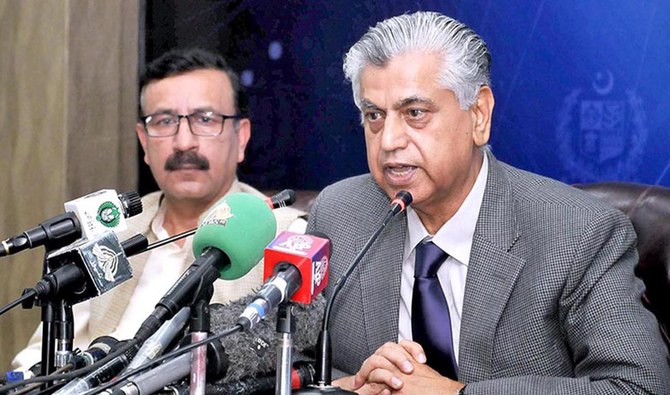
Caretaker Minister for Information and Broadcasting Murtaza Solangi speaks during a press conferenced in Islamabad, Pakistan on September 2, 2023. (APP)
Short Url
Updated 31 December 2023
Follow

Pakistan’s government has ‘nothing to do’ with rejection, acceptance of nomination papers — minister 

  • Ex-PM Khan’s party has accused returning officers of wrongfully rejecting its candidates’ nomination papers 
  • Only election commission has authority to decide on matters related to polls, says information minister 

ISLAMABAD: Pakistan’s caretaker government has “nothing to do” with the rejection or acceptance of nomination papers for the polls, Information Minister Murtaza Solangi said this week amid allegations of “pre-poll rigging” by the Pakistan Tehreek-e-Insaf (PTI) party against the country’s government and election regulator.  

The Election Commission of Pakistan (ECP) scrutinized thousands of nomination papers of candidates for polls scheduled on Feb. 8, from Dec. 24-30.  

The PTI cried foul as the election regulator rejected former prime minister Imran Khan’s nomination to contest the 2024 national elections in two constituencies. Other PTI members whose nominations were rejected included Ali Amin Khan Gandapur, Murad Saeed, Sahibzada Sibghatullah, Dr. Amjad Khan, Fazal Hakim Khan, Mian Sharafat, Salim-ur-Rahman, said Omar Ayub Khan, a Khan aide and a former federal minister. 

“Only the Election Commission has the authority to decide on election-related matters,” Solangi was quoted by the Associated Press of Pakistan (APP) on Saturday. He was speaking to a private news channel.  

“The caretaker government had nothing to do with the acceptance or rejection of nomination papers which was part of the constitutional process.” 

Reiterating that polls would be held on Feb. 8, Solangi said the caretaker government was committed to providing financial and administrative support to the ECP for elections. 

In response to a question, Solangi said Pakistan’s constitutional bodies had been working “within their limits.” 

Khan, who is in prison since August after being convicted in a graft case, has accused Pakistan’s powerful military, the ECP, and his political rivals of colluding to keep him and the PTI away from elections. He denies any wrongdoing and says the charges against him are politically motivated. 

The Pakistani military, the election regulator, and the caretaker government deny Khan’s allegations. 

Tensions between Khan’s party and the ECP escalated earlier this month when the regulator stripped the PTI of its electoral symbol, a cricket bat, for violating rules in the intraparty elections. The symbol is reflective of Khan’s past as a successful cricketer, who led Pakistan to their only 50-over World Cup win in 1992. 

The decision, however, was overturned by a Pakistani high court which ruled the PTI could retain the bat as its symbol.  


Bangladesh approves new rice imports from Pakistan amid price pressures

Updated 23 December 2025
Follow

Bangladesh approves new rice imports from Pakistan amid price pressures

  • The deal follows Bangladesh’s resumption of direct rice trade with Pakistan earlier this year ⁠for the first time since independence in 1971
  • Diplomatic ties between the two nations have improved since the ouster of prime minister Sheikh Hasina after mass protests last year

DHAKA: Bangladesh has approved the import of 50,000 metric tons of white rice from Pakistan under a government-to-government deal as ​part of efforts to stabilize domestic prices, officials said on Tuesday.

The Cabinet Committee on Government Purchase cleared the deal at $395 per ton, reinforcing Dhaka’s renewed trade engagement with Islamabad.

Rice prices in Bangladesh have jumped by between 15 percent and 20 percent over ‌the past ‌year, with medium-quality ‌rice ⁠selling ​at about ‌80 taka ($0.66) per kilogram. Despite increased imports and the removal of duties to ease supply constraints, prices for the staple grain remain stubbornly high.

The deal follows Bangladesh’s resumption of direct rice trade with Pakistan earlier this year ⁠for the first time since independence in 1971. In ‌February, it imported 50,000 ‍tons of rice from ‍Pakistan at $499 per ton under a ‍similar agreement.

Diplomatic ties between the two South Asian nations have improved since an interim government led by Nobel laureate Muhammad Yunus took office after ​mass protests forced then prime minister Sheikh Hasina to flee to neighboring ⁠India last year.

Formerly East Pakistan, Bangladesh gained independence after a nine-month war in 1971, and relations with Pakistan have remained fraught in the decades since the conflict.

Separately, the government approved another 50,000 tons of parboiled rice through an international tender, part of a series of recent purchases aimed at cooling local prices. India’s Pattabhi Agro Foods secured ‌the contract with the lowest bid of $355.77 per ton.