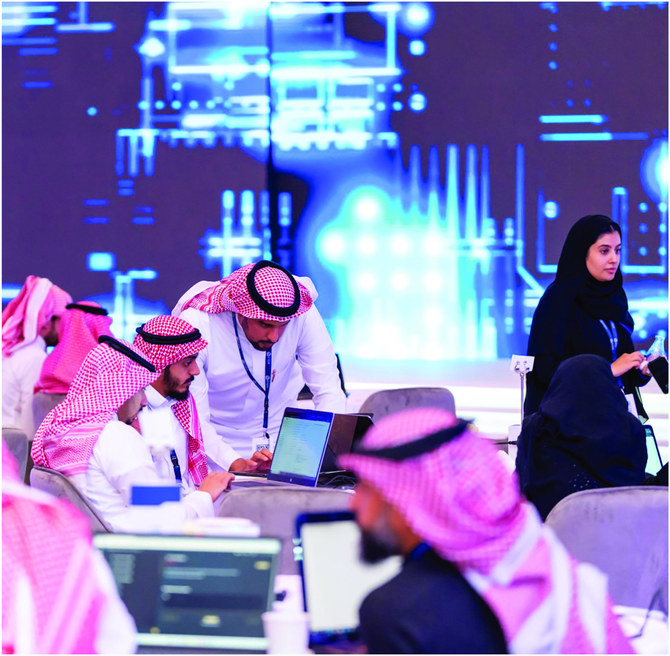
Saudi venture capital space records unprecedented growth in 2023

The Kingdom’s robust entrepreneurial environment positions the country as a key player in the region’s startup scene. (SPA)
Short Url
Updated 30 December 2023
Follow

Saudi venture capital space records unprecedented growth in 2023

CAIRO: Saudi Arabia’s startup ecosystem flourished in 2023 with the venture capital sector reaching new heights.
The entrepreneurial environment in the Kingdom charted a new course for economic prosperity, positioning Saudi Arabia as a leading country in the region’s burgeoning startup scene. 
The year was marked by robust participation from startups, venture capitalists, government bodies, and various stakeholders, all contributing significantly to the enhancement of the Kingdom’s startup ecosystem. 
This collective effort was characterized by a surge in investments and a range of initiatives aimed at fostering growth and innovation across the sector.

A record-breaking year 
In an interview with Arab News, Philip Bahoshy, founder of venture data platform MAGNiTT, shed light on the remarkable growth trajectory of Saudi Arabia’s venture ecosystem. 
He highlighted the advancements the Kingdom has made over the years and expressed optimism that the momentum would continue in 2024 and investments are likely to surpass 2023 figures.
Reflecting on the evolution of the sector, Bahoshy remarked: “If you go back to 2018, only $50 million were invested in local tech companies. This year, we’re on track to exceed last year’s investment total of $1 billion. This phenomenal growth is a direct result of the active involvement at the government level.” 
Bahoshy stated that the Kingdom is expected to be the only country to see an increase in funding year on year.

National alignment 
He credited the Kingdom’s Ministry of Communications and Information Technology with the phenomenal growth of the ecosystem. 
Bahoshy also highlighted key initiatives such as LEAP, the Saudi Unicorns program, and the National Technology Development Program. These initiatives have been pivotal in encouraging startups to establish their presence in the Kingdom. 
The top executive noted that entities like Saudi Venture Capital and Jada Funds of Funds have made significant strides this year, contributing to the growth of the ecosystem. 
“There is clearly a national push toward tech venture as an asset class,” Bahoshy stated. He concluded by asserting that the Kingdom is poised to end the year as the leading venture ecosystem in the Middle East and North Africa region, underscoring the national commitment to nurturing and expanding the tech venture sector.

Rising talent 
The evolution of venture capital in the Kingdom has had a profound impact not only on the nation’s economic stature but also on the cultivation of its talent pool. 
The year 2023’s growth in venture capital investment has created a fertile environment for innovation and entrepreneurship, enabling local talent to thrive and contribute significantly to the diversification and dynamism of the Saudi economy. 
Bahoshy noted that Saudi Arabia’s talent pool is experiencing organic growth, further enhanced by the influx of international talent. 
This increase is attributed to the expansion and relocation of more companies to the Kingdom, attracting a diverse range of skills and expertise.

A year ahead 
Saudi Arabia’s venture capital sector in 2023 has surpassed expectations, demonstrating resilience and growth even amid global economic challenges. 
Bahoshy, analyzing the Kingdom’s venture ecosystem, anticipates that this upward trajectory will extend into 2024. 
He commented: “Considering the Saudi ecosystem’s robust performance in a turbulent economic climate, there’s a strong indication that 2024 could mirror, if not exceed, the success of 2023.” 
He highlighted the importance of interest rates as a key factor influencing venture capital performance. 
With predictions pointing toward a potential decline in US interest rates in 2024, Bahoshy believes such a scenario will significantly enhance the investment environment. 
A decrease in interest rates, according to Bahoshy, could lead to not just an uptick in regional investments but also a resurgence in international funding. This would mark a notable shift from the slowdown observed in 2023. 
He also foresees that while both Saudi Arabia and the UAE are likely to experience concurrent growth in 2024, a broader upward trend across MENA nations is expected by 2025, signaling a region-wide boost in the venture capital sector.

The Kingdom’s firm position 
Talking to Arab News, Mohammed Al-Zubi, founder of Saudi-based Nama Ventures, emphasized Saudi Arabia’s role as a key player in the MENA region’s startup ecosystem. 
Al-Zubi stated: “Saudi Arabia has consistently been a pivotal market in the MENA region, which is why Nama Ventures chose Riyadh as its base. This year, however, has truly cemented the Kingdom’s status as the prime location for launching entrepreneurial ventures targeting the MENA market.” 
He further highlighted the strength and progress of Saudi Arabia’s entrepreneurial landscape, particularly in the face of challenging economic conditions. 
The entrepreneur elaborated: “The Kingdom’s entrepreneurial scene has demonstrated remarkable resilience amid the broader macroeconomic downturn. More impressively, it has shown substantial growth and maturity, which is clearly evident in the performance figures and investment trends we’ve seen.” 
Echoing Bahoshy’s views, Al-Zubi described 2023 as a challenging yet transformative period for entrepreneurs in the Kingdom. He noted that the beginning of the year saw a tightening in funding, compelling entrepreneurs to adopt drastic measures for survival. 
“2023 has been a rollercoaster for MENA entrepreneurs. We’ve shifted from a pre-2023 mindset of prioritizing growth at all costs to adopting strategies focused on surviving to fight another day,” Al-Zubi said. 
“With funding becoming scarce, entrepreneurs had to downsize to sustain and remain competitive. Our advice to our portfolio companies was to prioritize sustainability over aggressive growth,” Al-Zubi explained. 
As the year draws to a close, Al-Zubi observed an upturn in the market. “As we approach the year’s end, there are emerging signs of improved liquidity in the market. This change indicates that entrepreneurs should now start focusing on achieving sustainable growth as we move into 2024,” he added. 
This shift marks a crucial turning point for the Kingdom’s entrepreneurial landscape, signaling a move toward more balanced and sustainable business strategies.

Sectoral outlook 
The projected growth trajectory of Saudi Arabia is expected to encompass a broad range of sectors, with a particular emphasis on those experiencing high demand. 
Bahoshy views the continuing expansion of e-commerce and logistics as a given. However, he also foresees a significant surge in the fintech sector, indicating a diverse growth pattern across various industries. 
Concurrently, Al-Zubi offered a different perspective. “At Nama, we see the potential to disrupt traditional businesses in many areas, particularly in the MENA region and Saudi Arabia. That’s why, we maintain a sector-agnostic approach.” 
“We believe technology will act as a major disruptor across all sectors. In 2023, our investments spanned logistics, and food tech, among others, and we plan to stick to our strategy in 2024, positioning ourselves as the go-to early-stage, sector-agnostic fund,” he stated.


Consumer packaged goods in MENA market to hit $650bn by 2030

Updated 8 sec ago
Follow

Consumer packaged goods in MENA market to hit $650bn by 2030

  • Growth to be primarily supported by positive fundamentals, consumer demand

RIYADH: The consumer packaged goods market in the Middle East and North Africa region is expected to reach up to $650 billion by 2030, representing a compound annual growth rate of 5 percent from now, according to an analysis. 

In its latest report, Bain & Co. said that this growth will be primarily supported by positive regional fundamentals and continued consumer demand, especially in countries like Saudi Arabia and the UAE. 
The findings align with the evolution of countries in the MENA region, where economic diversification efforts are progressing steadily, and these nations are positioning themselves as a hub for tourism, entertainment and business. 
“CPG leaders should view MENA as a true growth arena. The opportunity is real, but the bar is rising — consumers are more time-starved, more intentional, and increasingly focused on trust and relevance,” said Faisal Sheikh, senior partner at Bain & Co. 
He added: “The winners will be the companies that tailor their growth algorithms to the region’s realities and invest behind the moments that matter most to local consumers. This will inevitably mean streamlining the cost structure to create funds that can be reinvested behind growth.” 
The report draws on a survey of 3,500 consumers across the four focus markets — Saudi Arabia, the UAE, Egypt, and Iraq — and interviews with 20 regional CPG executives, alongside Bain analysis and supporting market data.
In 2025, global consulting firm AlixPartners echoed similar views and said that the consumer market in the region, especially in Saudi Arabia, is evolving rapidly, characterized by adaptability, shifting spending patterns, and resilience in the face of global economic challenges.
Another report by Oxford Economics said that real household consumption across the Gulf Cooperation Council region is projected to increase by 3.4 percent per annum over the next five years, nearly double the 1.7 percent growth forecast for advanced economies. 
In October, another report by Grand View Research projected a slightly smaller figure for the CPG market in the region.  
The report said that the Middle East CPG market size was estimated at $175.72 billion in 2024 and is projected to reach $258.68 billion by 2033, growing at a CAGR of 4.5 percent. 

MENA’s growing role in the CPG sector
According to Bain & Co., the MENA region has emerged as a significant contributor to CPG growth, with the UAE and Saudi Arabia leading the way. 
The UAE recorded approximately 6 percent volume growth in the sector in 2024 — well above the 1.7 percent global average, while Saudi Arabia closely followed with around 4 percent. 
Both countries posted solid value growth alongside volume gains, signaling a strong ability to manage inflation pressures that continue to surge in many parts of the world.
In December, Saudi Arabia’s General Authority for Statistics revealed that the Kingdom’s annual inflation rate slowed to 1.9 percent in November, easing from 2.2 percent in the previous two months. 
The International Monetary Fund, in October, also said that Saudi Arabia is expected to maintain an annual inflation rate of 2.1 percent in 2025 and 2 percent in 2026.
Highlighting the robust size of MENA CPG ecosystem, Bain & Co. revealed that the market totals more than $450 billion in fast-moving consumer goods sales, comprising around $200 billion in the food and beverage sector and $250 billion in non-F&B categories. 
Egypt, having recently rebounded from macroeconomic turbulence, is now leading the regional CPG market with an estimated $67 billion in sales, closely followed by Saudi Arabia at around $65 billion.

Factors driving growth
According to the report, the region’s growth in the CPG sector has been supported by robust structural fundamentals over the recent years. 
Bain & Co. highlighted that population growth in the region is on a steady upward trajectory, laying the groundwork for sustained long-term demand. 
More than half of the GCC’s population is under 30, and rapid urbanization is fueling demand for consumer products, modern retail formats, and global brands.
Easing inflation and anticipated interest rate cuts have also enhanced disposable income and improved consumer spending.
Moreover, government-led initiatives to lessen dependence on oil have paid off, creating new economic opportunities with the intent to lower unemployment rates. 
The report added that increased salaries in the UAE and Saudi Arabia are also increasing consumer spending. The average monthly household income for Saudis exceeds SR18,000 ($4,800), providing purchasing power for more discretionary spending.

Channel evolution and digital adoption
According to the report, in-store shopping remains the dominant channel in the grocery segment, but online platforms are also gaining traction in this area, especially among urban, younger, and higher-income consumers.
Satisfaction with online grocery still trails global benchmarks due to stock and delivery issues, yet adoption is rising quickly as MENA consumers embrace hybrid shopping habits.
The report added that identity-driven brand relationships are a core driver of new purchasing decisions and shopping habits. 
MENA consumers anchor themselves in family, spirituality, education, and work, with Gen Z leaning into self-betterment and older generations emphasizing legacy and stability.
More than half of MENA consumers report boycotting brands due to value misalignment, putting trust and alignment alongside price and quality as decision drivers.
Bain & Co. added that digital adoption and channel evolution are accelerating in MENA’s CPG market. In the UAE alone, e-commerce penetration is already 12 to 14 percent of retail sales and is expected to rise to 20 to 25 percent by 2030, capturing roughly 60 percent of incremental growth.
“MENA’s growth is being shaped by channel evolution and rising expectations on convenience, especially in markets like the UAE, where e-commerce is already meaningful and still expanding,” Federico Piro, partner at Bain & Co. 
He added: “Companies that adapt route-to-market, sharpen their portfolios, and execute with discipline can capture growth while strengthening brand resilience.” 

Potential challenges and combat measures
The report notes that while MENA is emerging as a bright spot, CPGs in the region are still navigating shifting consumption patterns, rising cost pressures, and regulatory complexity, while also competing harder for share against insurgents and strong local incumbents. 
CPG players in the region are under pressure to rebuild investor and customer confidence, revive volume growth, and strengthen resilience, while funding the capabilities required to succeed in the sector. 
“The next chapter in MENA will reward companies that turn complexity into advantage, by simplifying where it counts, freeing up resources through continuous productivity, and using technology to build deeper customer intimacy and operational excellence. This is a moment to be bold and practical at the same time,” said Karim Chehade, associate partner at Bain & Co. 
Bain & Co. said that companies operating in the sector should make bold moves and execute flawlessly to maximize core market profit pools, while expanding categories and geographies to access new profit pools.
It is also essential to go beyond traditional cost-cutting by simplifying portfolios and operations to free up resources for growth.
“MENA remains one of the most dynamic frontiers for consumer products, but winning will require more than importing global playbooks,” said Bain & Co. 
It concluded: “With decisive leadership, bold strategies, and disciplined execution, CPGs can secure both resilience and relevance, positioning themselves as trusted partners in the everyday lives of MENA consumers.”