

Ex-PM Khan aides decry rejection of election nominations, allege ‘pre-poll rigging’

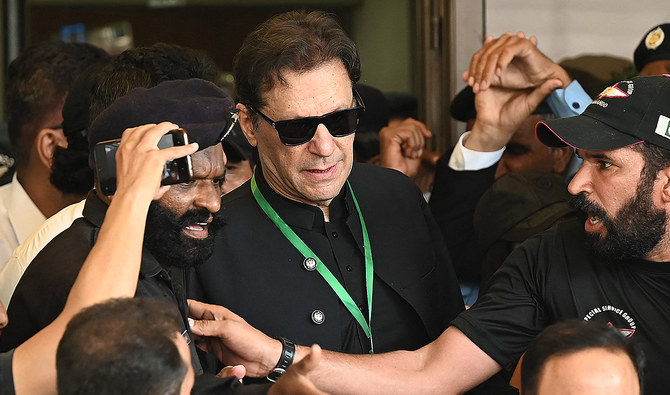
In this file photo, taken on July 24, 2023, Pakistan’s former Prime Minister Imran Khan (C) leaves after appearing in the Supreme Court in Islamabad. (AFP/File)
Short Url
Updated 30 December 2023
Follow

Ex-PM Khan aides decry rejection of election nominations, allege ‘pre-poll rigging’

  • Pakistan’s election regulator has also rejected Khan’s nomination to contest the 2024 national elections in Lahore, Mianwali
  • Khan, who is in prison, has accused authorities and his rivals of colluding to keep him out of elections, a charge denied by both

ISLAMABAD: Former prime minister Imran Khan’s aides on Saturday said Pakistan’s election regulator had rejected nomination papers of several members of their Pakistan Tehreek-e-Insaf (PTI) party, alleging “pre-poll rigging” ahead of the national elections scheduled for February 8.
The Election Commission of Pakistan’s (ECP) deadline to file nominations expired on Dec 24, with 28,626 candidates submitting their nominations for national and provincial assembly elections. It was followed by the process of scrutiny of nominations by election officials till December 30.
The ECP rejected Khan’s nomination to contest the 2024 national elections in two constituencies. Other PTI members whose nominations were rejected included Ali Amin Khan Gandapur, Murad Saeed, Sahibzada Sibghatullah, Dr. Amjad Khan, Fazal Hakim Khan, Mian Sharafat, Salim-ur-Rahman, said Omar Ayub Khan, a Khan aide and a former federal minister.
“Had already predicted that ROs (returning officers) will reject PTI candidates nomination papers on flimsy grounds. More rejections of PTI candidates nomination papers by under pressure ROs are expected today,” Omar said on X.
“If this pre poll rigging continues unabated, the transparency of election process is and will be called into question. Political instability will grow exponentially after a rigged election, and national cohesion will deteriorate.”

In a list of rejected candidates from Lahore, the election regulator said Khan’s nomination was rejected because he was not a registered voter of the constituency and was “convicted by the court of law and has been disqualified.”
His media team said the commission had also rejected his nomination to contest the elections from his hometown, Mianwali.
Zulfikar Bukhari, another Khan aide, said his nomination papers had been rejected on the basis that they bore his “fake” signatures.
“Returning officers are accomplice & reason why PTI had requested ROs from Judiciary & not bureaucracy,” Bukhari said in a statement.
The ECP earlier this month also stripped Khan’s party of its electoral symbol, a cricket bat, for violating rules in the intraparty elections. The symbol is reflective of Khan’s past as a successful cricketer, who led Pakistan to their only 50-over World Cup win in 1992.
However, a Pakistani high court on Dec. 26 suspended the ECP’s decision and restored cricket bat as the election symbol of Khan’s party.
Khan, who is in prison since August after being convicted in a graft case, has accused Pakistan’s powerful military, the ECP, and his political rivals of colluding to keep him and the PTI away from elections. He denies any wrongdoing and says the charges against him are politically motivated.
The Pakistani military, the election regulator, and the caretaker government deny Khan’s allegations.


Pakistan likely to import around 7 million cotton bales this year as local production nearly halves

Updated 5 sec ago
Follow

Pakistan likely to import around 7 million cotton bales this year as local production nearly halves

  • Pakistan produced 5.3 million cotton bales by mid-December against 10 million targeted, government data shows
  • While the imports may ensure smooth supply of raw material, they may put pressure on foreign exchange reserves

KARACHI: Pakistan is likely to import around 7 million cotton bales this year owing to a decline of nearly half the annual target set by the Federal Committee on Agriculture (FCA), industry stakeholders said on Tuesday.

Pakistan’s cotton production stood at 5.3 million bales each weighing 170 kilograms as of Dec. 15, according to state-run Pakistan Central Cotton Committee (PCCC) data. The FCA had set a target of 10.2 million bales in April.

Karachi Cotton Brokers Forum (KCBF) Chairman Naseem Usman Osawala sees the country’s cotton production declining by 46 percent this season, compared to the FCA target.

“The country is expected to produce about 5.5 million bales this year,” he told Arab News, adding Pakistan would have to import around 7 million bales to meet requirement of its textile industry which consumes about 12 million bales a year.

The country had sown cotton over 2.002 million hectares, which was down by 11 percent from the targeted 2.26 million hectares.

Muhammad Waqas Ghani, head of research at Karachi-based JS Global Capital brokerage firm, said the South Asian country is likely to miss its cotton output target of 10 million bales.

“At the current rate of arrival, the output can reach 7 million bales at its best,” he added.

Cotton is a raw material for Pakistan’s largest textile industry and was the worst hit crop by climate-induced floods earlier this year.

Osawala said Pakistan’s cotton production has been falling because of an increasing number of sugar mills being established in the country’s cotton-producing regions.

Courts in Pakistan have been issuing significant rulings to bar the establishment of sugar mills in the designated cotton belt areas of the Punjab province. In 2018, the Supreme Court ordered relocation of three sugar mills from cotton-producing districts in southern Punjab to protect the crop.

Since cotton prices are low in the international market, textile millers would go for more imports, according to the KCBF chairman.

On Dec. 22, the price of cotton in the New York market stood at as much as 65.85 cents per pound, 1.64 cents lower than last year, according to the PCCC data.

Osawala said Pakistan’s increasing textile imports are also “hurting local cotton production.”

According to the Pakistan Bureau of Statistics’ (PBS) July-November data, the country had imported raw cotton, synthetic fiber, synthetic and artificial silk yarn and worn clothing worth $2.82 billion, 5 percent more than the imports during the same period last year.

Speaking of the impact of Pakistan’s falling cotton production, Kamran Arshad, chairman of All Pakistan Textile Mills Association (APTMA), said the millers would have to import “a lot of cotton” this year.

“I think approximately 7-7.5 million bales will have to be imported this year,” he said.

The textile and apparel sector is Pakistan’s largest exporter, accounting for more than half of the country’s overall exports and contributing around 8.5 percent of the gross domestic product (GDP) by employing nearly 40 percent of the industrial labor force. But high energy costs and outdated infrastructure among other factors continue to slow growth and leave the country trailing regional peers.

In the last fiscal year, Pakistan imported as much as 6.2 million cotton bales each weighing 220 kilograms, mostly from Brazil and the United States, according to KCBF Chairman Arshad.

Shankar Talreja, head of research at Karachi-based Topline Securities, said Pakistan is likely to import cotton worth $1.2 billion this year “considering the requirement.”

“The full-year import of cotton is likely to remain over $1 billion,” Talreja said.

Economic experts say while importing more cotton would ensure smooth supply of raw material to Pakistan’s textile sector, it may put pressure on the country’s foreign exchange reserves that rose to $15.9 billion last week after the International Monetary Fund (IMF) released a $1.2 billion tranche under Pakistan’s $7 billion loan program.