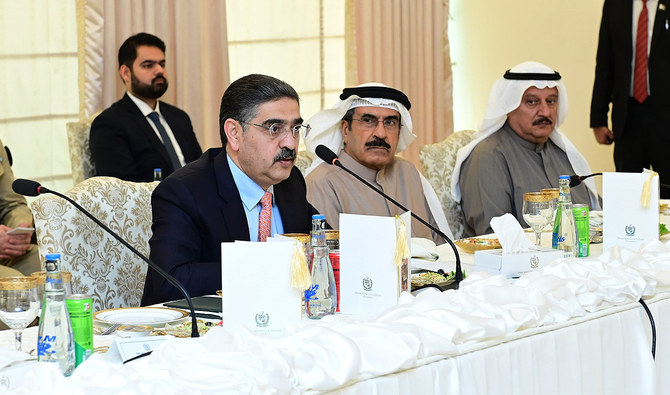
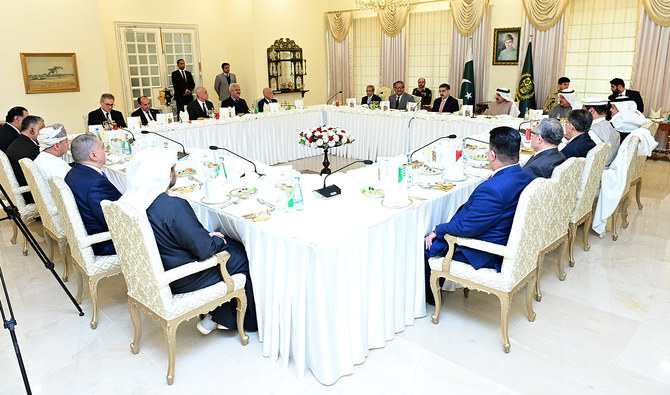
ISLAMABAD: Pakistan’s Caretaker Prime Minister Anwaar-ul-Haq Kakar met Muslim ambassadors of the Middle East and North Africa (MENA) region on Wednesday to discuss the deteriorating human rights situation in Palestine, Islamophobia, and other issues, a statement from the Prime Minister’s Office (PMO) said.
Islamabad enjoys fraternal ties with Muslim countries in the MENA region, particularly Saudi Arabia and the United Arab Emirates (UAE). Over three million Pakistani expatriates live in the two countries alone, making them a huge source of remittances for the South Asian country.
Pakistan has consistently lobbied for a cease-fire in Gaza, as the human rights situation in the Middle East worsens. Israel’s defense forces have killed over 20,000 Palestinians and wounded thousands more since Oct. 7, as it mounts air and ground offensives against Hamas.
Kakar met the ambassadors of Bahrain, Egypt, Iraq, Jordan, Kuwait, Lebanon, Libya, Morocco, Oman, Palestine, Saudi Arabia, Syria, UAE and Yemen for lunch on Wednesday, the PMO said.
“The Prime Minister shared Pakistan’s perspective on a number of issues, particularly the deteriorating human rights and humanitarian situation in the occupied Palestinian territories,” the statement said.
“Other challenges confronting the Muslim world such as Islamophobia were also discussed.”
The premier stressed the need for Muslim countries to work closely and collectively, especially through the Organization of Islamic Cooperation (OIC) on these “complex issues,” the PMO added.
Kakar underscored the importance that Pakistan attaches to fraternal relations with Muslim states, particularly those in the MENA region.
“The Prime Minister praised the Ambassadors for their efforts to forge stronger ties between Islamabad and their respective capitals,” the PMO said.
The ambassadors, in turn, thanked Kakar and reiterated their support toward advancing bilateral relations with Pakistan, the statement said.


Pakistan’s PM discusses Palestine crisis, Islamophobia with ambassadors of MENA countries
https://arab.news/gjv7m
Pakistan’s PM discusses Palestine crisis, Islamophobia with ambassadors of MENA countries

- PM Kakar meets ambassadors of Saudi Arabia, UAE, Palestine, Jordan, Egypt and other countries from MENA region
- Pakistan’s premier urges countries to work closely and collectively, especially through OIC, to combat mutual challenges

Pakistan launches second indigenous EO-2 satellite from China, SUPARCO says
- Earth observation satellite launched from Yangjiang Seashore Launch Center in China
- EO-2 to enhance disaster response, governance, resource management capabilities
KARACHI: Pakistan has successfully launched its second indigenous Earth Observation satellite, EO-2, from China’s Yangjiang Seashore Launch Center, the national space agency SUPARCO said on Thursday.
The launch marks a significant step in Pakistan’s efforts to strengthen its domestic space and remote sensing capabilities, with the satellite expected to improve imaging continuity, disaster monitoring, agricultural planning and strategic resource management.
In a statement, Pakistan’s SUPARCO said the EO-2 satellite would enhance the country’s earth observation and imaging capabilities and support governance and planning functions across multiple sectors.
“Pakistan’s second indigenous EO-2 satellite has been successfully launched,” SUPARCO said, adding that the mission represents a “milestone” in the expansion of the country’s satellite fleet.
According to the agency, EO-2 will provide critical data for planning and resource management while improving the continuity and accuracy of national earth observation systems.
The satellite is expected to support disaster management, urban planning, environmental monitoring and infrastructure development by supplying updated geospatial imagery and data.
SUPARCO said the launch demonstrates growing indigenous capability in satellite development and reflects Pakistan’s broader objective of strengthening its national space program through locally developed platforms.
Pakistan has gradually expanded its space cooperation with China in recent years, including satellite launches and joint missions, as Islamabad seeks to build technical capacity and reduce reliance on external data sources.
The EO-2 satellite is expected to play a key role in improving data availability for federal and provincial authorities, particularly in areas vulnerable to floods, climate stress and rapid urbanization.


