

Bagdhad condemns US strike on Iraqi military positions

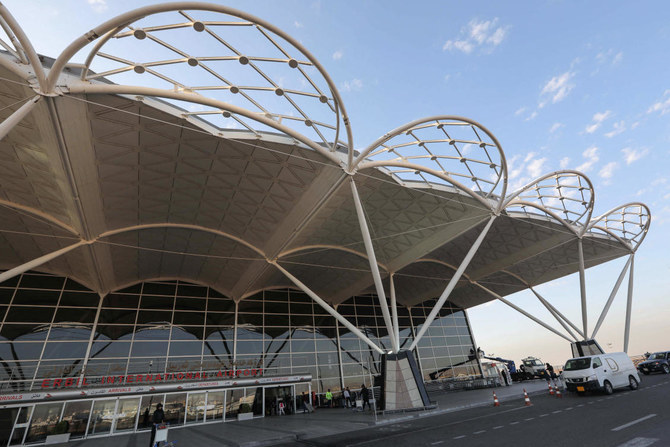
A picture taken on December 24, 2019, shows a view of the entrance to the terminal of Erbil International Airport. (File/AFP)
Short Url
Updated 26 December 2023
Follow

Bagdhad condemns US strike on Iraqi military positions

  • US forces have repeatedly targeted sites used by Iran and its proxy forces in Iraq and Syria in response to dozens of attacks on American and allied forces in the region following Israel's war on Gaza

BAGHDAD: Iraq on Tuesday denounced US air strikes in the country as a "hostile act" after the Pentagon said it had targeted three sites used by pro-Iran forces after coming under fire.
The government said the strikes that killed one member of the security forces and wounded 24 other people, including civilians, were an "unacceptable attack on Iraqi sovereignty" that damaged bilateral relations.

An Iraqi interior ministry official said the strikes targeted a Hashed Al-Shaabi site in the central city of Hilla, one of two locations targeted in Babylon province.
One person was killed and 20 wounded, while four others were wounded in another strike in the southern province of Wassit, the official said. Two security sources in Babylon and Wassit provinces gave the same information.
Hours earlier the United States said its forces had carried out strikes on three sites used by pro-Iran groups in Iraq in response to a series of attacks on US personnel.
US forces have repeatedly targeted sites used by Iran and its proxy forces in Iraq and Syria in response to dozens of attacks on American and allied forces in the region since the October 7 outbreak of the Israel-Hamas war.
“US military forces conducted necessary and proportionate strikes on three facilities used by Kataeb Hezbollah and affiliated groups in Iraq,” US Defense Secretary Lloyd Austin said in a statement.
The Iran-backed Kataeb Hezbollah, or Hezbollah Brigades, forms part of the Hashed Al-Shaabi, a coalition of former paramilitary forces that are now integrated into Iraq’s regular armed forces.
“These precision strikes are a response to a series of attacks against US personnel in Iraq and Syria by Iranian-sponsored militias, including an attack by Iran-affiliated Kataeb Hezbollah and affiliated groups on Irbil Air Base” on Monday, Austin said.
That attack wounded three US military personnel, one critically, US National Security Council spokesperson Adrienne Watson said.
US President Joe Biden was briefed on the attack — which was carried out with a one-way attack drone — and directed the US strikes in a call with Austin and other national security officials after ordering the defense department to prepare a response, the statement said.
Biden “places no higher priority than the protection of American personnel serving in harm’s way. The United States will act at a time and in a manner of our choosing should these attacks continue,” the statement added.
The drone attack was claimed by the Islamic Resistance in Iraq, a loose formation of armed groups affiliated with the Hashed Al-Shaabi.
A tally by US military officials has counted 103 attacks against its troops in Iraq and Syria since October 17, most of which have been claimed by the Islamic Resistance in Iraq, which opposes US support for Israel in its war against Hamas in the Gaza Strip.

Opinion

This section contains relevant reference points, placed in (Opinion field)


US makes plans to reopen embassy in Syria after 14 years

Updated 21 February 2026
Follow

US makes plans to reopen embassy in Syria after 14 years

  • The administration has been considering re-opening the embassy since last year
  • Trump told reporters on Friday that Al-Sharaa was “doing a phenomenal job” as president

WASHINGTON: The Trump administration has informed Congress that it intends to proceed with planning for a potential re-opening of the US Embassy in Damascus, Syria, which was shuttered in 2012 during the country’s civil war.
A notice to congressional committees earlier this month, which was obtained by The Associated Press, informed lawmakers of the State Department’s “intent to implement a phased approach to potentially resume embassy operations in Syria.”
The Feb. 10 notification said that spending on the plans would begin in 15 days, or next week, although there was no timeline offered for when they would be complete or when US personnel might return to Damascus on a full-time basis.
The administration has been considering re-opening the embassy since last year, shortly after longtime strongman Bashar Assad was ousted in December 2024, and it has been a priority for President Donald Trump’s ambassador to Turkiye and special envoy for Syria, Tom Barrack.
Barrack has pushed for a deep rapprochement with Syria and its new leadership under former rebel Ahmad Al-Sharaa and has successfully advocated for the lifting of US sanctions and a reintegration of Syria into the regional and international communities.
Trump told reporters on Friday that Al-Sharaa was “doing a phenomenal job” as president. “He’s a rough guy. He’s not a choir boy. A choir boy couldn’t do it,” Trump said. “But Syria’s coming together.”
Last May, Barrack visited Damascus and raised the US flag at the embassy compound, although the embassy was not yet re-opened.
The same day the congressional notification was sent, Barrack lauded Syria’s decision to participate in the coalition that is combating the Daesh militant group, even as the US military has withdrawn from a small, but important, base in the southeast and there remain significant issues between the government and the Kurdish minority.
“Regional solutions, shared responsibility. Syria’s participation in the D-Daesh Coalition meeting in Riyadh marks a new chapter in collective security,” Barrack said.
The embassy re-opening plans are classified and the State Department declined to comment on details beyond confirming that the congressional notification was sent.
However, the department has taken a similar “phased” approach in its plans to re-open the US Embassy in Caracas, Venezuela, following the US military operation that ousted former President Nicolás Maduro in January, with the deployment of temporary staffers who would live in and work out of interim facilities.