

‘It’s a big deal’: Exporters see demand growth for Bangladeshi spices in Saudi Arabia

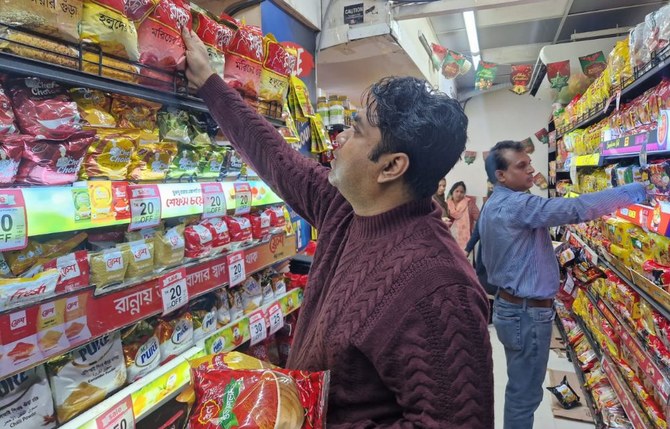
A customer browse through the spice section at a local supermarket in Dhaka. (AN Photo)
Short Url
Updated 25 December 2023
Follow

‘It’s a big deal’: Exporters see demand growth for Bangladeshi spices in Saudi Arabia

  • Gulf region is a top destination for Bangladeshi spices overall, official data shows
  • More than half of Bangladeshi spice exports to Gulf region had gone to the Kingdom

DHAKA: Saudi Arabia is a growing export destination for Bangladeshi spices, with the country’s producers crediting the growth to improved product quality and the Bangladeshi diaspora in the Kingdom.

Bangladesh exported more than $17 million worth of spices to Gulf countries between July and November this year, more than half of which had gone to Saudi Arabia, according to data from the Export Promotion Bureau.

“Saudi Arabia is our top export destination in the Gulf region. Next to the Kingdom, there is the UAE, Jordan and Oman,” Mohammad Sazzadul Karim, head of export at leading food company BD Food, told Arab News.

“In Saudi Arabia, we are noticing an increasing demand … all of our consumer goods producers have been producing better quality products in recent years. Our spices are penetrating into the Gulf markets, beating the Indian spices. It’s a big deal.”

BD Food mainly exports powder forms of turmeric, chili, curry, coriander and cumin, he said, adding that the Bangladeshi diaspora alone makes up a large base of consumers.

More than 2.6 million Bangladeshis live and work in Saudi Arabia, making them the biggest expat worker community in the Kingdom.

“We have a captive market for spices in the Kingdom as the country hosts more than 2.5 million Bangladeshis. Besides, there are a large number of Indian communities over there and both countries have similar food choices.”

The PRAN-RFL Group, one of Bangladesh’s largest conglomerates with a presence in more than 100 countries, said the spice market in the Gulf region has undergone a transformation in recent years.

“One decade ago, our customers were mostly Bangladeshi migrants in the Gulf region. Later on, people from India, Pakistan, Nepal, Sri Lanka, Bhutan and the Philippines started liking our spices,” Kamruzzaman Kamal, the group’s marketing director, told Arab News.

“In spite of the differences in food habits, Saudi locals are also consuming some of our spices. The number of our spice consumers is increasing day by day in Saudi Arabia.”

But to keep the momentum and to boost the spice market potential in the Gulf, Bangladeshi producers must “ensure quality and competitive prices,” said Dr. M.A. Rahim, who heads the department of agricultural science at the Daffodil International University.

“Neighboring India remains one of our main competitors in this sector. So, the government should also provide different policy support to accelerate our spice exports (to the Gulf).”


US warns UK to stop arresting Palestine Action supporters

Updated 4 sec ago
Follow

US warns UK to stop arresting Palestine Action supporters

  • Undersecretary of state for diplomacy: Arrests doing ‘more harm than good’ and ‘censoring’ free speech
  • Group was banned in July 2025 after series of break-ins

LONDON: UK authorities should stop arresting protesters showing support for banned group Palestine Action, the White House has warned.

The US undersecretary of state for diplomacy said arrests are doing “more harm than good” and are “censoring” free speech.

Sarah Rogers told news site Semafor: “I would have to look at each individual person and each proscribed organization. I think if you support an organization like Hamas, then depending upon whether you’re coordinating, there are all these standards that get applied.

“This Palestine Action group, I’ve seen it written about. I don’t know what it did. I think if you just merely stand up and say, ‘I support Palestine Action’, then unless you are really coordinating with some violent foreign terrorist, I think that censoring that speech does more harm than good.”

So far, more than 2,000 people have been arrested in the UK for showing support for the group.

It was banned in July 2025 after a series of break-ins nationwide, including at a facility owned by a defense manufacturer and a Royal Air Force base, during which military aircraft were damaged.

Last year, Swedish climate activist Greta Thunberg was among those arrested while protesting for Palestine Action.

The group is challenging its ban, saying it should not be compared to terrorist organizations such as the Irish Republican Army, Daesh or Al-Qaeda.

The ban has been criticized by numerous bodies, with Amnesty International calling it a case of “problematic, overly broad and draconian restrictions on free speech.”

In Scotland, prosecutors have been offering to drop charges against some protesters in return for accepting a fine of £100 ($134.30). 

Adam McGibbon, who was arrested at a demonstration in Edinburgh last year, refused the offer, saying: “The fact that the authorities are offering fines equivalent to a parking ticket for a ‘terrorism offence’ shows just how ridiculous these charges are. Do supporters of (Daesh) get the same deal?

“I refuse to pay this fine, as has everyone else I know who has been offered one. Just try and put all 3,000 of us who have defied this ban so far in jail.”

Rogers said the UK is also wrong to arrest people using the phrase “globalize the intifada” while demonstrating in support of Palestine, after police in Manchester said in December that it would detain people chanting it.

“I’m from New York City where thousands of people were murdered by jihadists,” she said. referring to the terror attacks of Sept. 11, 2001. “I don’t want an intifada in New York City, and I think anyone who does is disgusting, but should it be legal to say in most contexts? Yes.”