

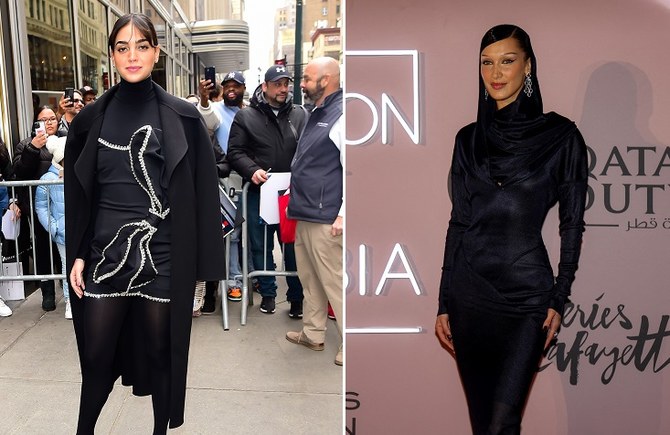
Melissa Barrera, Bella Hadid post for Palestine on Christmas

Actress Melissa Barrera, left, took to Instagram to share a message related to Gaza, while Bella Hadid posted an illustration on Christmas Eve. (Getty Images/ AFP)
Short Url
Updated 25 December 2023
Follow

Melissa Barrera, Bella Hadid post for Palestine on Christmas

DUBAI: Actress Melissa Barrera and supermodel Bella Hadid took to social media this week to share pro-Palestinian messages for Christmas.

Mexican star Barrera, who was previously fired from the “Scream” horror franchise over her stance, took to Instagram Stories to say: “I hope this Christmas feels… weird … I hope you can’t ignore the fact that you’re celebrating the birth of a child who was persecuted and targeted and his parents forced to flee to Egypt while right now millions of Palestinians from the exact part of the world are being persecuted and targeted and forced to flee their homes while they are indiscriminately and relentlessly bombed.”



A screenshot of Melissa Barrera's post. (Instagram) 

Barrera appeared in the two most recent films in the “Scream” franchise but was fired from her lead role in the upcoming “Scream 7” film after she took to social media to share pro-Palestinian views.

She previously shared a post that accused Israel of “genocide and ethnic cleansing” and posted an excerpt from Jewish Currents magazine about distorting “the Holocaust to boost the Israeli arms industry.”

“Scream” producer Spyglass severed ties with Barrera after the posts.

“Spyglass’ stance is unequivocally clear: We have zero tolerance for antisemitism or the incitement of hate in any form, including false references to genocide, ethnic cleansing, Holocaust distortion or anything that flagrantly crosses the line into hate speech,” the company told Variety. 

One day after Spyglass fired Barrera in November, it was revealed that castmate Jenna Ortega will also not be returning to the franchise due to filming conflicts.  This week, director Christopher Landon also departed from his role on “Scream 7,” taking to X on Saturday to write: “I guess now is as good a time as any to announce I formally exited ‘Scream 7’ weeks ago. This will disappoint some and delight others. It was a dream job that turned into a nightmare. And my heart did break for everyone involved. Everyone. But it’s time to move on.”

Meanwhile, US Dutch Palestinian model Hadid took to Instagram on Christmas Eve to share an illustration of the word “Palestine” in the form of a Christmas tree, topped with a dove holding an olive branch.


A post shared by Bella (@bellahadid)


Lebanese filmmaker turns archival footage into a love letter to Beirut

Updated 28 February 2026
Follow

Lebanese filmmaker turns archival footage into a love letter to Beirut

LONDON: Lebanese filmmaker Lana Daher’s debut feature “Do You Love Me” is a love letter of sorts to Beirut, composed entirely of archival material spanning seven decades across film, television, home videos and photography.

The film premiered at the 82nd Venice International Film Festival in September and has since traveled to several regional and international festivals.

Pink Smoke (2020) by Ben Hubbard. (Supplied)

With minimal dialogue, the film relies heavily on image and sound to reconstruct Lebanon’s fragmented history.

“By resisting voiceover and autobiography, I feel like I had to trust the image and the shared emotional landscape of these archives to carry the meaning,” Daher said.

A Suspended Life (Ghazal el-Banat) (1985) by Jocelyne Saab. (Supplied)

She explained that in a city like Beirut “where trauma is rarely private,” the socio-political context becomes the atmosphere of the film, with personal memory expanding into a collective experience — “a shared terrain of emotional history.”

Daher said: “By using the accumulated visual representations of Beirut, I was, in a way, rewriting my own representation of home through images that already existed."

Whispers (1980) by Maroun Bagdadi. (Supplied)

Daher, with editor Qutaiba Barhamji, steered clear of long sequences, preferring individual shots that allowed them to “reassemble meaning” while maintaining the integrity of their own work and respecting the original material, she explained.

The film does not feature a voice-over, an intentional decision that influenced the use of sound, music, and silence.

The Boombox (1995) by Fouad Elkoury. (Supplied)

“By resisting the urge to fill every space with dialogue or score, we created room for discomfort,” Daher said, adding that silence allows the audience to sit with the image and enter its emotional space rather than being guided too explicitly.

 The film was a labor of love, challenging Daher personally and professionally.

“When you draw from personal memory, you’re not just directing scenes, you’re revisiting parts of yourself and your childhood,” she said. “There’s vulnerability in that.”