
RIYADH: Saudi Arabia’s private sector’s contribution to the country’s real gross domestic product increased 3.4 percent year-on-year in the third quarter of 2023, official data showed.
The General Authority of Statistics revealed commercial enterprise added SR322.08 billion ($85.86 billion) to the Kingdom’s output in the three months to the end of September — a 45 percent share of the overall figure. This was primarily led by hospitality, manufacturing, real estate and financial activities.
This growth reflected the Kingdom’s efforts to foster an enabling environment with strategic planning and supportive initiatives.
Saudi Arabia’s real GDP stood at SR719.1 billion in the third quarter, reflecting a 4 percent decline from the previous year.
The annual decrease is primarily due to a 17 percent reduction in the contribution of oil activities to SR255 billion in the third quarter compared to the year-ago period.
The fall in oil activities resulted from the voluntary crude production cuts initiated in April, agreed upon as per the agreement of the Organization of the Petroleum Exporting Countries and its allies, also known as OPEC+.
However, the figure rises to SR727.54 billion after adjusting for predictable seasonal patterns, reported GASTAT.
On Nov. 1, the Finance Ministry’s budget performance report revealed a 36 percent decline in oil revenues in the third quarter to SR147.01 trillion compared to the corresponding period last year.
Conversely, non-oil activities contributed positively to real GDP, marking a 3.5 percent increase to SR345.9 billion. This sector added SR111.53 trillion to the Kingdom’s budget, representing a 53 percent revenue increase during the period under review.
HIGHLIGHTS
A vital catalyst to the non-oil industry performance was the Kingdom’s Shareek Program, an investment and diversification strategy to grow private sector investments.
Government initiatives, such as the Financial Sector Development Program, have propelled the sector’s expansion, establishing over 201 entities in financial technology, surpassing the target of 150 companies by 2023.
The launch of the Saudi Insurance Authority in November is also expected to enhance the industry’s efficiency and contribution further, supporting private sector growth.
Wholesale and retail trade, along with restaurants and hotels, demonstrated positive growth in the Kingdom’s GDP, marking the second-highest contribution of 10.32 percent to the total, amounting to SR74.23 billion.
A vital catalyst to the non-oil industry performance was the Kingdom’s Shareek Program, an investment and diversification strategy to grow private sector investments.
Launched in 2021 by Saudi Crown Prince Mohammed bin Salman, the program has created a fresh wave of business opportunities in the Kingdom.
In March, the program announced signing framework agreements for 12 projects with a combined investment of SR192.4 billion.
Private sector growth
Within the private sector, finance, insurance, real estate, and business activities made an 11 percent contribution in the third quarter to nearly SR79 billion, growing by 3.68 percent over the same period last year.
Government initiatives, such as the Financial Sector Development Program, have propelled the sector’s expansion, establishing over 201 entities in financial technology, surpassing the target of 150 companies by 2023.
The launch of the Saudi Insurance Authority in November is also expected to enhance the industry’s efficiency and contribution further, supporting private sector growth.
This move is crucial to integrating Saudi Arabia’s insurance sector with the global financial landscape, ensuring stability, protecting policyholders’ rights and fostering innovation and growth within the industry.
Wholesale and retail trade, along with restaurants and hotels, demonstrated positive growth in the Kingdom’s GDP, marking the second-highest contribution of 10.32 percent to the total, amounting to SR74.23 billion.
Manufacturing, excluding petroleum refining, contributed 8.01 percent of real GDP, totaling SR57.63 billion. This share can be attributed to the Kingdom’s dedicated efforts to boost the industrial sector’s competitiveness, enhance the value of local content and support locally manufactured products.
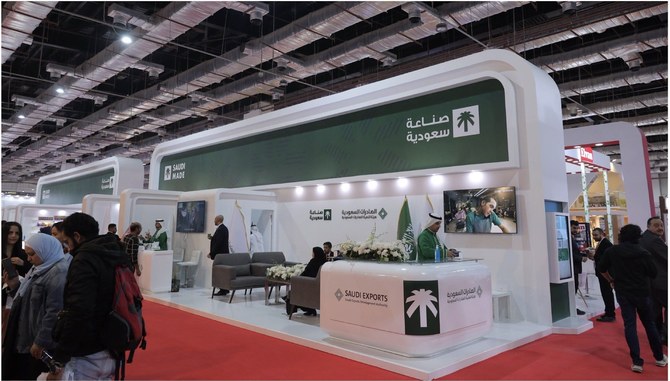
These strategic initiatives are part of the National Industrial Development and Logistics Program and the Saudi Export Development Authority, which introduced the “Made in Saudi” program in 2021, emphasizing the promotion of local talent and innovation.
In the third quarter, Saudi Arabia witnessed a significant surge in industrial development, granting 412 new licenses, marking an 83.9 percent increase compared to the corresponding period in the previous year, according to the Ministry of Investment.
Speaking at the Industrial Sector Enablers’ Forum organized by the Riyadh Chamber, Mohammed Al-Swailem, the undersecretary of the Ministry of Industry and Mineral Resources for industrial services, unveiled the Kingdom’s ambition to reach 36,000 establishments by 2035, aligning with the National Industrial Strategy.
In August alone, the number of factories experienced a 3.76 percent surge, reaching 11,110, compared to 10,707 in the same month the previous year.
Transport, storage and communication made a SR39.62 billion contribution to real GDP — 5.51 percent of the total. This kind of economic activity has shown a positive growth of 5.14 percent during this period.
According to the Ministry of Finance, the National Transport and Logistics Strategy is anticipated to position the Kingdom as a global logistics hub, connecting three continents. The strategy aims to triple the number of passengers in the aviation sector, reaching 330 million by 2030.
As part of this initiative, King Salman International Airport is set to expand its capacity to accommodate 120 million passengers, connect the Kingdom with 250 new destinations, and enhance airfreight capacity to 4.5 million tons annually by 2030.
Additionally, the communications and technology market in the Kingdom is projected to reach SR163 billion by the end of 2023, reflecting a 6 percent growth compared to 2022, according to the ministry.
Notably, the sector attracted $4 billion in investments in cloud computing from major global companies, including Microsoft, Oracle, Huawei and Zoom.
Despite a small percentage share of 3.46 percent of GDP, community, social, and personal services exhibited the highest growth of 11.83 percent during this period, amounting to SR24.87 billion.
In addition to the gross value added contributed by the private sector, government activities and net taxes on products comprised 12.86 percent and 3.58 percent, respectively, of the real GDP.
Notably, taxes on products exhibited the highest growth among all economic activities, experiencing a significant increase of 26.77 percent during this period and reaching 25.75 billion.
Public sector contribution
Within the public sector, government activities contributed SR92.45 billion to the Kingdom’s real GDP, constituting a 12.86 percent share. This sector witnessed a 2 percent growth during the specified period.
According to the revised budget estimates released by the Finance Ministry for fiscal year 2023, real GDP is expected to grow by 0.03 percent, while the non-oil sector is anticipated to expand by 5.9 percent.
The fiscal year 2024, however, looks promising, with a projected 4.4 percent growth in real GDP, supported by the expansion of non-oil activities resulting from economic reforms and efforts to accelerate economic diversification.
This growth is also attributed to programs establishing the private sector as a critical economic driver and job creator, aligning with the goals of Saudi Vision 2030. Various initiatives under Vision 2030 remain integral to achieving national transformation objectives.