UN Security Council acts to boost Gaza aid after US abstains

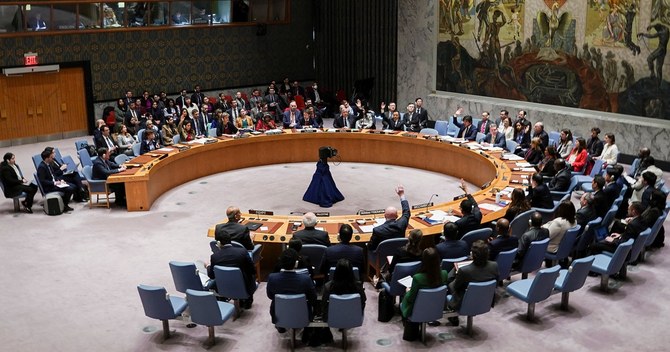
Members of the United Nations Security Council vote on a proposal to demand that Israel and Hamas allow aid access to the Gaza Strip — via land, sea and air routes — and set up UN monitoring of the humanitarian assistance delivered, during a meeting at the UN headquarters in New York, on Dec. 22, 2023. (Reuters)
Short Url
Updated 22 December 2023
Follow

UN Security Council acts to boost Gaza aid after US abstains

  • US abstained to allow 15-member council to adopt resolution drafted by UAE
  • Resolution no longer dilutes Israel’s control over all aid deliveries to 2.3 million people in Gaza

UNITED NATIONS: The United Nations Security Council on Friday approved a toned-down bid to boost humanitarian aid to the Gaza Strip and called for urgent steps “to create the conditions for a sustainable cessation of hostilities” after a week of vote delays and intense negotiations to avoid a veto by the United States.
Amid global outrage over a rising Gaza death toll in 11 weeks of war between Israel and Hamas and a worsening humanitarian crisis in the Palestinian enclave, the US abstained to allow the 15-member council to adopt a resolution drafted by the United Arab Emirates.
The remaining council members voted for the resolution except for Russia which also abstained.
Following high-level negotiations to win over Washington, the resolution no longer dilutes Israel’s control over all aid deliveries to 2.3 million people in Gaza. Israel monitors the limited aid deliveries to Gaza via the Rafah crossing from Egypt and the Israeli-controlled Kerem Shalom crossing.
But a weakening of language on a cessation of hostilities frustrated several council members — including veto power Russia — and Arab and Organization of Islamic Cooperation states, some of which, diplomats said, view it as approval for Israel to further act against Hamas for a deadly Oct. 7 attack.
The adopted resolution “calls for urgent steps to immediately allow safe, unhindered, and expanded humanitarian access and to create the conditions for a sustainable cessation of hostilities.” The initial draft had called for “an urgent and sustainable cessation of hostilities” to allow aid access.
Earlier this month the 193-member UN General Assembly demanded a humanitarian cease-fire, with 153 states voting in favor of the move that had been vetoed by the United States in the Security Council days earlier.
The US and Israel oppose a cease-fire, believing it would only benefit Hamas. Washington instead supports pauses in fighting to protect civilians and free hostages taken by Hamas.

AID MONITORING
Last month the United States abstained to allow the Security Council to call for urgent and extended humanitarian pauses in fighting for a “sufficient number of days” to allow aid access. The move came after four unsuccessful attempts to take action.
Washington traditionally shields its ally Israel from UN action and has already twice vetoed Security Council action since an Oct. 7 attack by Hamas militants in which Israel says 1,200 people were killed and 240 people taken hostage.
Israel has retaliated against Hamas by bombarding Gaza from the air, imposing a siege and launching a ground offensive. Some 20,000 Palestinians have been killed, according to health officials in Hamas-ruled Gaza.
Most people in Gaza have been driven from their homes and UN officials have warned of a humanitarian catastrophe. The World Food Programme says half of Gaza’s population is starving and only 10 percent of the food required has entered Gaza since Oct. 7.
A key sticking point during negotiations on the resolution adopted on Friday had been an initial proposal for UN Secretary-General Antonio Guterres to establish a mechanism in Gaza to monitor aid from countries not party to the war.
A toned-down compromise was reached to instead ask Guterres to appoint a senior humanitarian and reconstruction coordinator to establish a UN mechanism for accelerating aid to Gaza through states that are not party to the conflict.
The coordinator would also have responsibility “for facilitating, coordinating, monitoring, and verifying in Gaza, as appropriate, the humanitarian nature” of all the aid.
The council also called for the warring parties “to adhere to international humanitarian law and ... deplores all attacks against civilians and civilian objects, as well as all violence and hostilities against civilians, and all acts of terrorism.”


STC announces dissolution

Updated 29 min 43 sec ago
Follow

STC announces dissolution

The Yemeni separatist group Southern Transitional Council (STC) has announced it will dissolve following talks in Saudi Arabia. Several STC members are in Riyadh for discussions on ending unrest in southern Yemen. The group praised Saudi Arabia’s efforts, while former STC leader Aidarous al-Zubaidi, now wanted by the Presidential Council for high treason, has fled Yemen and has not participated in the talks. 

A Yemeni source told Arab News: “this announcement and ease shown in the televised video statement shows that in fact Al Zubaidi was the obstacle, and that most southerners are open to resolving their matter via dialogue and discussion”

The members of the Southern Transitional Council (STC) in Yemen spoke during the Riyadh Southern Dialogue Conference on Friday.

During the meeting, the Council said military operations in Hadramout and Mahra harmed the Southern cause in Yemen. 

The Council said they did not participate in the decision for the military operations in Hadramout and Mahra. 

"We hope to reach a vision and concept for resolving the Southern issue at the Riyadh Conference,” said the Council.

The Council thanked Saudi Arabia for hosting the dialogue conference in Riyadh.

  • Below is a full translation of the STC announcement as reported by the Arabic language Yemeni news agency (SABA):  

Announcement of the Dissolution of the Southern Transitional Council

The Presidency of the Southern Transitional Council, the Supreme Executive Leadership, the General Secretariat, and the other affiliated bodies convened a meeting to assess the recent unfortunate events in the governorates of Hadramout and Al-Mahrah, and the subsequent rejection of all efforts toward de-escalation and resolution. These developments have led to serious and painful consequences. Referring to the statement issued by the Ministry of Foreign Affairs of the Kingdom of Saudi Arabia regarding its sponsorship of a southern dialogue to resolve the southern issue—and in order to safeguard the future of the southern cause and the right of the southern people to restore their state according to their will and aspirations, and to preserve peace and social security in the South and the broader region—we make the following declaration:

The Southern Transitional Council was established to carry the cause of the southern people, represent them, and lead them toward achieving their aspirations and restoring their state. We founded it with the belief that the goal was to achieve this mission—not to cling to it as a means of gaining power, monopolizing decision-making, or excluding others.

Since we were not involved in the decision to launch the military operation in Hadramout and Al-Mahrah—an operation that harmed southern unity and damaged relations with the coalition led by the Kingdom of Saudi Arabia, which has made and continues to make great sacrifices and provide ongoing political, economic, and military support—the continued existence of the Council no longer serves the purpose for which it was created. In light of this and our historical responsibility toward the southern cause, we hereby announce the dissolution of the Southern Transitional Council, the disbanding of all its main and subsidiary bodies, and the closure of all its offices inside and outside the country. We will instead work to achieve our just southern goal by preparing for and participating in the comprehensive southern conference under the Kingdom’s sponsorship.

We commend the Kingdom of Saudi Arabia for its clear and explicit commitments and the sincere concern it has shown for our cause in seeking solutions that meet the aspirations and will of the southern people.

We call on all active southern figures and leaders to engage in the path of the comprehensive southern dialogue conference, hoping that the participants will reach a vision and framework to resolve the southern issue and fulfill the people’s aspirations through their free will, and to establish an inclusive southern framework.

From this platform, we call on the people of the South, our colleagues in the capital Aden, and all the governorates of our beloved South to recognize the gravity of this moment, the sensitivity of the current phase, and the importance of uniting efforts to preserve our gains and protect the South from chaos or instability.

We reaffirm our continued commitment to serving the just and legitimate cause of the southern people and achieving their aspirations according to their will. We also extend our gratitude to the leadership and people of the Kingdom of Saudi Arabia for hosting the comprehensive southern dialogue conference and for their support of the South, its cause, and its people across all fields and stages.