

Turkmenistan’s struggling economy hit as Caspian Sea level drops

1 / 2
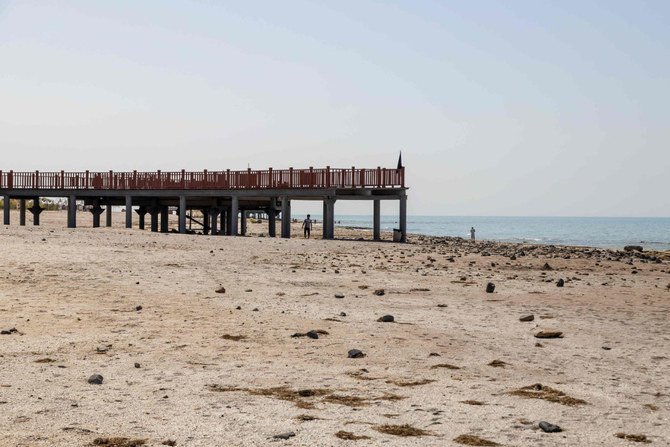
Low water levels are seen in Turkmenistan's Caspian Sea resort of Avaza on September 13, 2023. The Caspian Sea, the inland body of water flanked by the Caucasus region and Central Asia, has been shrinking precipitously year on year. (AFP)
2 / 2
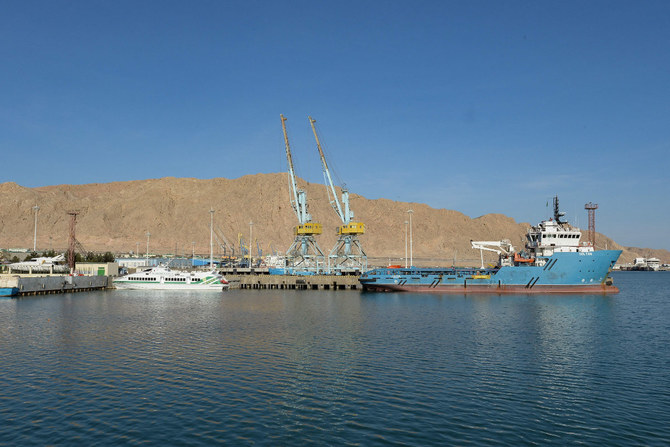
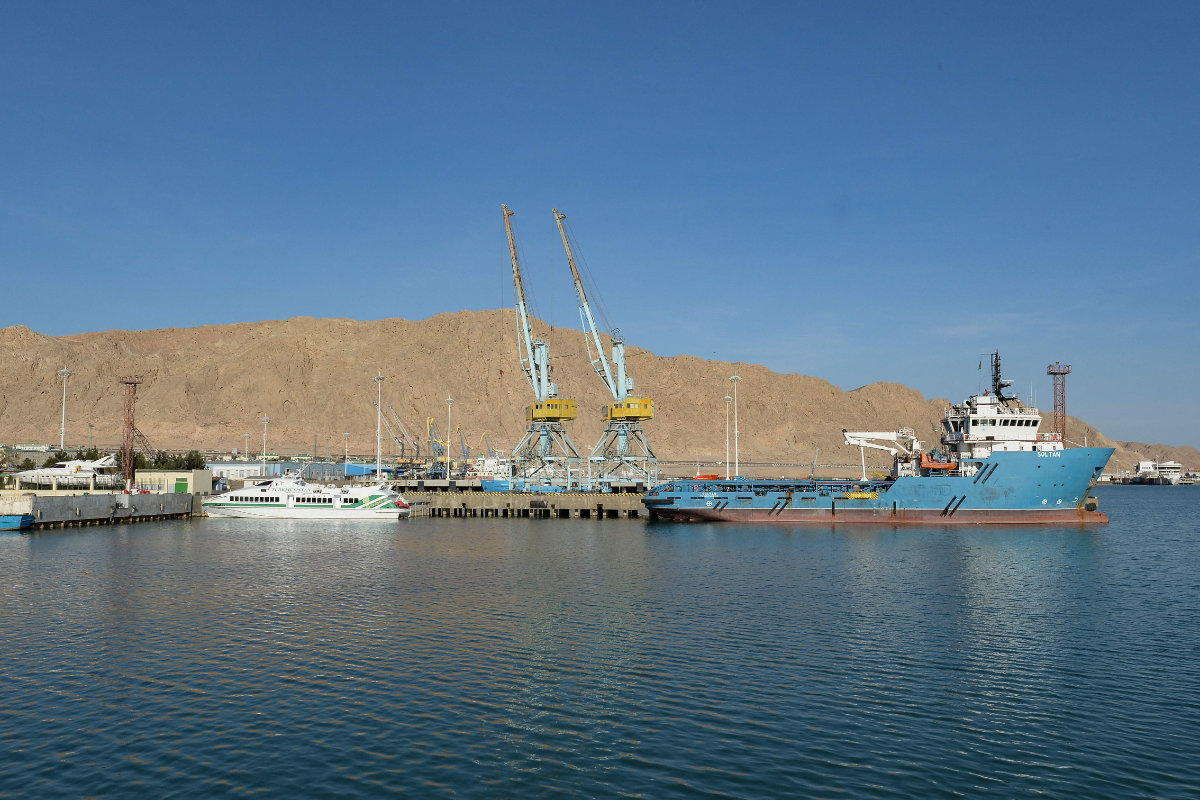
A view of the main port of Turkmenbashi, the largest Caspian Sea coastal city in Turkmenistan, on November 19, 2023. (AFP)
Short Url
Updated 09 January 2024
Follow

Turkmenistan’s struggling economy hit as Caspian Sea level drops

  • In the seaside town of Hazar, the shore has receded by around 800 meters on both sides
  • The Caspian Sea, an inland body of water, is flanked by the Caucasus region to the west and Central Asia to the east

TURKMENBASHI: On the Caspian Sea coast in Turkmenistan, Batyr Yusupov can no longer ferry his passengers between two ports. There is not enough water.

“I used to go between Turkmenbashi and Hazar,” the 36-year-old ferry worker said of the ports separated by a small gulf on Turkmenistan’s coast.
“But we haven’t been able to go there for a year due to the serious shrinking of the Caspian,” he said.
In at least one seaside city, local bathers have noted the waters receding by hundreds of meters.
But it is not just about ferry routes or having to walk further for a proper swim: the changes hit the heart of Turkmenistan’s struggling economy.
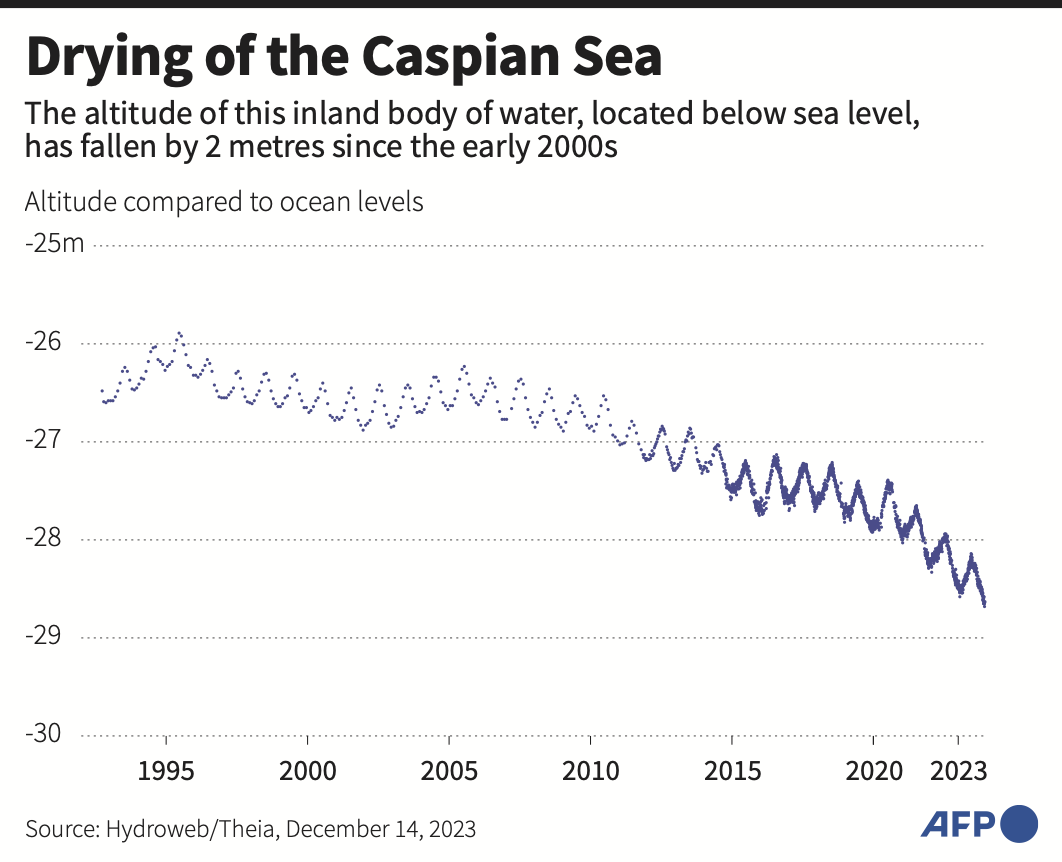
And year after year, the water levels are falling.
It is still not entirely clear why that is happening, but scientists say it is down to naturally occurring processes exacerbated by climate change.
One 2021 study projected that by 2100, water levels in the Caspian Sea could drop by another 8 to 30 meters (26 to 98 feet).
The Caspian Sea, an inland body of water, is flanked by the Caucasus region to the west and Central Asia to the east.
Turkmenistan, a former Soviet republic, is one of five countries on the Caspian Sea together with Azerbaijan, Kazakhstan, Iran and Russia.
And they are all, to some extent or another, affected by the changes.
South of Turkmenbashi, in the seaside town of Hazar, satellite images show the shore has receded around 800 meters (half a mile) on both sides.
That has turned the town, which sits at the end of a peninsula, into an island.
Instead of sailing between Hazar and the main port of Turkmenbashi, Yusupov now takes passengers to Gyzylsuw — between the two — which is more accessible by boat.
But even there, the situation is not much better.
“A new pier is being built because the old one is no longer deep enough,” said one local resident, 40-year-old Aisha.
Dozens of rusty boats line the shore in Gyzylsuw.
Aisha’s house has stilts protecting it from the sea, which now seem superfluous.
“Even during storms, the water doesn’t reach the house,” she said.
In Turkmenbashi itself, Turkmenistan’s largest coastal city, the changing shoreline is evident to swimmers.
“Last summer, the water was up to my shoulders, then around my waist,” said one regular, 35-year-old Lyudmila Yesenova.
“This year, it’s below my knees.”
The receding waters threaten the maritime infrastructure of Turkmenbashi, a major Central Asia port crucial for trade between Europe and Asia.
And on the opposite coast of the Caspian lies Baku, the capital of oil-rich Azerbaijan.
Turkmen Foreign Minister Rashid Meredov sounded the alarm in a recent speech.
“At present, the sea level is close to the minimum values for the entire time of instrumental observations,” he said in August.
“In the last 25 years, it has decreased by almost two meters,” which meant that the retreat of the sea had become particularly noticeable in recent years, he added.
“The sea has moved hundreds of meters away from its former shores,” he said. “In the north of the Caspian these figures are even higher.”
Neighbouring Kazakhstan, Central Asia’s largest country, has echoed some of Turkmenistan’s concerns.
But after years of disputes over the control of huge hydrocarbon reserves in the region, the collaboration Meredov has called for is only in its earliest stages.

Turkmen scientist Nazar Muradov attributes the changing sea levels to “tectonic movements and seismic phenomena, which change the seabed.”
He said the sea level had previously fallen in the 1930s and the 1980s before rising again. But the changing climate also had to be factored into this latest phenomenon, he added.
“The sea level also depends on the flow of rivers — whose levels are diminishing — as well as low levels of precipitation and intense evaporation.”
Kazakhstan also depends on the sea for its oil and gas industry.
The drop in water levels, coupled with a rise in temperatures, has also hit marine life in the Caspian, including seals.
In a sign he is taking the situation seriously, Kazakh leader Kassym-Jomart Tokayev has announced he had taken the decline in the seal population under his “personal control.”
He also said Kazakhstan would create a research institute for the study of the Caspian.


Moscow made an offer to France regarding a French citizen imprisoned in Russia, says Kremlin

Updated 26 December 2025
Follow

Moscow made an offer to France regarding a French citizen imprisoned in Russia, says Kremlin

  • Laurent Vinatier, an adviser for Swiss-based adviser Center for Humanitarian Dialogue, Vinatier was arrested in Moscow in June 2024
  • He is accused of failing to register as a “foreign agent” while collecting information about Russia’s “military and military-technical activities” 

The Kremlin on Thursday said it was in contact with the French authorities over the fate of a French political scholar serving a three-year sentence in Russia and reportedly facing new charges of espionage.
Kremlin spokesman Dmitry Peskov told reporters that Russia has made “an offer to the French” regarding Laurent Vinatier, arrested in Moscow last year and convicted of collecting military information, and that “the ball is now in France’s court.” He refused to provide details, citing the sensitivity of the matter.
French President Emmanuel Macron is following Vinatier’s situation closely, his office said in a statement. French Foreign Ministry spokesperson Pascal Confavreux said Thursday that all government services are fully mobilized to pay provide consular support to Vinatier and push for his liberation as soon as possible.
Peskov’s remarks come after journalist Jérôme Garro of the French TF1 TV channel asked President Vladimir Putin during his annual news conference on Dec. 19 whether Vinatier’s family could hope for a presidential pardon or his release in a prisoner exchange. Putin said he knew “nothing” about the case, but promised to look into it.
Vinatier was arrested in Moscow in June 2024. Russian authorities accused him of failing to register as a “foreign agent” while collecting information about Russia’s “military and military-technical activities” that could be used to the detriment of national security. The charges carry a maximum penalty of five years in prison.
The arrest came as tensions flared between Moscow and Paris following French President Emmanuel Macron’s comments about the possibility of deploying French troops in Ukraine.
Vinatier’s lawyers asked the court to sentence him to a fine, but the judge in October 2024 handed him a three-year prison term — a sentence described as “extremely severe” by France’s Foreign Ministry, which called for the scholar’s immediate release.
Detentions on charges of spying and collecting sensitive data have become increasingly frequent in Russia and its heavily politicized legal system since Moscow invaded Ukraine in February 2022.
In addition to criticizing his sentence, the French Foreign Ministry urged the abolition of Russia’s laws on foreign agents, which subject those carrying the label to additional government scrutiny and numerous restrictions. Violations can result in criminal prosecution. The ministry said the legislation “contributes to a systematic violation of fundamental freedoms in Russia, like the freedom of association, the freedom of opinion and the freedom of expression.”
Vinatier is an adviser for the Center for Humanitarian Dialogue, a Switzerland-based nongovernmental organization, which said in June 2024 that it was doing “everything possible to assist” him.
While asking the judge for clemency ahead of the verdict, Vinatier pointed to his two children and his elderly parents he has to take care of.
The charges against Vinatier relate to a law that requires anyone collecting information on military issues to register with authorities as a foreign agent.
Human rights activists have criticized the law and other recent legislation as part of a Kremlin crackdown on independent media and political activists intended to stifle criticism of the war in Ukraine.
In August 2025, Russian state news agency Tass reported that Vinatier was also charged with espionage, citing court records but giving no details. Those convicted of espionage in Russia face between 10 and 20 years in prison.
Russia in recent years has arrested a number of foreigners — mainly US citizens — on various criminal charges and then released them in prisoner swaps with the United States and other Western nations. The largest exchange since the Cold War took place in August 2024, when Moscow freed journalists Evan Gershkovich and Alsu Kurmasheva, fellow American Paul Whelan, and Russian dissidents in a multinational deal that set two dozen people free.