Saudi Arabia leads UN celebration of Arabic language

1 / 2
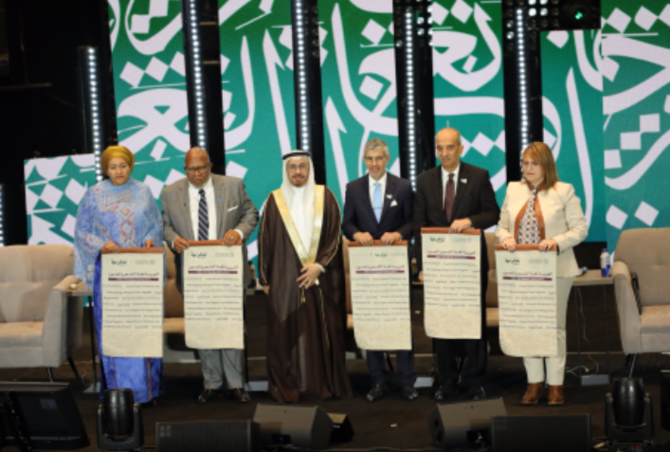
Dr. Abdullah Al-Washmi, Secretary General of KSGAAL speaking during the Saudi celebrations of the World Arabic Language Day 2023 in the United Nations Headquarters in New York City. (Supplied)
2 / 2
(From left) Amina Mohammed, Deputy Secretary-General of the United Nations and Chair of the United Nations Sustainable Development Group; Ambassador Dennis Francis, President of the 78th session of the United Nations General Assembly; Dr. Abdullah Al-Washmi, Secretary General of King Salman Global Academy for ‎Arabic Language; Amb. Dr. Abdulaziz Al-Wasel, Permanent Representative of the Kingdom of ‎Saudi Arabia to United Nations Headquarters; Osama Mahmoud, the Permanent Representative of the Arab Republic of Egypt to the United Nations Headquarters, and chairman of the Arab Group in New York during December 2023; and Dr. Nasria Flitti, Minister Plenipotentiary, Deputy Permanent Observer of the League of Arab States to the United Nations‎. (Supplied)
Short Url
Updated 21 December 2023
Follow

Saudi Arabia leads UN celebration of Arabic language

  • Abdulaziz Al-Wasel, the Saudi permanent representative to the UN in New York, said: “The Arabic language has preserved its cultural identity”
  • Saudi Arabia continued to make concerted efforts to promote the Arabic language, to help shape cultural identity

RIYADH: Saudi Arabia launched two new books about translation during an event held at the UN headquarters in New York to celebrate the Arabic language.
The Kingdom led three days of related activities to mark World Arabic Language Day on Dec. 18 and the 50th anniversary of its adoption as an official UN language‎.
Abdullah Al-Washmi, secretary-general of the King Salman Global Academy for Arabic Language, said: “We recently launched a group of international programs, including centers for teaching the Arabic language, a standardized test for Arabic language learners, and a contemporary dictionary close to the beneficiaries, in addition to many programs around the world.”
He noted that one of the books launched at the event was a reference guide covering interpretation in international organizations, while the other detailed Arabic translation in the UN.
“We have also provided translations of a group of books, including ‘The 100 Most Famous Questions About the Arabic Language,’ and ‘A Guide to the Culture of the Arabic Language,’” Al-Washmi added.
Abdulaziz Al-Wasel, the Saudi permanent representative to the UN in New York, said: “The Arabic language has preserved its cultural identity and is distinguished by carrying a great heritage and intellectual, literary, and scientific production extending back more than 14 centuries.
“The Arabic language is one of the pillars of the cultural diversity of humanity. It has also gained great importance among Muslims around the world because it is the language of the Holy Qur’an.”
He noted that Saudi Arabia continued to make concerted efforts to promote the Arabic language, to help shape cultural identity and maintain an historical legacy.
“This is being done through the Kingdom launching many initiatives to highlight the cultural and humanitarian role of the Arabic language through Saudi institutions, including the King Salman Global Academy for Arabic Language, the King Abdullah bin Abdulaziz International Center for Arabic Language Service, and other centers.
“The presence of the Arabic language in the United Nations has contributed to achieving the goals of sustainable development in the world based on its role in addressing many issues in the language of the Arab community,” Al-Wasel added.
World Arabic Language Day‎ was established by the UN Educational, Scientific, and Cultural Organization in 2010 to celebrate multilingualism and cultural diversity while also promoting equal use of all six of its official working languages throughout the organization.


Saudi chef wins culinary competition

Updated 58 min 51 sec ago
Follow

Saudi chef wins culinary competition

  • Event aimed to empower chefs’ ability to showcase talent on global scale 
  • Bayan Abdullah Al-Sudani: It (has) encouraged me to participate in more challenging spaces

RIYADH: A Saudi has won the Saudi Elite Chefs competition at Horeca Riyadh.

The event, which was organized by the Culinary Arts Commission of the Ministry of Culture, in alignment with the ministry’s long-term goals, aimed to empower Saudi chefs’ ability to showcase their talent and creativity on a global scale.

Speaking to Arab News, the winner, Bayan Abdullah Al-Sudani, shed light on how the competition equipped her with confidence for the future, saying: “It was a big challenge, and I faced off against strong chefs. It (has) encouraged me to participate in more challenging spaces.”

On her future plans, Al-Sudani wants to give back to the industry, and added: “I look forward to opening the Bayan Academy soon so that I can support chefs and help them with the pastry sector specifically.”

Celebration and achievement were echoed throughout, and it was evident at the event that the culinary industry in the Kingdom is hungry for growth, recognition, and global competition.

Seba Zarea, general manager of strategy and program delivery at the Culinary Arts Commission, told Arab News of the many facets of the industry that the ministry was prioritizing.

Zarea said: “This competition is just one of the initiatives that the Culinary Arts Commission is working on. There are also local scholarships (and) vocational training. We are also working on attracting the best culinary schools to Saudi. For example, Le Cordon Bleu is opening next year in Misk City.”

Zarea stressed the rewards of events like the Saudi Elite Chefs competition, adding that the winner had a fast track to Bocuse d’Or and the World Pastry Cup — representing global opportunities to place both competitors and Saudi cuisine on the map.

Zarea added: “Food is a soft power and, in terms of tourism, food is a universal language so we codified the Saudi cuisine, an initiative started four years ago, and we came up with more than 1,300 codified recipes, items, and local produce from the Kingdom.”

Zarea went into depth on some of the behind-the-scenes efforts that have helped create the food that the Kingdom is able to showcase.

She shared the example of the Wild Plant Initiative, a program designed to explore plants of various regions in the Kingdom to discover new ingredients that can be integrated into Saudi cuisine.

These efforts go into helping to build an industry that is rooted in culture, creativity, and passion. 

In the same way that the Saudi Elite Chefs competition provides its winners and participants with the tools to bring their success to global attention, the Culinary Arts Commission works to elevate the Kingdom’s cuisine through tourism and hospitality.

Zarea said: “This sector is the easiest way to showcase the culture.”