Baloch leader says marchers against rights abuses arrested outside Pakistani capital

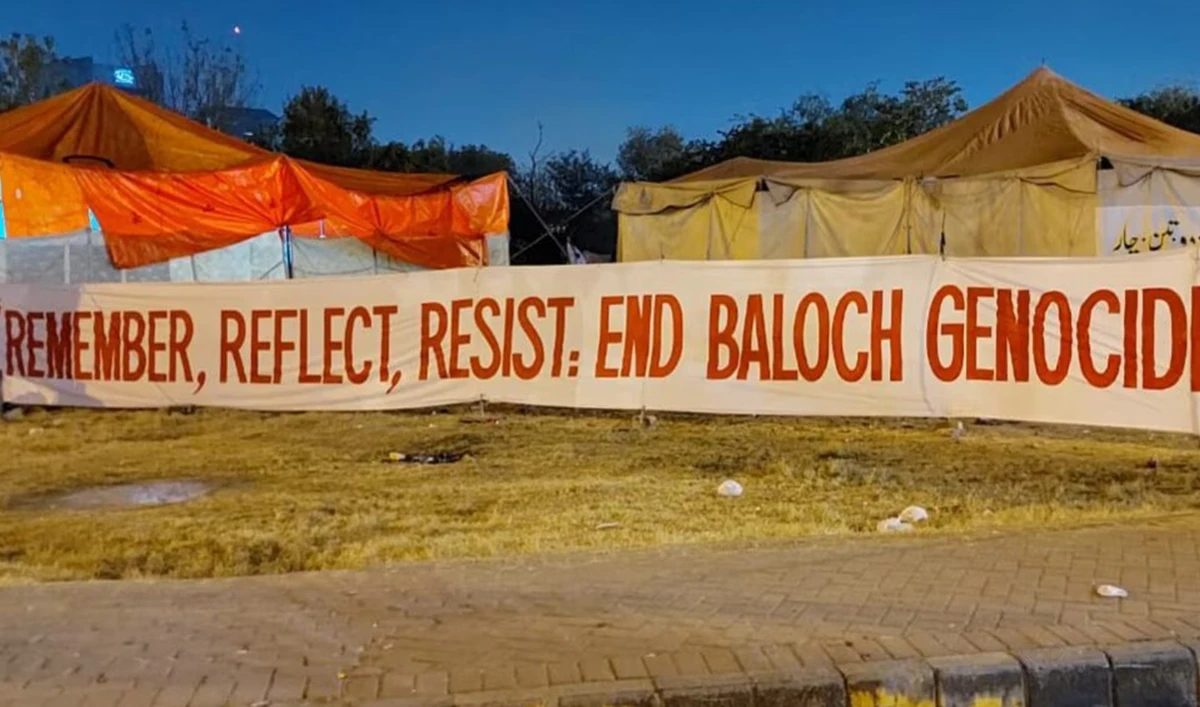
Activists' banner is displayed near the Islamabad press club, Pakistan on December 20, 2023. (Photo courtesy: VOA)
Short Url
Updated 21 December 2023
Follow

Baloch leader says marchers against rights abuses arrested outside Pakistani capital

  • Police confirm arresting protesters, say they pelted officers with stones after reaching outskirts of Islamabad
  • Protesters led by women started march from Turbat against ‘extrajudicial killings and enforced disappearances’

ISLAMABAD/LAHORE: An ethnic Baloch activst leader said on Thursday protesters marching to draw attention to what they call a campaign of ‘enforced disappearances and extrajudicial killings’ in their home province of Balochistan had been blocked by authorities from entering the federal capital and arrested, with police confirming they had taken demonstrators into custody. 

The over 1,600 km long march is being led by the Baloch Yakjehti Committee (BYC) under Dr. Mahrang Baloch, 30, who became an activist when she was still a teenager after what she says were the enforced disappearances and custodial deaths of her father and brother. 

The march started from Turbat district in the southwestern Balochistan province on December 6, where protests have been ongoing since last month over the alleged extrajudicial killing of a 24-year-old ethnic Baloch man. The killing has renewed debate over extrajudicial detentions and deaths in Balochistan where such incidents are not uncommon, though state agencies deny complicity. The province has been the scene of a low-level separatist insurgency for decades.

In widely shared social media posts, the BYC said the protesters, who reached the outskirts of Islamabad on Wednesday evening and had planned a demonstration at the National Press Club in the heart of the federal capital, were blocked by police from entering the city and arrested.

In an X post on Thursday morning, Dr. Baloch, the protest leader, said arrested protesters were being moved to different police stations in the city.

“At this time they are taking women and children to another station. We are unable to connect to our male fellows, we fear that the state will abduct them.”

Police said it had arrested protesters because they pelted officers with stones and were blocking roads.

“Police retaliated and arrested several protesters,” Islamabad police said in a statement, which did not specify how many people had been arrested. “Legal action will be taken against those blocking the road.”

Police warned citizens against being “part of any illegal assembly or violent demonstration” and asked women and children to stay “away from violent protests.”

In an audio message sent to Arab News before reaching Islamabad, Baloch said dozens of young Baloch had been forcefully disappeared in the last many decades, but now “a new wave of extrajudicial killings” had started:

“Family members of all the disappeared have come together to instill fresh strength in this movement,” she said, describing the long march.

The Balochistan and federal governments have not commented on the latest events surrounding the arrival of the march in Islamabad and the arrest of protesters.

Last month, the Counter Terrorism Department (CTD) Balochistan issued a statement, seen by Arab News, saying Balach Baloch, the man killed in Turbat, had confessed in custody to being a militant and carrying out a number of attacks. He was arrested on Nov. 20, as per the statement, in possession of five kilograms of explosive materials.

Balach was later killed in a raid on a militant hideout in the city of Turbat, the CTD said. The killing unleashed sit-ins and strikes across the province. Balach’s family has refuted CTD claims saying he was not involved in any unlawful activities but was picked up by the CTD on Oct. 29 and later killed in a “fake encounter.”

Political leaders, human rights activists and families of victims have for decades spoken against killings in Balochistan by security agencies in staged encounters, a practice where officials claim the victim was killed in a gunfight though they were summarily executed. Authorities deny involvement in such incidents.
Pakistan rules out talks with Afghanistan, says over 330 Afghan fighters killed in clashes

Updated 10 sec ago
Follow

Pakistan rules out talks with Afghanistan, says over 330 Afghan fighters killed in clashes

  • Clashes between the neighbors erupted after Pakistan’s airstrikes on Afghan territory last weekend
  • US voices support for Pakistan, Information Minister Attaullah Tarar says they aim to make Pakistan safe

ISLAMABAD: Pakistan has ruled out any talks with Afghanistan until an end to “terrorism” emanating from the Afghan soil, officials said on Friday, following the killing of more than 330 Afghan fighters in cross-border clashes this week.

The latest clashes between the neighbors erupted after Pakistan’s airstrikes on Afghan territory last weekend triggered Afghan retaliatory attacks along the border on Thursday, escalating long‑simmering tensions over Pakistan’s claim that Afghanistan shelters Pakistani Taliban militants. Afghanistan denies this and argues Pakistan is deflecting blame for its own security failures.

Pakistani Information Minister Attaullah Tarar said they had killed 331 Afghan fighters, destroyed over 100 posts and targeted 37 military locations across Afghanistan. Afghan officials have said that more than 50 Pakistani soldiers have been killed and several Pakistan posts have been captured by their forces. None of the casualty figures or battlefield claims from either side could be independently verified.

Meanwhile, Mosharraf Zaidi, Prime Minister Shehbaz Sharif’s spokesperson for foreign media, ruled out any talks with Afghanistan until Kabul addresses the issue as the United States (US) expressed his support for what it called Pakistan’s “right to defend itself” against attacks from Afghanistan’s Taliban rulers.

“There won’t be any talks, there is nothing to talk about... Terrorism from Afghanistan has to end,” Zaidi told Pakistani state media, saying Islamabad would continue to target militant havens inside Afghanistan.

“Pakistan’s responsibility is to protect its citizens. If we know that there is a terrorist in point A and we know that there is a terrorist enabler at point A, we will find a weapon to land at point A and eliminate the threat.”

Zaidi said he didn’t expect Pakistan to deviate from this position and that the government had clearly conveyed what it was doing.

“We have clearly articulated what we are doing and what we plan on continuing to do and what it will take for us to stop doing what we are doing,” Zaidi said.

“And we will expect that both the international community and the regime in question, the Afghan Taliban, will come to their senses and will help reduce instability and disorder in this region.”

Pakistan is a major non-NATO ally of Washington, while the US considers the Afghan Taliban to be a “terrorist” group.

“The United States supports Pakistan’s right to defend itself against attacks from the Taliban, a Specially Designated Global Terrorist group,” Reuters quoted a State Department spokesperson as saying. US diplomat Allison Hooker said on X she spoke on Friday with Pakistan Foreign Secretary Amna Baloch.

The State Department spokesperson said Washington was aware of the escalation in tensions and “outbreak of fighting between Pakistan and the Afghan Taliban,” adding the US was “saddened by the loss of life.”

“The Taliban have consistently failed to uphold their counterterrorism commitments,” the State Department said, adding that “terrorist groups use Afghanistan as a launching pad for their heinous attacks.”

Meanwhile, Afghan Taliban spokesperson Zabihullah Mujahid called for talks to resolve the crisis.

“We have always emphasized peaceful resolution, and now too we want the issue to be resolved through dialogue,” he said on Friday afternoon.

Asked what Pakistan desired, Information Minister Tarar said: “Neutralizing the threat and ensuring that Pakistan is safe.”

“Because for us, we’ve been good neighbors, we’ve been very friendly neighbors, we’ve been very, very generous neighbors. Our generosity, unfortunately, has often been seen as our weakness,” he told state media.

“So the objective, aim is to neutralize the threat and make Pakistan safe.”

To a question about a ceasefire, Tarar said it was “too early” to comment on that as it was an evolving situation.