

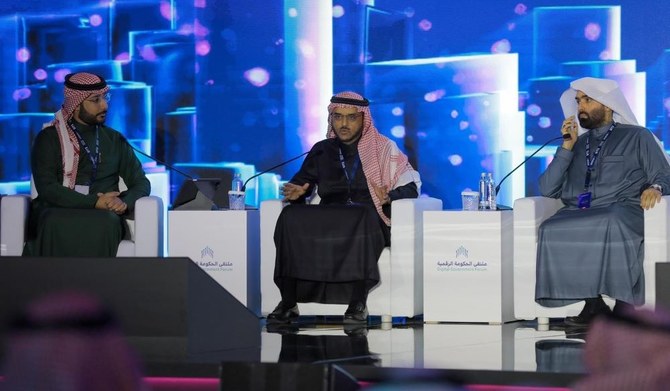
Interior Ministry launches AI service on Absher for people with disabilities

A personal assistance service for people with disabilities was launched on the Absher platform at the Digital Government Forum in Riyadh. (SPA)
Short Url
Updated 20 December 2023
Follow

Interior Ministry launches AI service on Absher for people with disabilities

  • Service on Absher platform for people with disabilities allows access to services using advanced voice recognition and artificial intelligence technologies
  • Prince Bandar bin Abdullah Al-Mishari told the second Digital Government Forum in Riyadh that the service enabled quick and easy access to ensure a distinguished user experience

JEDDAH: The Ministry of Interior on Wednesday launched a personal assistance service on the Absher platform for people with disabilities, allowing them to access services using advanced voice recognition and artificial intelligence technologies.

Prince Bandar bin Abdullah Al-Mishari, the assistant minister of interior for technology affairs, told the second Digital Government Forum in Riyadh that the service enabled quick and easy access to ensure a distinguished user experience.

This aligns with the goals of the ministry in promoting the progress of digital transformation initiatives, developing services, and making them accessible to all sections of society.

The Kingdom is dedicated to providing a good quality of life for all its inhabitants, while addressing the diverse needs of different groups. Individuals with disabilities hold a significant place among these groups, comprising 7.1 percent of the Kingdom’s population.

The two-day forum, which boasted the theme “Our Future Now,” concluded on Dec. 20. It was attended by various government entities and ministers, as well as a group of experts, specialists, and decision-makers in the field of digital government at both local and international levels.

The forum offered panel discussions with several ministers; workshops in the field of digital transformation; the launch of new digital products and services; and the announcement of the winners of the Digital Government Award in its second edition in the Kingdom, as well as the winners of the award for the Gulf Cooperation Council countries in its fifth cycle.

The forum also revealed results of the Digital Transformation Measurement 2023, which is aimed at improving the performance and effectiveness of government entities to accelerate the pace of digital transformation, advancing the Kingdom in international indicators, in line with the programs and targets of Saudi Vision 2030.


Red Sea Global unveils scientific model for regenerative tourism worldwide

Updated 26 February 2026
Follow

Red Sea Global unveils scientific model for regenerative tourism worldwide

  • The report details the model’s rollout at “The Red Sea” and “AMAALA” destinations, backed by studies covering 8 marine habitats

TABUK: Red Sea Global (RSG) has unveiled a science-based model aimed at achieving a 30% net positive conservation benefit across its tourism destinations by 2040. 

The framework is now available for global adoption, according to a statement released by RSG.

Owned by Saudi Arabia’s Public Investment Fund (PIF), Red Sea Global is the multi-project developer behind ambitious regenerative tourism destinations like “The Red Sea” and “AMAALA.” 

As a cornerstone of the Kingdom’s Vision 2030, the company aims to diversify the national economy while setting new global benchmarks for sustainable, nature-positive development.

CEO John Pagano stated that openly sharing this detailed approach will help elevate the global tourism sector and secure a healthier environment for future generations.
 

Map showing the boundaries of the Red Sea Zone. (Graphic from the RSG report)

The cornerstone of this initiative is the proprietary SIIG Model, a four-step framework:
• Survey: Establish biodiversity baselines and monitor long-term changes.
• Identify: Assess risks to priority habitats and species.
• Intervene: Execute evidence-based actions, such as regulating fishing and enhancing natural habitats.
• Gain: Measure and verify biodiversity improvements.

The report details the model’s rollout at “The Red Sea” and “AMAALA” destinations, backed by extensive 2022–2023 environmental baseline studies covering eight marine habitats and priority species groups during 2022 and 2023. 

A major intervention is the 5,015-square-kilometer Fishery Management Area in Al-Wajh Lagoon. The plan reserves 38% of the area for priority conservation—protecting 62% of local coral reefs—while allocating 61% for sustainable fishing.

According to scientific modeling, eliminating fishing in high-protection zones could increase reef fish populations by 113%, sharks and rays by 72%, and marine mammals by 24%. These measures are expected to boost coral resilience, support ecosystem recovery, and protect vulnerable species like sea turtles and seabirds.
Ihab Kindi, RSG’s Red Sea Destination Executive Director, called the data-driven model a practical roadmap for large-scale marine recovery. The complete methodology is available in the new report, “The SIIG Model: A Roadmap Toward Achieving Measurable Conservation Gains.”