



DAMMAM: At the crack of dawn on Dec. 17, as the seemingly endless line of trucks and cars whizzed by at the busy-at-all-hours Dammam checkpoint on the way to Riyadh, one commuter on wheels prepared to embark his 30-day journey across the Kingdom.
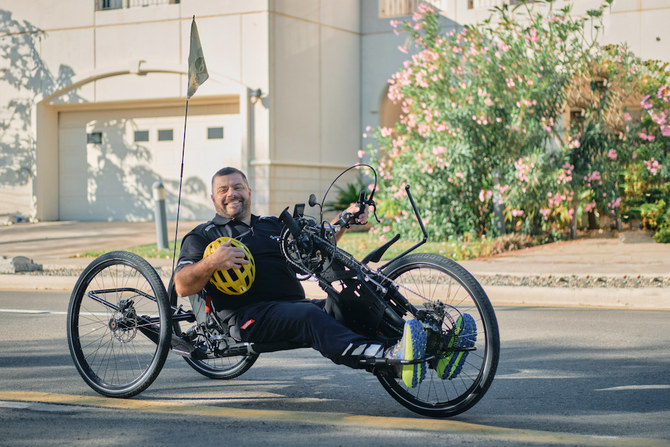
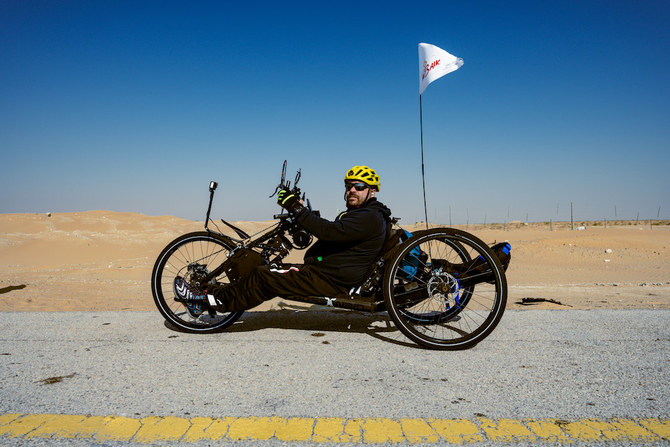
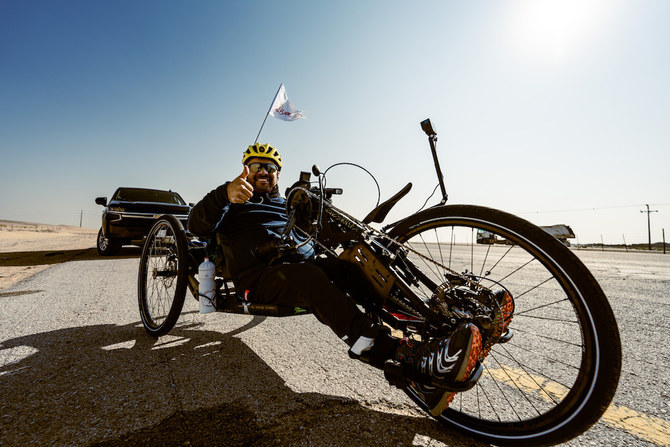
The lone biker wearing a helmet, warm jacket and shirt embedded with advanced biosensors began hand cycling down the road, as the harsh morning winter air swirled around him. An entourage of about a dozen team members followed in various vehicles behind him.
He is none other than King Abdullah University of Science and Technology’s associate professor of applied mathematics and computational science, Matteo Parsani, who lost the use of his legs six years ago after a road accident. He did not want to let that stop him from making this historic journey.
The journey, called "Athar - East to West," will take him from Dammam to Riyadh, to Qassim to Hail, then AlUla in 2023 and, starting in 2024, he will stop at Red Sea Global, Madinah, Makkah, Jeddah and finally, KAUST on Jan. 17. Parsani will cover a distance of over more than 3,000 km, or 150 km per day.
“I would say that maybe I’m like a moving lab,” he told told Arab News moments before he started rolling away.
Parsani will be wearing custom-made biosensors made by KAUST scientists that will gather data from his body. The sensors will collect biodata in real time, and have been developed by a team of researchers and scientists. One sensor will monitor his heart rate, while another will measure things like his dopamine levels, energy level, sweat secretion rate as well as body motion.
It all started a few years ago when he asked his dean for about a month off so he could handcycle across the Kingdom. The dean told him he would get back to him.
A few weeks later, Parsani found himself on a Zoom call with about six other professors who work at the university. They proposed that he wear some of the sensors that they were developing in their labs. Instead of merely going on a handcycling holiday, Parsani’s journey would become part of the KAUST research experience.
“It's a very nice collaboration, a very nice synergy with my colleagues,” he said.
The dates are significant. He chose to start two days after the KAUST commencement, which was on Dec. 15. While many at the university conduct research in December and January, there are no scheduled classes during that time.
The cooler weather is another positive factor.
Everything logistical was planned meticulously ahead of time by his dedicated team — they even did a dry run of the entirety of the route ahead of time to test out the whole journey and anticipate all plausible interruptions or disruptions. About a dozen experts and team members will join him along the way, with some coming along for only part of the journey.
Parsani also has a whole line of Saudi government entities and commercial sponsors backing him. Local sponsors include the Ministry of Sport, Ministry of Interior, Saudi Embassy in the US, Authority for Persons with Disabilities, Albaik, Red Sea Global, Diriyah Gate Development Authority, the Royal Commission for AlUla and Saudi Sports for All Federation. International entities sponsoring the project include McLaren Applied, McLaren F1, E1 Series, Sparco, Villa Beretta Rehabilitation Research Innovation Institute and Partanna.
The Authority for Persons with Disabilities will distribute 50 handbikes to various groups across the cities Parsani will pass through so that locals can join in the fun.
But anyone can tune in, no matter where they are. Parsani has three GoPros on him which will live stream to the KAUST website via YouTube.
As a young person, Parsani was always athletic: “I have been always a ‘sport person,’ I played at a semi-professional level. When I was younger, at a certain point, I decided to quit the soccer career and focus on my master’s degree and then Ph.D. So, at that point, I had to find something else to move — to get excited. I started to run. And then in 2017, I had a road accident, and I got a spinal cord injury,” he said.
That accident, which happened six years ago, changed Parsani’s life.
“My legs and part of my body stopped functioning. So, I spent two years really dark — I was 36 at the time,” he said.
But his positive outlook on life started to emerge as he had conversations with those around him. He met a group of young women visiting Saudi Arabia and one of them told him how she lost two sisters and her father to a road accident. That conversation changed his perspective.
“And then at that point, I thought: ‘I have a wonderful bike, which costs a lot of money. I have a wheelchair, which also cost a lot of money because I can afford it, I have a beautiful job.’ I want to do something for somebody … to give hope to the community, to give back to Saudi Arabia, which I’d say is a place to call home now,” he said.
Parsani said that he wants to join the conversation on inclusivity in the Kingdom and that his handcycle journey is bigger than just him.
Dr. Franco Molteni, director of Valduce Hospital Physical Medicine and Rehabilitation Department, “Villa Beretta” Rehab Centre in Italy, who has been monitoring and treating Parsani ever since the accident, highlighted the impact of physical activity on the professor’s progress: “The last five years of Matteo’s follow-up demonstrates that exercise can regenerate some connection between the brain and the muscles.”
But as much as they prepared, part of the excitement for Parsani is not knowing exactly what to expect in terms of landscape. And while they planned meetings, they are excited about the organic interactions they will have with nature and with people.
“I couldn’t sleep last night, I felt like before an exam at the university. It was really a weird sensation. So, I’m looking forward to start, because I just want to do it,” he said.
Parsani began his physical training a year and a half ago, and the logistics of defining the route and securing the sponsors along the way took about six months.
The journey is possibly the first documented Kingdom-wide route from coast to coast by anyone, even an able-bodied person.
At first, Parsani was meant to travel for 20 days, but after discussions with his team, the journey was extended to one month, giving the associate professor the opportunity to see the beauty of Saudi Arabia and have meetings along the way.
“I also need to let my body to rest,” he said.
Along the route Parsani will make key stops at specific places to have meetings with organizations and the disability community.
“There are a lot of things going on. The reason why we do that is because we will want to reach out to many, many people and pass the message; doing this kind of activity is going to enhance the message and the impact,” he said.
This 30-day journey aims to promote physical activity, raise awareness about people with disabilities, showcase KAUST research and highlight the beauty of Saudi Arabia’s regions. It will also study the effect of intense physical exercise on the musculoskeletal system and the mental health of people with limited mobility.
Parsani said: “I believe in the power of personal stories to inspire change. My journey embodies the spirit of determination and resilience. I also see this as an opportunity to showcase Saudi Arabia’s commitment to inclusivity and its promotion of adaptive sports and, in general, sports to enhance quality of life.”
He added that the research aspect is critical: “It will help us identify gaps and areas for improvement. We are looking forward to the valuable insights this journey will provide.”
Parsani will listen to music along the route, from a playlist created with the help of his family. His daughter is possibly his biggest supporter and source of hope: “She helped me to prepare the playlist and she is always worried about me,” he added. “She saw me before the accident and after … when I could walk around and do many things, and now that I have certain limitations or that I can do things differently.”
His family is a huge reason why he feels empowered to undertake the journey.
“I also have a son who is six years old. He was born two weeks after I had my accident and I didn’t see him for a long time because I was in the ICU,” he said. “I want to show them that there are many things that they cannot do, but there are also big things they can do. My kids — they’re one of the reasons I’m doing this,” he said.
Parsani will return to KAUST two days before his daughter’s 12th birthday so he can be there to celebrate with her.


