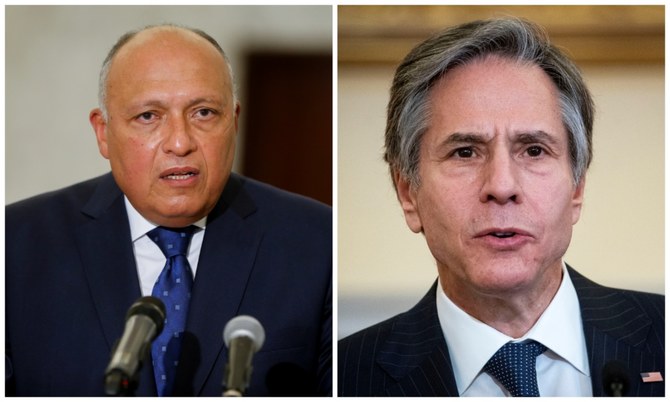
Egypt, US ministers discuss Gaza, maritime security concerns in Red Sea

Egyptian Minister of Foreign Affairs Sameh Shoukry recently held talks with US Secretary of State Antony Blinken to discuss the latest developments in the Gaza Strip. (Reuters/File Photo)
Short Url
Updated 20 December 2023
Follow

Egypt, US ministers discuss Gaza, maritime security concerns in Red Sea

  • Shoukry and Blinken agreed to use all means at their disposal to prevent the displacement of Palestinians outside of the Gaza Strip

CAIRO: Egyptian Minister of Foreign Affairs Sameh Shoukry recently held talks with US Secretary of State Antony Blinken to discuss the latest developments in the Gaza Strip and maritime security concerns in the southern Red Sea and Bab El-Mandeb, the strait that connects the Red Sea with the Gulf of Aden.

Ahmed Abu Zeid, a spokesman for Egypt’s Ministry of Foreign Affairs, said Shoukry received a phone call on Tuesday evening from Blinken who spoke of America’s keenness to work closely with Egypt on regional and global issues during the new term in office of President Abdel Fattah El-Sisi.

Shoukry and Blinken agreed to use all means at their disposal to prevent the displacement of Palestinians outside of the Gaza Strip and their territories, and the Egyptian minister highlighted the importance of working to ensure the delivery of humanitarian aid to Gaza.

He also urged the US to support a draft resolution proposed by Arab and Islamic groups in the UN Security Council aimed at removing obstacles to aid getting into Palestine.

The talks, Abu Zeid added, also covered security challenges in the southern Red Sea region and the Bab El-Mandeb and their impact on maritime transport.

Shoukry pointed out the need to provide safe navigation for commercial vessels in the Red Sea, a shipping lane vital to global trade.

At the end of their discussions, Shoukry and Blinken pledged to stay in regular communication.


GCC states ‘face reliance on Saudi Arabia for food imports’

Updated 06 March 2026
Follow

GCC states ‘face reliance on Saudi Arabia for food imports’

  • With 70 percent of food coming through Strait of Hormuz, analysts warn of inevitable shortages

DUBAI: Some Gulf states may have to rely on overland food deliveries from Saudi Arabia if the US-Israel-Iran war continues to disrupt shipping through the Strait of Hormuz and restrict regional airspace, analysts warned on Thursday.
The region is up to 90 percent dependent on food imports, and price surges and scarcity of some goods are expected.
“With over 70 percent of GCC foodstuffs being imported through the Strait of Hormuz, Gulf states face shortages if the war persists,” said Neil ​Quilliam of the Chatham House think tank. 
“While GCC countries have taken steps to diversify suppliers and ensure sufficient stores to withstand disruption, this can only last several months. At this point, price increases ​and longer lead times will start to hit the markets.”
Commodities analyst Ishan Bhanu said: “The biggest immediate effect will be due to the blockade of Jebel Ali in Dubai, serving about 50 million people. Qatar, Kuwait, Bahrain and Iraq effectively become landlocked and will depend on overland routes through Saudi Arabia.”
Bottlenecks are yet to show and the UAE has said its strategic reserves of vital goods cover four to six months of needs. It urged residents to report unjustified price increases through a dedicated hotline.
Supermarket staff ​throughout the Gulf said shelves remain largely stocked, though suppliers are taking longer to replenish certain products. Iran’s strikes on the Gulf since Saturday prompted panic buying in supermarkets, a dry run for what could come. 
“Perception of risk matters, and even if stocks are sufficient now, public runs on supermarkets can spook the public,” Quilliam said.