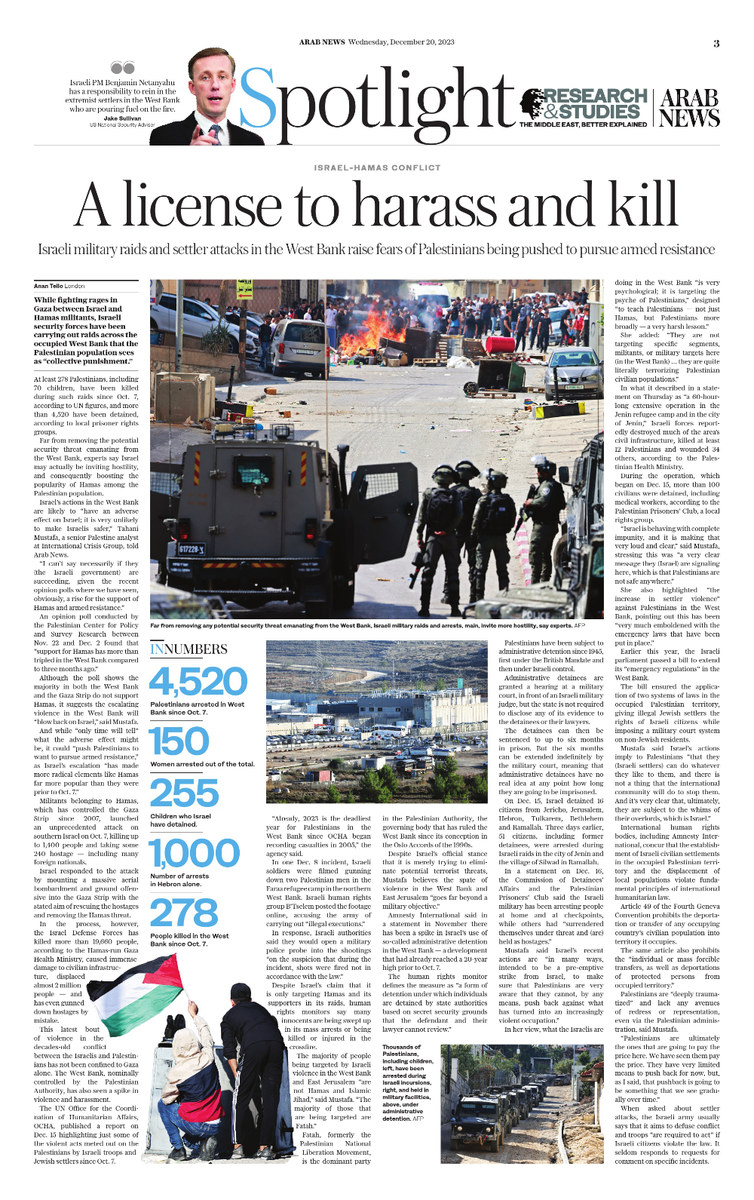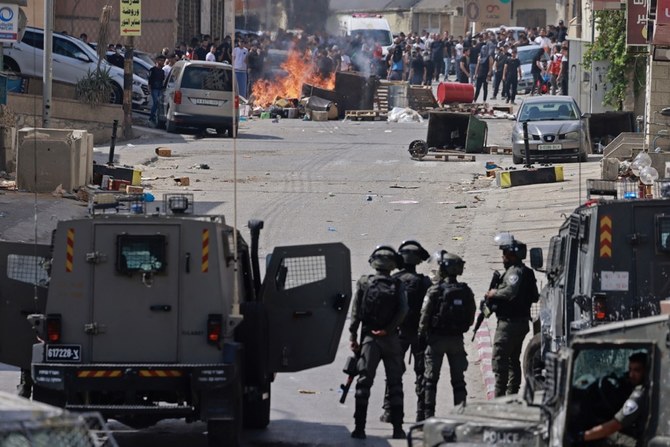

LONDON: While fighting rages in Gaza between Israel and Hamas, Israeli authorities have been carrying out raids across the occupied West Bank that the Palestinian population views as “collective punishment.”
At least 278 Palestinians, including 70 children, have been killed during such raids since Oct. 7, according to UN figures, and more than 4,520 have been detained, according to local prisoner rights groups.
Far from removing the potential security threat emanating from the West Bank, experts say Israel may actually be inviting hostility, and consequently boosting the popularity of Hamas among the Palestinian population.
Israel’s actions in the West Bank are likely to “have an adverse effect on Israel; it is very unlikely to make Israelis safer,” Tahani Mustafa, a senior Palestine analyst at International Crisis Group, told Arab News.
“I can’t say necessarily if they (the Israeli government) are succeeding, given the recent opinion polls where we have seen, obviously, a rise for the support of Hamas and armed resistance.”

Israeli security forces are seen outside Ofer military prison located between Ramallah and Baytunia. (AFP)
An opinion poll conducted by the Palestinian Center for Policy and Survey Research between Nov. 22 and Dec. 2 found that “support for Hamas has more than tripled in the West Bank compared to three months ago.”
Although the poll shows the majority in both the West Bank and the Gaza Strip do not support Hamas, it suggests the escalating violence in the West Bank will “blow back on Israel,” said Mustafa.
And while “only time will tell” what the adverse effect might be, it could “push Palestinians to want to pursue armed resistance,” as Israel’s escalation “has made more radical elements like Hamas far more popular than they were prior to Oct. 7.”
Militants belonging to Hamas, which has controlled the Gaza Strip since 2007, launched an unprecedented attack on southern Israel on Oct. 7, killing up to 1,400 people and taking some 240 hostage — including many foreign nationals.
Israel responded to the attack by mounting a massive aerial bombardment and ground offensive into the Gaza Strip with the stated aim of rescuing the hostages and removing the Hamas threat.
In the process, however, the Israel Defense Forces has killed more than 19,600 people, according to the Hamas-run Gaza Health Ministry, caused immense damage to civilian infrastructure, displaced almost 2 million people — and has even gunned down hostages by mistake.

A protester walks near burning tyres in the occupied West Bank. (AFP)
This latest bout of violence in the decades-old conflict between the Israelis and Palestinians has not been confined to Gaza alone. The West Bank, nominally controlled by the Palestinian Authority, has also seen a spike in violence and harassment.
The UN Office for the Coordination of Humanitarian Affairs, OCHA, published a report on Dec. 15 highlighting just some of the violent acts meted out on the Palestinians by Israeli troops and Jewish settlers since Oct. 7.
“Already, 2023 is the deadliest year for Palestinians in the West Bank since OCHA began recording casualties in 2005,” the agency said.
In one Dec. 8 incident, Israeli soldiers were filmed gunning down two Palestinian men in the Faraa refugee camp in the northern West Bank. Israeli human rights group B’Tselem posted the footage online, accusing the army of carrying out “illegal executions.”
In response, Israeli authorities said they would open a military police probe into the shootings “on the suspicion that during the incident, shots were fired not in accordance with the law.”
Despite Israel’s claim that it is only targeting Hamas and its supporters in its raids, human rights monitors say many innocents are being swept up in its mass arrests or being killed or injured in the crossfire.

The majority of people being targeted by Israeli violence in the West Bank and East Jerusalem “are not Hamas and Islamic Jihad,” said Mustafa. “The majority of those that are being targeted are Fatah.”
Fatah, formerly the Palestinian National Liberation Movement, is the dominant party in the Palestinian Authority, the governing body that has ruled the West Bank since its conception in the Oslo Accords of the 1990s.
Despite Israel’s official stance that it is merely trying to eliminate potential terrorist threats, Mustafa believes the spate of violence in the West Bank and East Jerusalem “goes far beyond a military objective.”
Amnesty International said in a statement in November there has been a spike in Israel’s use of so-called administrative detention in the West Bank — a development that had already reached a 20-year high prior to Oct. 7.
The human rights monitor defines the measure as “a form of detention under which individuals are detained by state authorities based on secret security grounds that the defendant and their lawyer cannot review.”
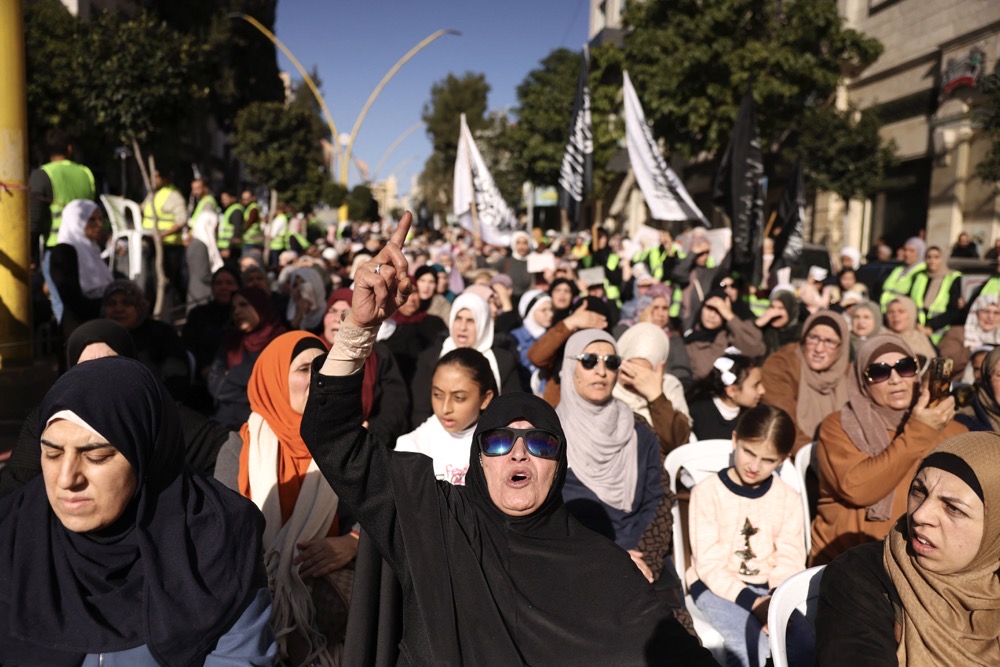
Palestinians attend a demonstration against the ongoing war between Israel and the Hamas. (AFP)
Palestinians have been subject to administrative detention since 1945, first under the British Mandate and then under Israeli control.
Administrative detainees are granted a hearing at a military court, in front of an Israeli military judge, but the state is not required to disclose any of its evidence to the detainees or their lawyers.
The detainees can then be sentenced to up to six months in prison. But the six months can be extended indefinitely by the military court, meaning that administrative detainees have no real idea at any point how long they are going to be imprisoned.
On Dec. 15, Israel detained 16 citizens from Jericho, Jerusalem, Hebron, Tulkarem, Bethlehem and Ramallah. Three days earlier, 51 citizens, including former detainees, were arrested during Israeli raids in the city of Jenin and the village of Silwad in Ramallah.
In a statement on Dec. 16, the Commission of Detainees’ Affairs and the Palestinian Prisoners’ Club said the Israeli military has been arresting people at home and at checkpoints, while others had “surrendered themselves under threat and (are) held as hostages.”
Mustafa said Israel’s recent actions are “in many ways, intended to be a pre-emptive strike from Israel, to make sure that Palestinians are very aware that they cannot, by any means, push back against what has turned into an increasingly violent occupation.”
In her view, what the Israelis are doing in the West Bank “is very psychological; it is targeting the psyche of Palestinians,” designed “to teach Palestinians — not just Hamas, but Palestinians more broadly — a very harsh lesson.”
She added: “They are not targeting specific segments, militants, or military targets here (in the West Bank) … they are quite literally terrorizing Palestinian civilian populations.”
In what it described in a statement on Thursday as “a 60-hour-long extensive operation in the Jenin refugee camp and in the city of Jenin,” Israeli forces reportedly destroyed much of the area’s civil infrastructure, killed at least 12 Palestinians and wounded 34 others, according to the Palestinian Health Ministry.
During the operation, which began on Dec. 15, more than 100 civilians were detained, including medical workers, according to the Palestinian Prisoners’ Club, a local rights group.
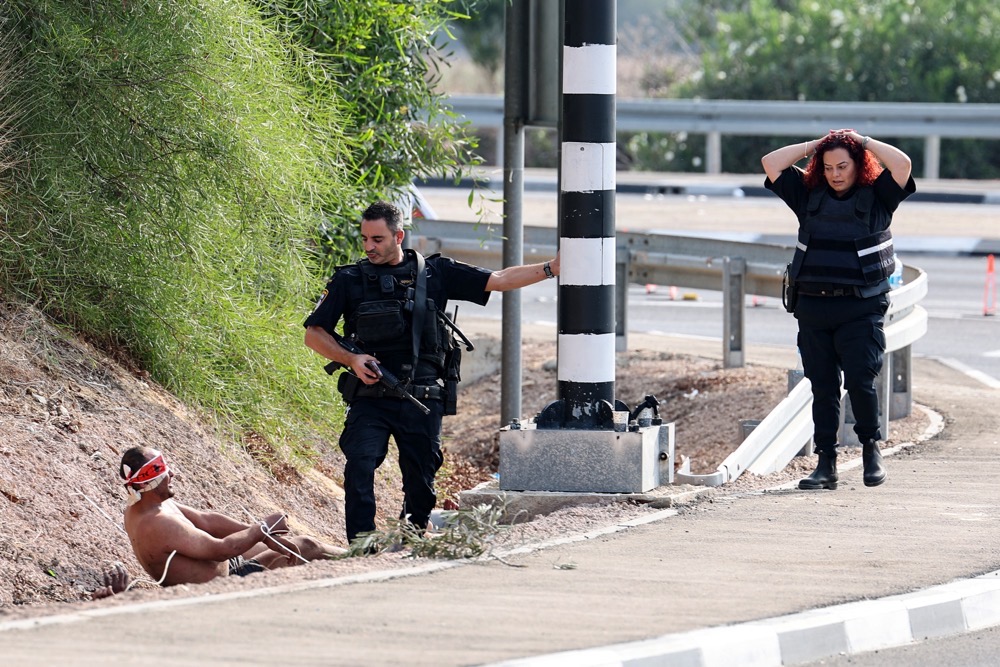
A blind-folded Palestinian prisoner speaks to a member of the Israeli security forces. (AFP)
“Israel is behaving with complete impunity, and it is making that very loud and clear,” said Mustafa, stressing this was “a very clear message they (Israel) are signaling here, which is that Palestinians are not safe anywhere.”
She also highlighted “the increase in settler violence” against Palestinians in the West Bank, pointing out this has been “very much emboldened with the emergency laws that have been put in place.”
Earlier this year, the Israeli parliament passed a bill to extend its “emergency regulations” in the West Bank.
The bill ensured the application of two systems of laws in the occupied Palestinian territory, giving illegal Jewish settlers the rights of Israeli citizens while imposing a military court system on non-Jewish residents.
INNUMBERS
• 4,520 Palestinians arrested in West Bank since Oct. 7.
• 150 Women arrested out of the total.
• 255 Children who Israel have detained.
• 1,000 Number of arrests in Hebron alone.
• 278 People killed in the West Bank since Oct. 7.
Mustafa said Israel’s actions imply to Palestinians “that they (Israeli settlers) can do whatever they like to them, and there is not a thing that the international community will do to stop them. And it’s very clear that, ultimately, they are subject to the whims of their overlords, which is Israel.”
International human rights bodies, including Amnesty International, concur that the establishment of Israeli civilian settlements in the occupied Palestinian territory and the displacement of local populations violate fundamental principles of international humanitarian law.
Article 49 of the Fourth Geneva Convention prohibits the deportation or transfer of any occupying country’s civilian population into territory it occupies.
The same article also prohibits the “individual or mass forcible transfers, as well as deportations of protected persons from occupied territory.”
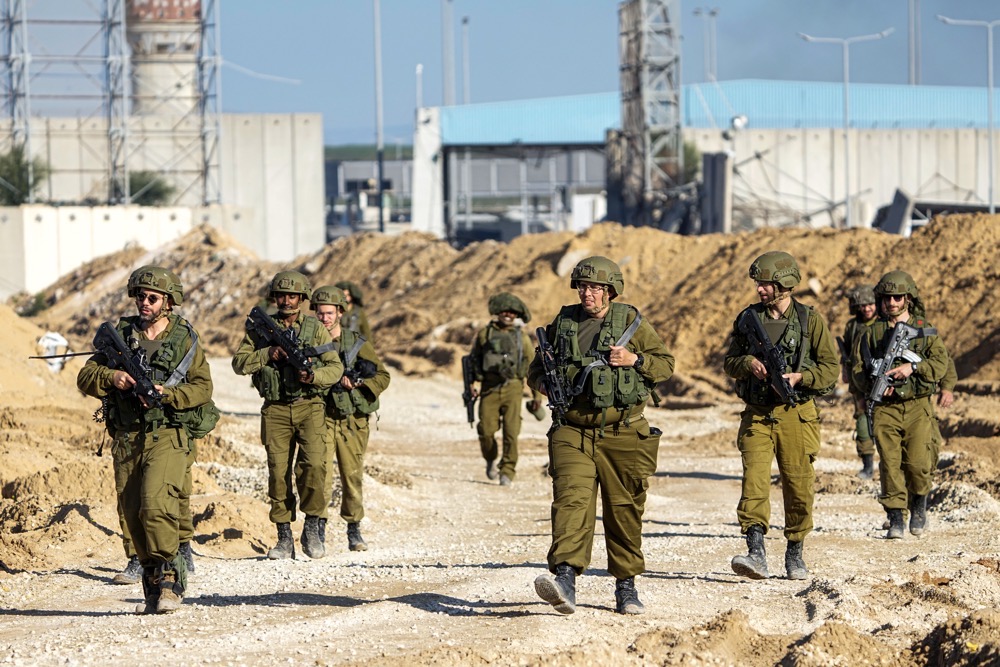
Israeli soldiers are seen during a ground operation in the northern Gaza Strip. (AP)
Palestinians are “deeply traumatized” and lack any avenues of redress or representation, even via the Palestinian administration, said Mustafa.
“Palestinians are ultimately the ones that are going to pay the price here. We have seen them pay the price. They have very limited means to push back for now, but, as I said, that pushback is going to be something that we see gradually over time.”
When asked about settler attacks, the Israeli army usually says that it aims to defuse conflict and troops “are required to act” if Israeli citizens violate the law. It seldom responds to requests for comment on specific incidents.