

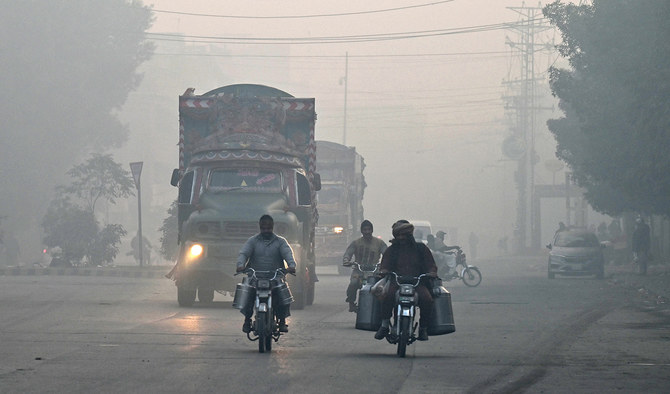

ISLAMABAD: Caretaker Punjab Chief Minister Mohsin Naqvi celebrated his administration’s success on Sunday in reducing pollution in eastern Lahore city following a successful cloud seeding experiment conducted by the United Arab Emirates to combat smog a day earlier.
Although the Air Quality Index (AQI) still rated Lahore’s environment as “unhealthy” after the artificially induced rain, there was notable improvement from the previously “hazardous” level.
Lahore has consistently been ranked among the world’s most polluted cities in recent weeks, mounting pressure on Naqvi’s interim Punjab administration to take necessary steps to deal with the problem.
“Finally Below 200,” Naqvi exclaimed in a social media post, accompanying a screenshot showing Lahore, previously topping the list, now improved to the sixth position with an AQI of 189.
The AQI typically ranges from 0 to 500, where lower values signify better air quality and higher values indicate poorer air quality.
Lahore has mostly hovered around 300 points in recent weeks, making the drop in its AQI ranking a relative improvement in one of the world’s most polluted cities.
The interim chief minister, in a news conference on Saturday, recognized the temporary nature of this improvement, stressing the importance of scientific research to identify the root causes of Lahore’s smog.
He noted that despite a reduction in previously blamed factors like crop stubble burning and emissions from low-grade diesel, the smog issue had continued.
“We have already assigned a research team,” Naqvi said. “At present, we are blank [in terms of what is causing the smog].”


