

On 9th anniversary of Peshawar school massacre, PM says ‘terrorists’ can never defeat nation

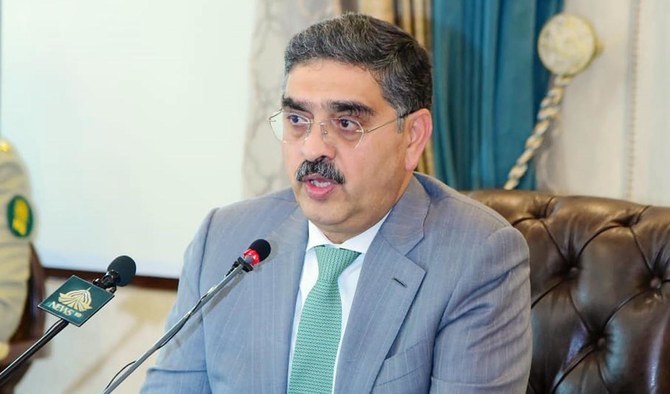
Pakistan's Caretaker Prime Minister Anwaar-ul-Haq Kakar interacts with foreign media in Islamabad on September 4, 2023. (Photo courtesy: PID/File)
Short Url
Updated 16 December 2023
Follow

On 9th anniversary of Peshawar school massacre, PM says ‘terrorists’ can never defeat nation

  • On Dec. 16, 2014, militants stormed school in Peshawar, killed over 130 children
  • Prime Minister Kakar says nation has won war on terror, foiled enemy’s tactics

ISLAMABAD: Caretaker Prime Minister Anwaar-ul-Haq Kakar vowed on Saturday that “terrorists” can never defeat the nation, as Pakistan marks the ninth anniversary of the Peshawar school massacre today. 

A group of heavily armed militants belonging to the proscribed Tehreek-e-Taliban Pakistan (TTP) faction — a separate group but allied with the Afghan Taliban — entered the Army Public School building on Dec. 16, 2014, and killed children and staff members. The incident took place in a high security area in Peshawar in Pakistan’s northwestern Khyber Pakhtunkhwa province. 

Pakistan has seen a surge in attacks since a fragile truce between the TTP and the government broke down in Nov. 2022. Thousands of Pakistanis have lost their lives in attacks claimed by the TTP since 2007, including an assassination attempt on Nobel Prize winner Malala Yousafzai. 

“Prime Minister said sympathies of the entire nation stand with the parents whose children made a great sacrifice in this tragedy,” the state-run Radio Pakistan said. “He said coward terrorists can never defeat the nation.” 

Kakar said the APS Peshawar incident strengthened the nation’s determination against “terrorism,” Radio Pakistan added. 

The state-run media quoted the prime minister as saying that with the APS incident, militants tried unsuccessfully to undermine the morale of the nation in the war against “terrorism.” 

“He said the nation has won the war on terror and foiled all the tactics of the enemy to spread mischief and chaos in the country,” Radio Pakistan said. 

Pakistan’s ties with Afghanistan have been strained ever since the Afghan Taliban seized power in Kabul in August 2021. Islamabad has urged Kabul to take action against TTP militants, which it says uses Afghan soil to launch attacks against Pakistan. 

Kabul denies the accusations and has urged Pakistan to deal with its security issues internally.


Pakistan says defense pact with Saudi Arabia elevated brotherly ties to ‘new heights’

Updated 25 February 2026
Follow

Pakistan says defense pact with Saudi Arabia elevated brotherly ties to ‘new heights’

  • Pakistan, Saudi Arabia signed strategic defense pact last year pledging aggression against one will be treated as attack on both
  • Deputy PM Ishaq Dar says enduring bonds with Islamic and Arab nations form vital pillar of Pakistan’s foreign policy 

ISLAMABAD: Deputy Prime Minister Ishaq Dar said on Wednesday that Pakistan’s defense pact with Saudi Arabia elevated its brotherly ties with the Kingdom to “new heights,” stressing that close ties with Arab and Islamic nations form a key pillar of Islamabad’s foreign policy. 

Pakistan and Saudi Arabia signed a Strategic Mutual Defense Agreement on Sept. 17 last year, pledging that aggression against one country would be treated as an attack on both, enhancing joint deterrence and formalizing decades of military and security cooperation.

Both nations agreed in October 2025 to launch an economic cooperation framework to strengthen trade and investment ties. 

“In the Middle East, our landmark Strategic Mutual Defense Agreement with Saudi Arabia has elevated our brotherly ties to new heights,” Dar said while speaking at the Pakistan Governance Forum 2026 event in Islamabad. 

The Pakistani deputy prime minister was speaking on the topic “Navigating International Relations Amidst Changing Geo-Politics.”

Dar noted that Pakistan has reinforced partnerships with other Middle Eastern nations such as the UAE, Qatar, Jordan, Oman, Egypt and Bahrain. He said these partnerships have yielded “concrete agreements” in investment, agriculture, infrastructure, and energy sectors. 

“Our enduring bonds with Islamic and Arab nations form a vital pillar of our foreign policy, and we will continue to expand our partnerships across Asia, Latin America, and Africa,” he said. 

Dar pointed out that the presidents of Kazakhstan, Uzbekistan and Kyrgyzstan have undertaken visits to Pakistan in recent months, reflecting Central Asian nations’ desire to boost cooperation with Islamabad.

On South Asia, the Pakistani deputy PM said Pakistan has successfully transformed its fraternal ties with Bangladesh into “a substantive partnership.”

“Similarly, the trilateral mechanism involving China, Pakistan, and Bangladesh has been launched with a view to expanding and deepening regional cooperation and synergy,” the Pakistani minister said. 

He said Islamabad has strengthened its “all-weather” partnership with China via the second phase of the multi-billion-dollar China-Pakistan Economic Corridor agreement and “unwavering support” from both sides for each other’s core interests. 

Dar said Pakistan had also reinvigorated its partnership with the US, advancing cooperation in trade, technology, investment, and regional stability. 

“This calibrated approach has enhanced our ability to navigate complexity with skill and confidence, ensuring that our national interests are served without compromising our core foreign policy principles,” he said.