

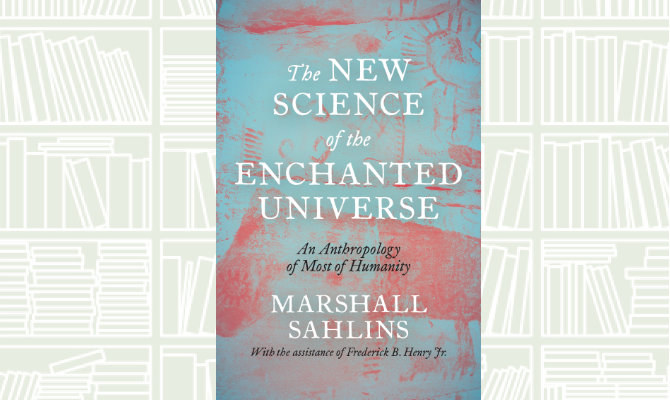
What We Are Reading Today: New Science of the Enchanted Universe

Short Url
Updated 15 December 2023
Follow

What We Are Reading Today: New Science of the Enchanted Universe

Author: Marshall Sahlins

From the perspective of Western modernity, humanity inhabits a disenchanted cosmos.
The vast majority of cultures throughout human history treat spirits as very real persons, members of a cosmic society who interact with humans and control their fate.
In most cultures, even today, people are but a small part of an enchanted universe misconstrued by the transcendent categories of “religion” and the “supernatural.”
“The New Science of the Enchanted Universe” shows how anthropologists and other social scientists must rethink these cultures of immanence and study them by their own lights.
Marshall Sahlins takes readers around the world. In the process, Sahlins sheds new light on classical and contemporary ethnographies that describe these cultures of immanence and reveals how even the apparently mundane, all-too-human spheres of “economics” and “politics” emerge as people negotiate with, and ultimately usurp, the powers.


Book Review: ‘Small Things Like These’ by Claire Keegan

Updated 19 February 2026
Follow

Book Review: ‘Small Things Like These’ by Claire Keegan

In “Small Things Like These,” Irish writer Claire Keegan delivers a quietly devastating meditation on conscience, courage and compassion.

Set in a small Irish town in 1985, the novella follows Bill Furlong, a coal merchant and devoted father whose steady routine is disrupted when he uncovers disturbing secrets within a local convent’s Magdalene laundry, institutions known for placing women in harsh working conditions under the guise of care. 

What unfolds is not a story of grand heroics but of moral awakening and quiet bravery. Keegan’s writing is economical yet deeply expressive, her sentences carrying a stillness that mirrors the winter atmosphere and the emotional restraint of her characters.

Furlong’s dilemma, whether to remain silent or act, reflects a broader question about how ordinary people respond to injustice when it happens in plain sight and when society prefers to look away. 

Keegan’s restraint is one of her greatest strengths. The novella avoids overt judgment or sentimentality, relying instead on nuance, rhythm and suggestion.

Everyday details, a gesture or a silence, reveal the quiet conflicts of conscience. Furlong’s character embodies the tension between comfort and conviction, reminding readers that doing nothing is itself a choice and that small decencies can carry immense moral weight. 

The book’s impact lies in its understatement. Within its brief length, Keegan captures the weight of an entire community’s silence and the redemptive power of individual decency. Her prose feels timeless in its precision, emotional intelligence and empathy. 

“Small Things Like These” is a beautiful, haunting work that lingers long after it ends.

It asks readers to consider how goodness survives in a world inclined toward indifference and how small acts can illuminate even the darkest corners of collective memory.