

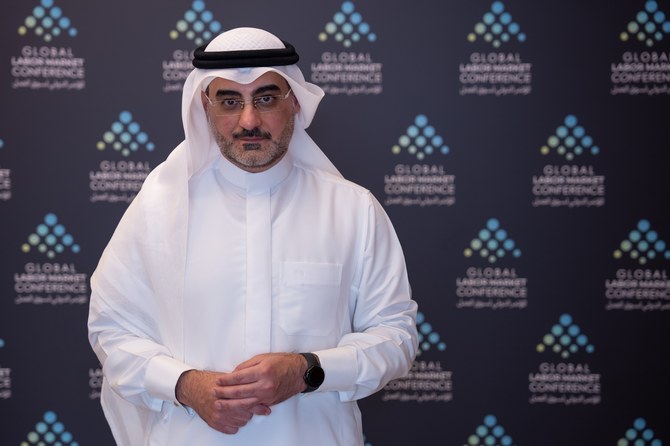

RIYADH: To navigate the unprecedented technological growth around the globe, there is a pressing need for rapid upskilling and widespread adaptability in the job market, says the CEO of Takamol.
As the global labor market faces emerging trends and challenges in the form of automation, remote work, and the gig economy, this creates a perpetual problem that “feeds on itself,” Ahmad Al-Yamani told Arab News in an interview on the sidelines of the Global Labor Market Conference in Riyadh.
The CEO noted the uncertainty surrounding the effect of the transition to artificial intelligence on global labor trends, questioning whether it will contribute to leveling the playing field among workers or result in a widening gap and economic divide between different skill sets.
These questions, coupled with a much faster transformation than the world has ever witnessed, have generated the need for workers to be “extremely prepared to reskill and upskill and change direction very quickly,” Al-Yamani said.
“One is the ability to reskill people very quickly because these are not the only technological changes that will happen. There will be many more and they will happen much faster than they have happened in the past. The transformation and the transition into AI is still an open question,” the CEO said.
“The ability to be agile enough to deal with these changes is a challenge that we are yet to see its consequences on global economies. But that’s one of the main focus areas of this conference and that’s one of the main discussion points of most of the sessions,” he added.
In the Kingdom, the nation’s governance is taking a proactive approach in enabling, supporting, digitizing, and legislating for a productive gig economy in the future, the CEO noted.
While in many global sectors, the transition has looked like “a step forward and another one backward” when it comes to the gig economy, Saudi Arabia wants to guarantee the protection of workers while assuring that the economy is not hurt, according to the executive.
“They (the government) have taken a courageous decision saying we will enable future work, in every possible way legislation, digital platforms, opportunities, etc. and that has created jobs or opportunities for freelancers whose number is now today and hundreds of thousands in the Saudi economy,” he said.
“These are freelancers who are actually making an income out of being freelancers. We believe this is the future of work,” he added.
As part of its mandate, Takamol has undertaken the task of digitizing the entire labor market of Saudi Arabia. A job that its CEO deems “a tough challenge, but it has been very much worth it.”
By analyzing each step of the Saudi labor market from the very beginning to the very end with it. Whether it’s the permission to get a visa, skill verification, issuance of the visa, contract authentication, the company has been “diligently working” on a platform that puts all of them in one place, Al-Yamani said.
According to the CEO, this has created a competitive advantage for the Saudi workforce compared to other labor markets worldwide.
He said: “We have probably and until now, I’m yet to verify, but probably the first labor market in the world that is all in one platform and many other nations and economies, you would see the visa issuance in one place, you would see the contract management in another place.”
He added: “What has happened in this economy is that the entire process for the entire journey of labor market or labor relationship between the employer and employee has been integrally tied in one place, creating an engine that takes the journey from A to Z, from the visa issuance to the termination of the contract, going through all the steps, whether if it’s the authentication, the smart inspection, the self-inspection, the dispute management, the protection, the mobility of the worker.”
Through this engine, the CEO underscored that a framework will be provided to build and be well-equipped for a future that is yet to be discovered and designed.
Another testament to the country’s adaptability, he noted, was its ability to reduce unemployment as an economy from 12 percent before the pandemic and 15 percent during the pandemic to 8.3 percent today.
“This is a 40 percent reduction from the year of COVID and a 25-30 percent reduction from the year before COVID-19 and reducing unemployment by quarter a percentage point is a very big challenge in a lot of countries in the world,” he said.
The ability to lower this figure over a short period, coupled with a framework to adapt to the gig economy, freelancers, flexible workers, and the future models of work, has given the Kingdom the confidence in its formula that “can and should be” analyzed, re-studied and reused either within the Kingdom or globally, according to Al- Yamani.


