Ex-PM Khan’s legal team objects to prison trial conduct as cipher case hearing resumes in Rawalpindi

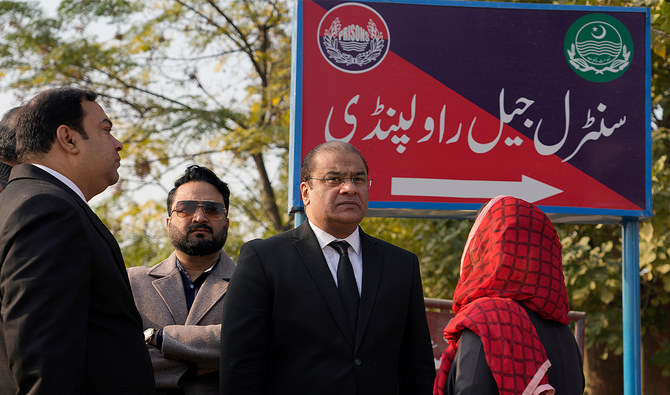
Salman Sardar, center, a lawyer of Pakistan's former Prime Minister Imran Khan's legal team, is pictured as he arrives for a hearing of Cipher case against Khan at Adiala prison, in Rawalpindi, Pakistan, on December 12, 2023. (AP/File)
Short Url
Updated 13 December 2023
Follow

Ex-PM Khan’s legal team objects to prison trial conduct as cipher case hearing resumes in Rawalpindi

  • A spokesperson to former prime minister says media and public are not getting proper access to the trial
  • Naeem Panjutha calls the ongoing proceedings a violation of Islamabad High Court open trial order

RAWALPINDI: Former prime minister Imran Khan’s legal team objected to the conduct of his prison trial on charges of leaking state secrets shortly the resumption of the proceedings on Wednesday which it said violated the Islamabad High Court’s instructions to hold an open trial.

A special court established to hear the case – commonly known as the “cipher reference” – had been conducting the trial inside the Adiala prison in Rawalpindi for weeks without media or members of the public allowed, before the high court ruled the hearings illegal last month and ordered them restarted in an open court.

Khan had already been indicted in the case in October during the now annulled trial but the special court judge announced last week he would be indicted again during the last hearing a day earlier as part of the restarted proceedings.

The special court, however, adjourned the hearing until today without the ex-premier being indicted as was widely expected.

The former prime minister’s spokesperson on legal affairs, Naeem Haider Panjutha, said in a video message the cipher trial could not be described as an open trial. He noted the Islamabad High Court had objected to the way the cipher proceedings were taking place and ordered its resumption from the beginning for the same reason.

However, he pointed out the special court was carrying out the trial in the same manner by only letting its own people and chosen journalists to attend the proceedings even when they were made to sit so far away that they could barely hear anything.

“Is this just a drama that require people to be taken inside [the courtroom],” he asked. “What is the use of sending them in when they cannot even hear what is going on?”

“Can we call it an open trial,” he said. “Open trial means that the public, lawyers, family [of the accused] and journalists can get complete access to the proceedings. In any case, why is this trial being held in jail? If you cannot provide security to one person, how will you provide security to the nation?”

Despite the high court’s orders, only about five journalists were allowed inside on Tuesday while a dozen others waited outside the jail premises. No followers of Khan, arguably the most popular politician in Pakistan and the founder of the Pakistan Tehreek-e-Insaf party, had arrived at the scene, and there was scant police and security presence.


Pakistan, global crypto exchange discuss modernizing digital payments, creating job prospects 

Updated 05 December 2025
Follow

Pakistan, global crypto exchange discuss modernizing digital payments, creating job prospects 

  • Pakistani officials, Binance team discuss coordination between Islamabad, local banks and global exchanges
  • Pakistan has attempted to tap into growing crypto market to curb illicit transactions, improve oversight

ISLAMABAD: Pakistan’s finance officials and the team of a global cryptocurrency exchange on Friday held discussions aimed at modernizing the country’s digital payments system and building local talent pipelines to meet rising demand for blockchain and Web3 skills, the finance ministry said.

The development took place during a high-level meeting between Finance Minister Muhammad Aurangzeb, Pakistan Virtual Assets Regulatory Authority (PVARA) Chairman Bilal bin Saqib, domestic bank presidents and a Binance team led by Global CEO Richard Teng. The meeting was held to advance work on Pakistan’s National Digital Asset Framework, a regulatory setup to govern Pakistan’s digital assets.

Pakistan has been moving to regulate its fast-growing crypto and digital assets market by bringing virtual asset service providers (VASPs) under a formal licensing regime. Officials say the push is aimed at curbing illicit transactions, improving oversight, and encouraging innovation in blockchain-based financial services.

“Participants reviewed opportunities to modernize Pakistan’s digital payments landscape, noting that blockchain-based systems could significantly reduce costs from the country’s $38 billion annual remittance flows,” the finance ministry said in a statement. 

“Discussions also emphasized building local talent pipelines to meet rising global demand for blockchain and Web3 skills, creating high-value employment prospects for Pakistani youth.”

Blockchain is a type of digital database that is shared, transparent and tamper-resistant. Instead of being stored on one computer, the data is kept on a distributed network of computers, making it very hard to alter or hack.

Web3 refers to the next generation of the Internet built using blockchain, focusing on giving users more control over their data, identity and digital assets rather than big tech companies controlling it.

Participants of the meeting also discussed sovereign debt tokenization, which is the process of converting a country’s debt such as government bonds, into digital tokens on a blockchain, the ministry said. 

Aurangzeb called for close coordination between the government, domestic banks and global exchanges to modernize Pakistan’s payment landscape.

Participants of the meeting also discussed considering a “time-bound amnesty” to encourage users to move assets onto regulated platforms, stressing the need for stronger verifications and a risk-mitigation system.

Pakistan has attempted in recent months to tap into the country’s growing crypto market, crack down on money laundering and terror financing, and promote responsible innovation — a move analysts say could bring an estimated $25 billion in virtual assets into the tax net.

In September, Islamabad invited international crypto exchanges and other VASPs to apply for licenses to operate in the country, a step aimed at formalizing and regulating its fast-growing digital market.