



NEW YORK CITY: An extremely crowded meeting of the UN General Assembly echoed to the sound of applause on Tuesday after an overwhelming majority of 153 member nations voted in favor of a resolution calling for an immediate ceasefire in Gaza. Only 10 countries voted against it and 33 abstained.
The vote took place during an emergency special session of the assembly titled “Protection of Civilians and Upholding Legal and Humanitarian Obligations.” It was called last week by the representatives of Egypt and Mauritania, in their capacities as chair of the Arab Group and chair of the Organisation of Islamic Cooperation respectively, after the US on Friday vetoed a Security Council resolution calling for a ceasefire.
The draft of the text of the resolution adopted by the General Assembly on Tuesday, and seen by Arab News, closely reflected the vetoed Security Council resolution. It expresses “grave concern over the catastrophic humanitarian situation in the Gaza Strip and the suffering of the Palestinian civilian population, and (emphasizes) that the Palestinian and Israeli civilian populations must be protected in accordance with international humanitarian law.”
It calls for “an immediate humanitarian ceasefire” as well as the “immediate and unconditional release of all hostages.”

Austria proposed an amendment to the text that would have added a demand for the release of hostages “held by Hamas and other groups,” and added the need for “immediate” humanitarian access.
As it has done in response to all previous draft resolutions, the US once again proposed an amendment calling for the text to “unequivocally reject and condemn the heinous terrorist attacks by Hamas that took place in Israel starting Oct. 7, 2023, and the taking of hostages.”
Resolutions adopted by the General Assembly are non-binding because, unlike Security Council resolutions, they do not have the force of international law behind them. Nonetheless, they do carry political weight. And given the overwhelming outcome of the vote on this resolution, it could be considered to reflect the prevailing global view of the war in Gaza.
Dennis Francis, the president of the General Assembly, opened the session by again calling for an “immediate humanitarian ceasefire.” He said it was incumbent upon the UN to bring an end to “the suffering of innocent civilians,” and vowed to support all efforts to “put an end to the bloodshed and the psychological torture of the people of Gaza.”
The plight of Gazans is the result of an “unprecedented collapse of an already crumbling humanitarian system (and) profound disrespect for both international law and international humanitarian law,” he said.
“Since Dec. 1, we are witnessing the resumption of violence with a kind of ferocity that one asks, ‘What more, next?’
“No more time left. The carnage must stop. In the name of humanity, I ask you once more: Stop the violence now.”
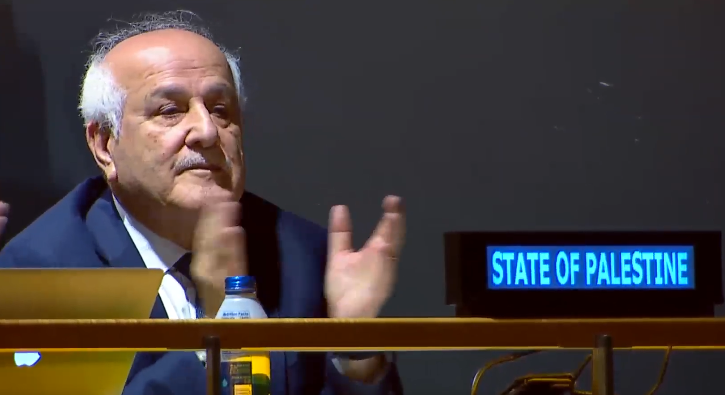
Palestinian Permanent Observer to the United Nations Riyad H. Mansour claps as a majority of 153 member nations voted in favor of a resolution calling for an immediate ceasefire in Gaza as the UN General Assembly holds an emergency special session on the Israel-Hamas war at the United Nations headquarters on December 12, 2023 in New York City. (Photo courtesy: UN General Assembly)
The Saudi ambassador to the UN, Abdulaziz Alwasil, said his country was voting in favor of the resolution to end “the suffering caused by an inhumane military attack by the Israeli occupation forces.”
He added: “Civilians must be protected. This is a main priority and no compromise shall be made regarding it. Failing to achieve this priority will only exacerbate this catastrophe, which falls upon Israel and the international community.”
Alwasil repeated the call for an immediate ceasefire to end the “bloodshed, protect civilians, and stop the collective punishment inflicted upon the people of Gaza.”
He also stressed the need to reach “a comprehensive and just solution for the Palestinian question in line with the Arab Peace Initiative, the two-state solution, and the establishment of a Palestinian state with Jerusalem as its capital.”
Osama Abdel Khalek, Egypt’s permanent representative to the UN and the chair of the Arab Group for the month of December, asked the General Assembly: “What are we all waiting for, to stop this fire? To end this zero-sum war?”
The US continued to justify its opposition to a ceasefire resolution by restating its belief that such a move would benefit only Hamas.
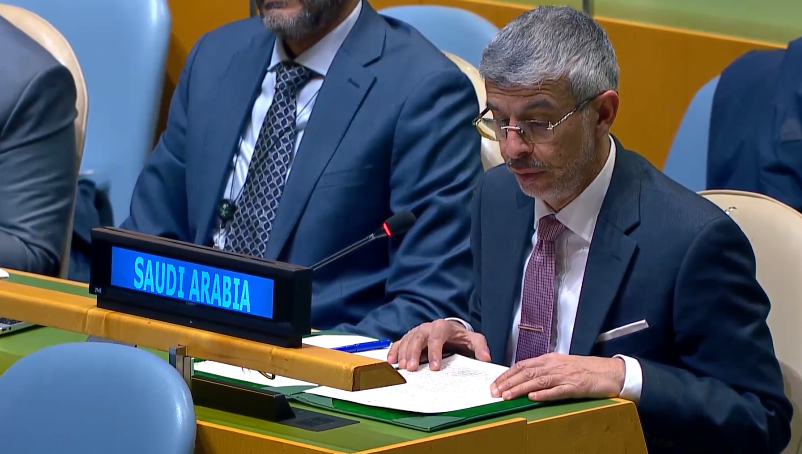
Saudi ambassador to the UN, Abdulaziz Alwasil at the United Nations headquarters on December 12, 2023 in New York City. (Photo courtesy: UN General Assembly)
Ahead of the vote, Linda Thomas-Greenfield, the US ambassador to the UN, called on the General Assembly to speak with one voice in condemnation of the militant group.
“This is the bare minimum and it should not be that difficult,” she said.
She encouraged members not to vote in favor of the resolution, on the grounds that “a ceasefire now would be temporary at best, and dangerous at worst.”
Pakistan’s permanent representative to the UN, Munir Akram, also speaking before the vote, denounced the amendments proposed by Austria and the US, saying that they “once again condemn only one side but exonerate the other.” Blaming Hamas alone for the conflict is neither “equitable” nor “just,” he added.
“The blame, if it is to be placed, has to be placed on both parties, especially on Israel,” said Akram, adding that if Hamas was named in the resolution and Israel was not, “you will provide a justification to the Israeli war machine to continue its roulette wheel of death.”
Israel is waging a war on the Palestinian people with the aim of erasing the very idea of Palestine, Akram said. He described Israel’s campaign in Gaza as “a carbon copy of the massive campaigns of racial slaughter by other settler colonial regimes in history.”
Gilad Erdan, Israel’s ambassador to the UN, said support for the resolution was tantamount to giving “terrorists a free pass,” and added: “A ceasefire will prolong the death and destruction in the region.”
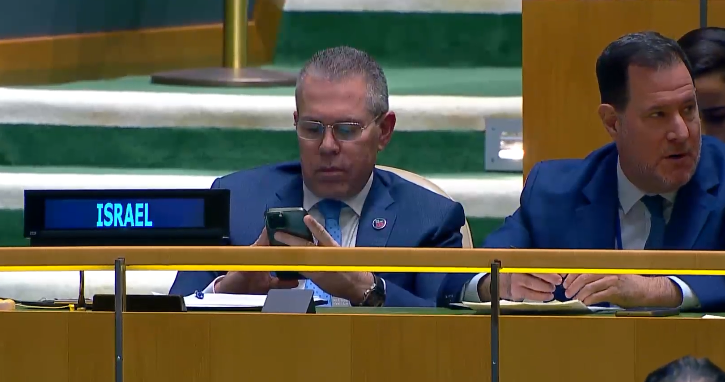
Gilad Erdan (left) Israel’s ambassador to the UN at the United Nations headquarters on December 12, 2023 in New York City. (Photo courtesy: UN General Assembly)
In October, the General Assembly adopted a resolution calling for “an immediate, durable and sustained humanitarian truce leading to a cessation of hostilities,” after 121 members voted in favor, 14 against, including the US, and 44 abstained.
The US used its power of veto in the Security Council last Friday to prevent the adoption of a ceasefire resolution during an urgent session called for by UN Secretary-General Antonio Guterres. He did so by invoking the rarely-used Article 99, one of the few powers granted to him by the UN Charter, which he can use to bring to the attention of the council any important issues he believes threaten global peace and security.
After the failure of the 15-member council to adopt the resolution — despite 13 votes in favor and one abstention (the UK) — Guterres expressed his regret and said the “authority and credibility” of the council, the UN body responsible for maintaining international peace and security, had been “severely undermined.”


