

In continuing stand-off with government, Pakistani pharma union calls for price hike of 262 drugs

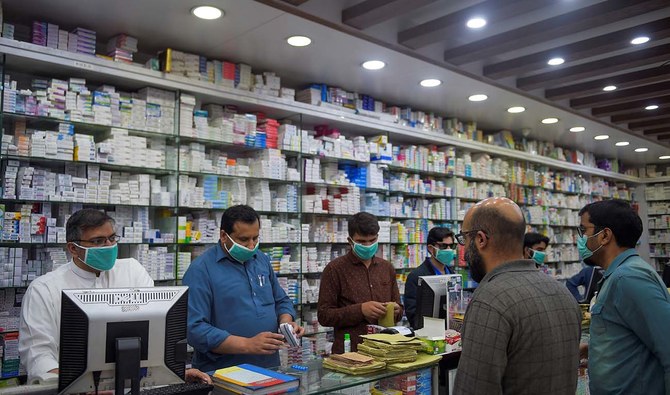
Pharmacy employees wearing facemasks as a preventive measure against the COVID-19 coronavirus attend to customers in Islamabad on March 23, 2020. (AFP/File)
Short Url
Updated 11 December 2023
Follow

In continuing stand-off with government, Pakistani pharma union calls for price hike of 262 drugs

  • Pakistan in April approved rise of up to 20 percent in retail prices of general medicines and 14 percent for essential ones
  • Associations have been demanding an across-the-board 39 percent rise, warning that the industry could otherwise collapse

KARACHI: The Pakistan Pharmaceutical Manufacturers Association (PPMA) on Monday called on the federal government to allow an increase in the prices of 262 medicines, the latest in a stand-off with an industry struggling to stem losses from soaring inflation and a weakened currency.

Since June, local and multinational companies have been lobbying the government to raise prices through industry lobby groups like the Pharma Bureau and the PPMA.

Pakistan last approved a rise of up to 20 percent in retail prices of general medicines and 14 percent for essential ones in April, prompting immediate criticism from drug manufacturers who said the increases were too small. Associations have been demanding an across-the-board 39 percent rise, warning that the industry could otherwise collapse.

In its statement on Monday, PPMA said a delay in the price hike would mean “more essential drugs wouldn’t be available in the local market.”

“Revision in prices of these medicines had become highly essential as the last time such an increase had been allowed by the government the value of the dollar was less than Rs 200,” PPMA Central Chairman Mian Khalid Misbah-ur-Rehman was quoted in the statement as saying.

On Monday, the dollar was worth Rs281.75 for buying and Rs284.75 for selling, according to the Exchange Companies Association of Pakistan.

 “In addition to the phenomenal increase in the dollar exchange rate, the production cost of medicines has increased manifold due to record inflation,” Rehman said.

Pakistan’s weekly inflation rate spiked to the highest level in six months in the week ending on December 7, driven by surging food and fuel prices, as per data released by the government.

Rehman warned that more multinational drug producers would be forced to wind up their businesses if the government kept delaying the decision to allow an increase in the prices of medicines.

“The number of multinational pharmaceutical companies in Pakistan has already significantly decreased over the past many years as any further reduction in their number will go against the current efforts of the government to attract foreign investment to Pakistan,” the PPMA chairman said.

Data from the statistics bureau released in March showed the pharma industry had cut overall output by 55 percent since June 2022.

Over 100 essential drugs were already unavailable in the market, Rehman added:

“The patients in such a scenario rely on spurious and smuggled drugs when the locally produced medicines aren’t available in the market.”

PPMA said the sustainability of the Pakistani pharmaceutical industry, which met up to 95 percent demand for medicines in the country, would be “seriously threatened” if the government didn’t review its drug pricing system.

“We have been constantly calling upon the government to pay heed to the ground realities affecting the drug producers in the country as the long-pending hardship cases of medicines should be expeditiously disposed of as per the law,” the PPMA chairman said.

Pakistan’s annual pharmaceutical exports stand at around$300 million, which Rehman said could be increased to $5 billion if the government “consistently implements favorable policies for the drug industry allowing it to adopt state-of-the-art production technologies.”

Pakistan air chief highlights modernization as PAF marks seven years since India aerial clash

Updated 27 February 2026
Follow

Pakistan air chief highlights modernization as PAF marks seven years since India aerial clash

  • Swift Retort was launched in 2019 after India attempted airstrikes following a Kashmir suicide bombing
  • Air chief’s remarks come amid fierce clashes between Pakistan and Afghanistan over cross-border militancy

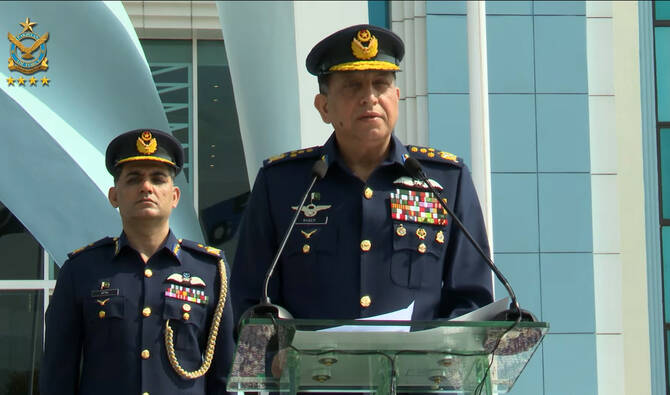
ISLAMABAD: Pakistan’s air chief said on Friday the country’s air force had undertaken “comprehensive modernization and indigenization” in recent years, as he addressed a ceremony at Air Headquarters to mark seven years since an aerial confrontation with India.

Operation Swift Retort was launched on Feb. 27, 2019, a day after India attempted airstrikes inside Pakistan following a suicide bombing in Indian-administered Kashmir that killed at least 40 Indian paramilitary troops.

Pakistan responded with aerial strikes across the Line of Control and shot down an Indian fighter jet in a subsequent dogfight, capturing one pilot who was later returned in what Islamabad called a gesture of de-escalation.

“PAF has pursued comprehensive modernization and indigenization to transition into a Next Generation Air Force,” Air Chief Marshal Zaheer Ahmed Baber Sidhu said, according to a statement circulated by the military’s media wing, the Inter-Services Public Relations.

He added that the force had recalibrated its operational doctrine and rapidly inducted advanced combat and support capabilities, including indigenously developed unmanned systems, electronic warfare, space and cyber assets, establishing what he described as a “home-grown multi-domain kill chain.”

Sidhu said Pakistan remained committed to peace but would respond decisively to violations of its sovereignty.

“Pakistan is a responsible country which desires peace with honor,” he continued.

The remarks come amid renewed security tensions on Pakistan’s western frontier.

Islamabad earlier this week launched airstrikes inside Afghanistan targeting what it described as hideouts of Tehreek-e-Taliban Pakistan (TTP) and Daesh militants. Afghan authorities condemned the strikes and subsequently launched their own military response that led to fierce clashes between the two sides overnight.

Pakistan has frequently accused Kabul of allowing militant groups to use Afghan territory to carry out cross-border attacks on Pakistani civilians and security forces, an allegation denied by Afghan officials.

Pakistani authorities said earlier in the day small drones launched from the Afghan side were intercepted and brought down by the country’s air defense systems.

Sidhu said the PAF would continue to maintain a vigilant yet responsible defense posture to safeguard national sovereignty.