Strong voter turnout on 2nd day of Egypt presidential election

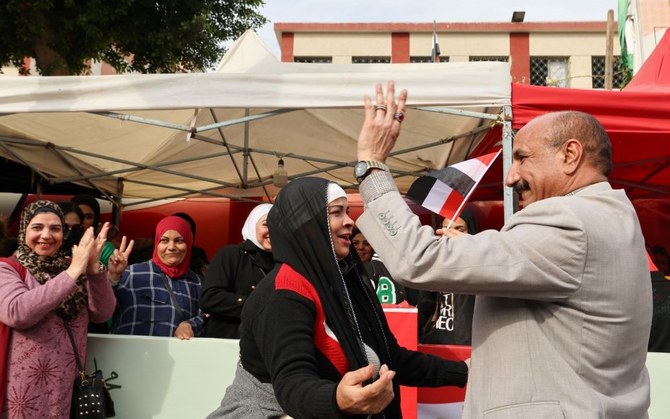
Supporters of presidential candidate and Egyptian President Abdel Fattah El-Sisi dance next to a polling station on the first day of the presidential election in Cairo, Egypt, Dec. 10, 2023. (Reuters)
Short Url
Updated 11 December 2023
Follow

Strong voter turnout on 2nd day of Egypt presidential election

  • Queues started forming on Monday at some polling stations in Cairo and elsewhere in the country long before they opened at 9 a.m.
  • Polls close at 9 p.m. on Tuesday, with the election results due to be announced on Dec. 18

CAIRO: Egyptian voters turned out in force on the second and penultimate day of a presidential election in which President Abdel Fattah El-Sisi was expected to sweep to a third, six-year term in office.

Queues started forming on Monday at some polling stations in Cairo and elsewhere in the country long before they opened at 9 a.m.

El-Sisi is competing against three other candidates: Abdel-Sanad Yamama, the head of Wafd, Egypt’s oldest party, Hazem Omar, leader of the Republican People’s Party, and Farid Zahran, of the Social Democratic Party.

In the coastal city of Alexandria, El-Sisi’s electoral campaign officials reported a strong turnout at ballot boxes, and voting centers were said to be particularly busy in central Cairo and the southwestern New Valley Governorate.

Moushira Khattab, president of Egypt’s National Council for Human Rights, said: “We are reassured about the conduct of the presidential elections.” She added that the council had so far not received any complaints relating to election conduct.

National Elections Authority officials said that voting operations were proceeding in a disciplined and smooth manner, adding that voter turnout on Sunday had also been brisk.

Polls close at 9 p.m. on Tuesday, with the election results due to be announced on Dec. 18.

Passant Tarek, a 27-year-old dentist who cast her vote in Suez, said: “Voting is our duty, and it is the least we can do for the country, especially during these critical times and with the developments happening around the world.”


Algeria inaugurates strategic railway to giant Sahara mine

President Tebboune attended an inauguration ceremony in Bechar. (AFP file photo)
Updated 02 February 2026
Follow

Algeria inaugurates strategic railway to giant Sahara mine

  • The mine is expected to produce 4 million tons per year during the initial phase, with production projected to triple to 12 million tons per year by 2030
  • The project is financed by the Algerian state and partly built by a Chinese consortium

ALGEIRS: Algerian President Abdelmadjid Tebboune on Sunday inaugurated a nearly 1,000-kilometer (621-mile) desert railway to transport iron ore from a giant mine, a project he called one of the biggest in the country’s history.
The line will bring iron ore from the Gara Djebilet deposit in the south to the city of Bechar located 950 kilometers north, to be taken to a steel production plant near Oran further north.
The project is financed by the Algerian state and partly built by a Chinese consortium.
During the inauguration, Tebboune described it as “one of the largest strategic projects in the history of independent Algeria.”
This project aims to increase Algeria’s iron ore extraction capacity, as the country aspires to become one of Africa’s leading steel producers.
The iron ore deposit is also seen as a key driver of Algeria’s economic diversification as it seeks to reduce its reliance on hydrocarbons, according to experts.
President Tebboune attended an inauguration ceremony in Bechar, welcoming the first passenger train from Tindouf in southern Algeria and sending toward the north a first charge of iron ore, according to footage broadcast on national television.
The mine is expected to produce 4 million tons per year during the initial phase, with production projected to triple to 12 million tons per year by 2030, according to estimates by the state-owned Feraal Group, which manages the site.
It is then expected to reach 50 million tons per year in the long term, it said.
The start of operations at the mine will allow Algeria to drastically reduce its iron ore imports and save $1.2 billion per year, according to Algerian media.