

Pakistan commerce minister on high-level China visit to improve balance of trade

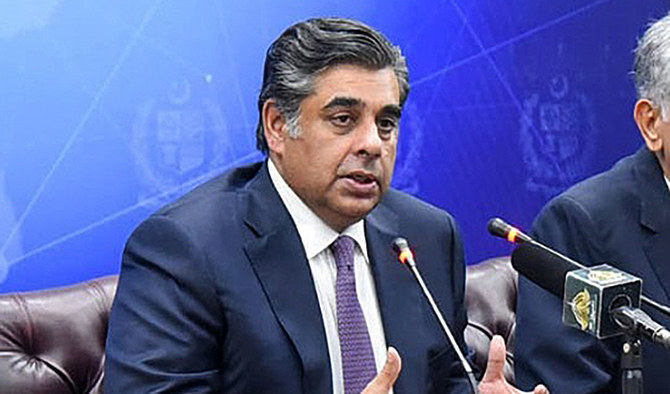
In this file photo, taken on September 8, 2023, Pakistan’s interim commerce minister Dr. Gohar Ejaz speaks during a joint press conference. (APP/File)
Short Url
Updated 11 December 2023
Follow

Pakistan commerce minister on high-level China visit to improve balance of trade

  • In 2022, Pakistan’s exports to China were recorded at US$2.53 billion, with agricultural exports catching the pace
  • China’s exports to Pakistan stood at $23.09 billion during 2022, according to UN’s COMTRADE database

KARACHI: Pakistani Minister of Commerce Dr. Gohar Ejaz is leading a high-level delegation to China to discuss economic ties, with a focus on improving the balance of trade between the two nations.

China is a major ally and investor, particularly in the China Pakistan Economic Corridor, a flagship project under China’s Belt and Road Initiative with more than $65 billion pledged for road, rail, agricultural and other infrastructure developments.

China is Pakistan’s largest trading partner and biggest source of foreign direct investment. In 2022, Pakistan’s exports to China were recorded at US$2.53 billion while China’s exports to Pakistan stood at $23.09 billion, according to the United Nations COMTRADE database.

“The delegation, led by Minister Dr. Gohar Ejaz, is engaged in discussions with Chinese counterparts aimed at improving the Sino-Pak trade relations and identifying avenues for collaborative ventures,” the minister’s office said in a statement.

“With a focus on improving the trade balance with China as part of the Minister’s vision to upon the momentum generated during Prime Minister [Anwaar-ul-Haq] Kakar’s visit, the delegation is actively exploring opportunities to enhance economic cooperation.”

On Monday, Ejaz met with Zhang Xinmin, Chairman of the China Chamber of Commerce for Import and Export of Textiles (CCCT), “to bolster textile trade between Pakistan and China, with a particular emphasis on addressing trade imbalances.”

Discussions included strategies for accessing new markets in China to promote Pakistani exports and facilitate smoother trade transactions.

The Pakistani minister also met with Luan Richeng, President of the COFCO Group, a key player in China’s food processing sector. 

“This meeting forms a pivotal part of Pakistan’s strategy to augment non-textile exports, leveraging the strength of COFCO Group’s position as China’s largest food processor, manufacturer, and trader,” Pakistan’s commerce ministry said. 

The delegation also held a series of business-to-business (B2B) meetings, providing a platform for Pakistani and Chinese businessmen to engage in discussions to fortify trade relations.


Pakistan reports current account surplus in Jan. owing to improved trade, remittances

Updated 17 February 2026
Follow

Pakistan reports current account surplus in Jan. owing to improved trade, remittances

  • Pakistan’s exports crossed the $3 billion mark in Jan. as the country received $3.5 billion in remittances
  • Last month, IMF urged Pakistan to accelerate pace of structural reforms to strengthen economic growth

ISLAMABAD: Pakistan recorded a current account surplus of more than $120 million in January, the country’s finance adviser said on Tuesday, attributing it to improved trade balance and remittance inflows.

Pakistan’s exports rebounded in January 2026 after five months of weak performance, rising 3.73 percent year on year and surging 34.96 percent month on month, according to data released by the country’s statistics bureau.

Exports crossed the $3 billion mark for the first time in January to reach $3.061 billion, compared to $2.27 billion in Dec. 2025. The country received $3.5 billion in foreign remittances in Jan. 2026.

Khurram Schehzad, an adviser to the finance minister, said Pakistan reported a current account surplus of $121 million in Jan., compared to a current account deficit of $393 million in the same month last year.

“Improved trade balance in January 2026, strong remittance inflows, and sustained momentum in services exports (IT/Tech) continue to reinforce the country’s external account position,” he said on X.

Pakistan has undergone a difficult period of stabilization, marked by inflation, currency depreciation and financing gaps, and international rating agencies have acknowledged improvements after Islamabad began implementing reforms such as privatizing loss-making, state-owned enterprises (SOEs) and ending subsidies as part of a $7 billion International Monetary Fund (IMF) loan program.

Late last month, the IMF urged Pakistan to accelerate the pace of these structural reforms to strengthen economic growth.

Responding to questions from Arab News at a virtual media roundtable on emerging markets’ resilience, IMF’s director of the Middle East and Central Asia Jihad Azour said Islamabad’s implementation of the IMF requirements had been “strong” despite devastating floods that killed more than 1,000 people and devastated farmland, forcing the government to revise its 4.2 percent growth target to 3.9 percent.

“What is important going forward in order to strengthen growth and to maintain the level of macroeconomic stability is to accelerate the structural reforms,” he said at the meeting.

Azour underlined Pakistan’s plans to privatize some of the SOEs and improve financial management of important public entities, particularly power companies, as an important way for the country to boost its capacity to cater to the economy for additional exports.

“This comes in addition to the effort that the authorities have made in order to reform their tariffs, which will allow the private sector of Pakistan to become more competitive,” the IMF official said.