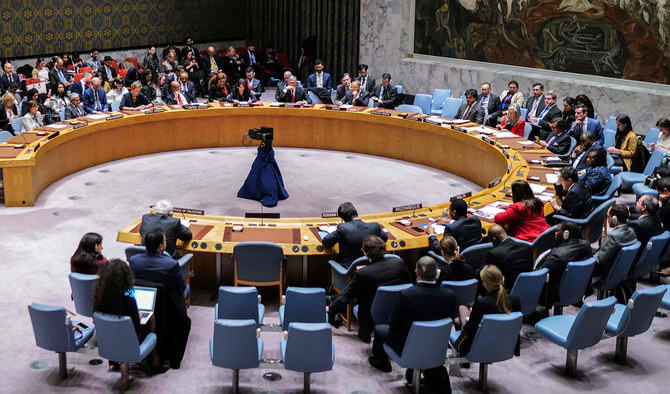
ISLAMABAD: Pakistan said on Saturday it was “deeply disappointed” by the United Nations Security Council’s failure to seek an end to Israeli airstrikes and ground offensive against the residents of Gaza amid a massive loss of human life in its latest session in New York.
The session was convened a day earlier after UN Secretary-General Antonio Guterres invoked a rarely exercised power under Article 99 of the UN Charter, urging the Security Council to respond to the situation in the Palestinian enclave where over 17,000 people have been killed in two months.
The war began on October 7 after a surprise attack on Israel by Hamas led to nearly 1,200 casualties, with the group describing its action as a response to the deteriorating Palestinian condition under Israeli occupation.
The international community widely viewed Israel’s response as disproportionate since it resulted in the destruction of hospitals and residential neighborhoods and the killings of significant number of civilians, including women and children.
As the Security Council convened its special meeting to address the issue, the United States vetoed a resolution demanding an immediate cease-fire in the Palestinian territory.
“Pakistan is deeply disappointed that the UN Security Council has once again failed to call for a cease-fire in Gaza, even in the face of a human tragedy of epic proportions taking place there,” the foreign office said in a statement released in Islamabad. “Despite the invocation of Article-99 of the UN Charter by the Secretary-General and his warnings of humanitarian catastrophe in Gaza, the Council has failed to perform its primary responsibility to maintain international peace and security.”
The foreign office described the “collective punishment” endured by the besieged people of Gaza as unprecedented and unacceptable.
“Continuation of Israel’s campaign in occupied Palestine will prolong human suffering, with massive civilian casualties and forced displacement of millions of people,” it added. “It could also trigger a wider and more dangerous conflict. A heavy responsibility rests on all who have contributed to the prolongation of uninterrupted bombing of the people of Gaza.”
The official Pakistani statement emphasized the need for an immediate and unconditional cease-fire, adding: “We urge the UN Security Council to act now, end this inhuman war and protect the people of Gaza from genocide.”
Palestinian President Mahmud Abbas also maintained earlier today that the United States was “responsible for the bloodshed” of children in the Gaza Strip.
A statement issued by the Palestinian Authority said: “The president has described the American position as aggressive and immoral, a flagrant violation of all humanitarian principles and values, and holds the United States responsible for the bloodshed of Palestinian children, women and elderly people in the Gaza Strip.”


Pakistan decries Security Council’s inability to demand Gaza cease-fire amid mounting Palestinian casualties
https://arab.news/mjtq8
Pakistan decries Security Council’s inability to demand Gaza cease-fire amid mounting Palestinian casualties

- Over 17,000 Palestinians have been killed by Israeli forces since the beginning of the war on October 7
- Pakistan asks the United Nations to ‘end this inhuman war and protect the people of Gaza from genocide’

Sindh assembly passes resolution rejecting move to separate Karachi
- Chief Minister Shah cites constitutional safeguards against altering provincial boundaries
- Calls to separate Karachi intensified amid governance concerns after a mall fire last month
ISLAMABAD: The provincial assembly of Pakistan’s southern Sindh province on Saturday passed a resolution rejecting any move to separate Karachi, declaring its territorial integrity “non-negotiable” amid political calls to carve the city out as a separate administrative unit.
The resolution comes after fresh demands by the Muttahida Qaumi Movement (MQM) and other voices to grant Karachi provincial or federal status following governance challenges highlighted by the deadly Gul Plaza fire earlier this year that killed 80 people.
Karachi, Pakistan’s largest and most densely populated city, is the country’s main commercial hub and contributes a significant share to the national economy.
Chief Minister Syed Murad Ali Shah tabled the resolution in the assembly, condemning what he described as “divisive statements” about breaking up Sindh or detaching Karachi.
“The province that played a foundational role in the creation of Pakistan cannot allow the fragmentation of its own historic homeland,” Shah told lawmakers, adding that any attempt to divide Sindh or separate Karachi was contrary to the constitution and democratic norms.
Citing Article 239 of Pakistan’s 1973 Constitution, which requires the consent of not less than two-thirds of a provincial assembly to alter provincial boundaries, Shah said any such move could not proceed without the assembly’s approval.
“If any such move is attempted, it is this Assembly — by a two-thirds majority — that will decide,” he said.
The resolution reaffirmed that Karachi would “forever remain” an integral part of Sindh and directed the provincial government to forward the motion to the president, prime minister and parliamentary leadership for record.
Shah said the resolution was not aimed at anyone but referred to the shifting stance of MQM in the debate while warning that opposing the resolution would amount to supporting the division of Sindh.
The party has been a major political force in Karachi with a significant vote bank in the city and has frequently criticized Shah’s provincial administration over its governance of Pakistan’s largest metropolis.
Taha Ahmed Khan, a senior MQM leader, acknowledged that his party had “presented its demand openly on television channels with clear and logical arguments” to separate Karachi from Sindh.
“It is a purely constitutional debate,” he told Arab News by phone. “We are aware that the Pakistan Peoples Party, which rules the province, holds a two-thirds majority and that a new province cannot be created at this stage. But that does not mean new provinces can never be formed.”
Calls to alter Karachi’s status have periodically surfaced amid longstanding complaints over governance, infrastructure and administrative control in the megacity, though no formal proposal to redraw provincial boundaries has been introduced at the federal level.


