

Nicolas Cage shares career insights and teases ‘Dream Scenario’ at RSIFF

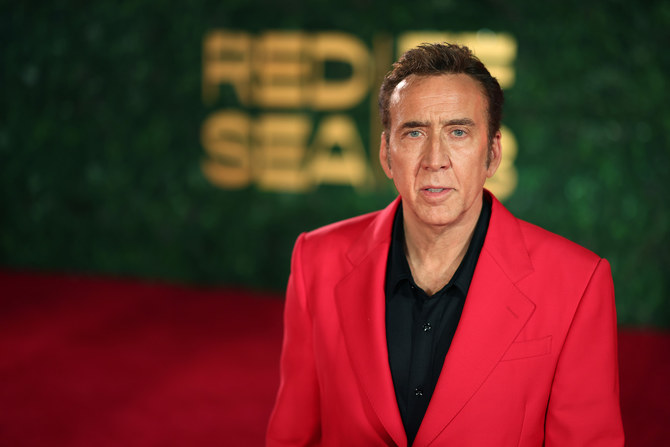
The event saw Cage start off by sharing the story of his name change from Nicolas Coppola to Nicolas Cage at the beginning of his career. (Getty Images)
Short Url
Updated 10 January 2024
Follow

Nicolas Cage shares career insights and teases ‘Dream Scenario’ at RSIFF

JEDDAH: During an “In Conversation” panel at Jeddah’s Red Sea International Film Festival, Oscar-winning actor Nicolas Cage captivated the audience in an hour-long discussion on his notable performances, ahead of the premiere of his latest film “Dream Scenario,” A24’s dark comedy about a man who begins spontaneously appearing in strangers’ dreams worldwide. Cage called it one of the five best scripts he’s read in his 45-year career, a career he said may be coming to a close.

“I said I have to make this movie. I didn’t want to change a word. And I thought it was a very interesting analysis on the subject of fame itself,” said Cage in a separate interview with Arab News over Zoom.

Moderated by Lebanese presenter Raya Abirached, the event at RSIFF saw Cage start off by sharing the story of his name change from Nicolas Coppola to Nicolas Cage at the beginning of his career.

He recounted instances of on-set bullying during the filming of “Fast Times at Ridgemont High,” where his talent was called into doubt due to his relation to renowned filmmaker Francis Ford Coppola.

Cage disclosed: “They would quote lines from ‘Apocalypse Now’ and change them to ‘I love the smell of Nicolas in the mornings’ instead of ‘napalm in the morning.’”

He acknowledged how directors and filmmakers might not want the name Coppola associated with their work, which led him to change his name. Cage explained: “I didn’t think any filmmaker in their own right would want the name Coppola above the title of their movie. So, I changed my name predominantly for business reasons.”

Reflecting on his role in the 1987 comedy film “Moonstruck” alongside Cher, Cage shared an amusing conversation in which he asked the singer why she wanted him in the movie. Cage recalled her response: “‘I saw you in ‘Peggy Sue Got Married’ and thought it was like a two-hour car accident, and I had to have you.’”

Cage evaluated his past works with enthusiasm, naming “Vampire’s Kiss,” “Leaving Las Vegas,” “Raising Arizona,” “Adaptation,” and the highly anticipated A24 production “Dream Scenario” as the five scripts he considers to be the pinnacle of his 45-year journey in the industry.

Providing a glimpse into his future endeavors, Cage unveiled details about his upcoming film “Dream Scenario,” where he will portray an ordinary man who mysteriously starts appearing in the dreams of others.

Cage also expressed his interest in exploring television and said: “I’m thinking about television. My son turned me on to ‘Breaking Bad,’ and I saw Bryan Cranston stare at a suitcase for one hour. I never get time to stare at a suitcase for an hour. I said, ‘Let’s do some TV.’”

He revealed his intention to transition to television while maintaining a selective approach to film projects, citing his desire to spend more time with his 15-month-old daughter as a motivating factor.

Cage also discussed the impact of winning the Academy Award for Best Actor for his performance in Mike Figgis’ “Leaving Las Vegas” in 1995. He credited the award for providing him with creative freedom and the opportunity to pursue his artistic vision. Cage joked that the award gave him a “tenure” to make movies, allowing him to work with directors while still retaining creative control.

During the conversation, Cage revealed a fascinating tidbit about almost starring in a “Superman” film directed by Tim Burton.

However, this exciting project was ultimately shelved due to the apprehension of studio executives. Cage explained: “Tim was riding high after the success of ‘Mars Attacks!’ Initially, they considered Renny Harlin to direct, but I knew that playing such an iconic role required hitting the bull’s eye. We came incredibly close, but the studio made the decision to cancel the entire production. I believe they were concerned about the potential cost and whether they would recoup their investment.”


Cairo book fair breaks visitor records

Updated 03 February 2026
Follow

Cairo book fair breaks visitor records

  • Strong Saudi participation underscores KSA’s prominent role in Arab cultural landscape
  • Egyptian writer Naguib Mahfouz, who was awarded the Nobel Prize in Literature in 1988, was selected as the fair’s featured personality

CAIRO: The 57th edition of the Cairo International Book Fair has attracted record public attendance, with the number of visits reaching nearly 6 million, up from a reported 5.5 million previously.

Egypt’s Minister of Culture Ahmed Fouad Hanou said: “This strong turnout reflects the public’s eagerness across all age groups to engage with the exhibition’s diverse cultural and intellectual offerings.”

Hanou said the event included “literary and intellectual activities, meetings with thinkers and creative figures, and thousands of titles spanning various fields of knowledge.”

The Egyptian writer Naguib Mahfouz, who was awarded the Nobel Prize in Literature in 1988, was selected as the fair’s featured personality, coinciding with the 20th anniversary of his death.

The exhibition’s official poster features a famous quote by Mahfouz: “Who stops reading for an hour falls centuries behind.”

A total of 1,457 publishing houses from 83 countries participated in the fair. Mahfouz’s novels occupied a special place, as Egypt’s Diwan Library showcased the author’s complete works, about 54 books.

“The pavilion of the Egyptian National Library and Archives witnessed exceptionally high attendance throughout the fair, showcasing a collection of rare and significant books.

Among the highlights was the book “Mosques of Egypt” in Arabic and English, Dr. Sherif Saleh, head of financial and administrative affairs at the Egyptian National Library and Archives, told Arab News.

The fair ended on Tuesday with a closing ceremony that featured a cultural performance titled “Here is Cairo.”

The event included the announcement of the winners of the fair’s awards, as well as the recipient of the Naguib Mahfouz Award for Arabic Fiction.

Organizers described this year’s edition as having a celebratory and cultural character, bringing together literature, art, and cinema.

Romania was the guest of honor this year, coinciding with the 120th anniversary of Egyptian-Romanian relations.

At the Saudi pavilion, visitors were welcomed with traditional coffee. It showcased diverse aspects of Saudi culture, offering a rich experience of the Kingdom’s heritage and creativity.

There was significant participation from Saudi Arabia at the event, highlighting the Kingdom’s prominent role in the Arab cultural arena.

Saudi Arabia’s participation aimed to showcase its literary and intellectual output, in alignment with the objectives of Vision 2030.

The Kingdom’s delegation was led by Saudi Arabia’s Ambassador to Egypt Saleh bin Eid Al-Hussaini. Also in attendance were Dr. Abdul Latif Abdulaziz Al-Wasel, CEO of the Literature, Publishing and Translation Commission, and Dr. Hilah Al-Khalaf, the commission’s director-general.

The King Abdulaziz Public Library placed the Encyclopedia of Saudi Arabia in a prominent position at the pavilion. The encyclopedia, consisting of 20 volumes, is organized according to the Kingdom’s culturally diverse regions.

Founded in 1980 by King Abdullah, the library was established to facilitate access to knowledge and preserve heritage collections. Over the years, it has grown into one of the Kingdom’s most important cultural institutions.

Internationally, the library has strengthened ties between Saudi Arabia and China, including the opening of a branch at Peking University and receiving the Crown Prince Mohammed bin Salman Award for Cultural Cooperation between the two nations.

Regionally, the library has played a pivotal role in the Arab world through the creation of the Unified Arabic Cataloging Project, one of the most important initiatives contributing to knowledge accessibility and alignment with global standards.