

Pakistan’s central bank releases ‘regulatory sandbox’ guidelines, seeks input for FinTech growth

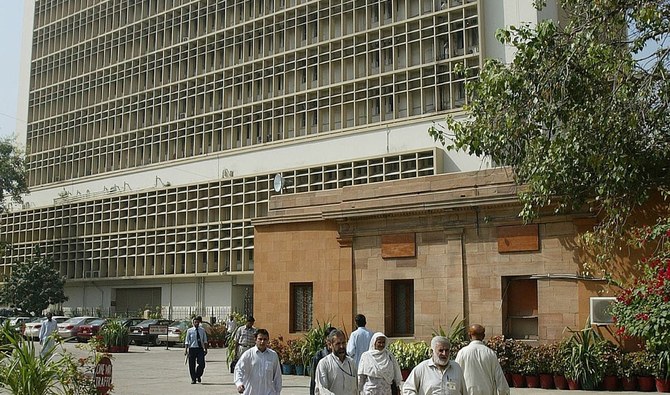
An undated file photo shows a general view of the State Bank of Pakistan's building in Karachi. (Photo courtesy: social media)
Short Url
Updated 08 December 2023
Follow

Pakistan’s central bank releases ‘regulatory sandbox’ guidelines, seeks input for FinTech growth

  • The emergence of high-tech companies for efficient service delivery has posed regulatory challenges for Pakistan
  • The regulatory sandbox approach has also been adopted by other countries to develop final set of rules for startups

ISLAMABAD: The State Bank of Pakistan (SBP) adopted a collaborative approach to developing a regulatory framework for startups and FinTech companies by issuing preliminary guidelines on Friday with an aim to test them against innovative products and business models before adopting the final set of rules.

The SBP’s “regulatory sandbox” approach is designed to provide a controlled environment for innovators to test their products and technologies, making it easier for the regulator to understand their implications for financial stability and consumer protection.

“State Bank of Pakistan has issued draft guidelines on regulatory sandbox for public consultation,” it said in a brief statement.

The SBP added this would allow the regulated entities, such as startups and FinTech firms, to participate in the process of testing new products and their preferred business models within the provided legal framework.

“As envisioned in SBP Vision 2028, the regulatory sandbox will encourage innovation in digital financial services and facilitate the existing and new market participants to build robust digital payments ecosystem in Pakistan,” the central bank explained in its statement.

“Similarly, it will help SBP to issue instructions and regulations for new and innovative FinTech solutions, ultimately resulting in increased financial and digital inclusion in the country,” it added.

The SBP said its initiative would strengthen its engagement with stakeholders in shaping the future of the country’s financial industry.

It invited banks, FinTech firms, industry experts, public and all interested parties to participate in the consultation process.

Pakistani startups, especially in fintech, e-commerce and logistics, have been attracting considerable investment from both domestic sources and international venture capital firms.

This burgeoning ecosystem, fueled by significant government support and a surge in digital adoption among a young, tech-savvy population, is said to be positioning the country as an emerging hub for technological innovation and entrepreneurship.

As the country increasingly depends on high-tech companies for efficient service delivery, it has been encountering various regulatory challenges.

The regulatory sandboxes approach has also been adopted by other countries, including the United Kingdom, Singapore, Australia and Canada etc., among many others.

Each country’s sandbox is tailored to its specific regulatory environment and financial sector needs, though the core idea is to provide a space where new and potentially disruptive financial technologies can be tested safely and without immediately incurring the full burden of financial regulation.


Security forces kill 11 militants in separate operations in Pakistan’s northwest

Updated 10 January 2026
Follow

Security forces kill 11 militants in separate operations in Pakistan’s northwest

  • Pakistan has struggled to contain a surge in militancy in northwestern Khyber Pakhtunkhwa province that borders Afghanistan
  • Militant groups such as the Pakistani Taliban frequently target convoys of security forces, police and government officials

ISLAMABAD: Security forces gunned down 11 Pakistani Taliban militants in separate operations in the country’s northwestern Khyber Pakhtunkhwa (KP) province, the Pakistani military said on Saturday, amid a surge in militancy in the South Asian country.

The first intelligence-based operation was conducted in North Waziristan district, which borders Afghanistan, during which six militants were killed, according to the Inter-Services Public Relations (ISPR), the military’s media wing.

Another joint intelligence-based operation by police and security forces was conducted in the Kurram district, which led to the killing of five other Pakistani Taliban militants in a fire exchange.

“Weapons and ammunition were also recovered from killed Indian-sponsored khwarij (militants), who remained actively involved in numerous terrorist activities,” the ISPR said in a statement.

“Sanitization operations are being conducted to eliminate any other Indian-sponsored kharja (militant) found in the area.”

There was no immediate comment by New Delhi to the Pakistani military statement.

Pakistan has struggled to contain a surge in militancy in KP in recent years. Militant groups such as the Pakistani Taliban, or the Tehreek-e-Taliban Pakistan (TTP), have frequently targeted convoys of security forces, police stations and check-posts besides kidnapping government officials in the region.

Last year, the South Asian country saw 73 percent increase in combat-related deaths, with both security forces and militants suffering casualties in large numbers.

As per statistics released by the Pakistan Institute for Conflict and Security Studies (PICSS), combat-related deaths in 2025 rose 73 percent to 3,387, compared with 1,950 in 2024. These deaths included 2,115 militants, 664 security forces personnel, 580 civilians and 28 members of pro-government peace committees (combatants), the think tank said in a press release.

Islamabad has frequently accused Afghanistan of allowing its soil and India of backing militant groups, including the TTP, for attacks against Pakistan. Kabul and New Delhi have consistently denied this.