

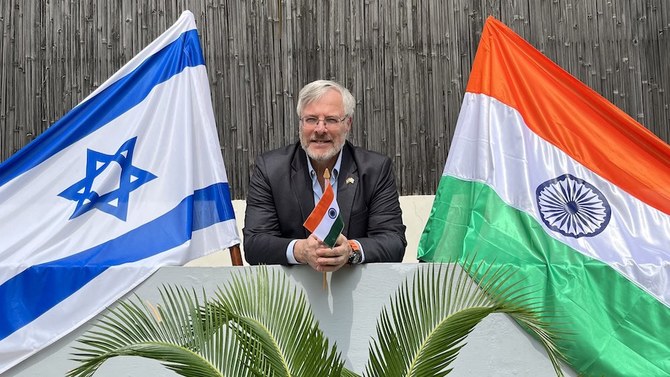

NEW DELHI: Indian scholars are warning against Israeli interference in academic freedom on their campuses after one university canceled a lecture on Palestinian history following a complaint by Tel Aviv’s envoy.
Naor Gilon, the Israeli ambassador in New Delhi, has regularly hosted briefings for journalists and made public statements attacking academics and media outlets critical of Israel’s deadly bombardment of Gaza.
When Achin Vanaik, a retired professor of international relations and global politics from the University of Delhi, presented his lecture on the history of conflict in Palestine at O.P. Jindal Global University last month, Gilon wrote to the institution’s vice chancellor expressing his “concern and extreme disappointment” over “an event delegitimizing the state of Israel.”
The controversy spurred by the letter resulted in the cancellation of Vanaik’s planned lecture at the Indian Institute of Technology Bombay and sent a shockwave among academics, leading to 470 of them to issue a joint statement last week objecting to the “Israeli ambassador’s interference with academic freedom on Indian campuses,” which “disrespects the competence of Indian scholars to analyze historical and political situations for themselves.”
Prof. Apoorvanand Jha from the Faculty of Arts of the University of Delhi told Arab News that the Israeli ambassador has crossed “all the limits,” and not for the first time.
“He has been issuing threatening letters, which in fact scared the university vice chancellor. But it’s a clear violation of the norms diplomats follow worldwide. They don’t comment on internal matters, they never do that,” Jha said.
“It’s a clear interference in the internal life of India; no diplomat does it. We criticize America, we criticize other countries, we hold seminars criticizing US imperialism and the US warmongering, and at no point of time has the US ambassador ever tried to interfere.”
Last month, Gilon drew criticism from journalists after he publicly attacked Frontline — one of the country’s most prominent magazines, which has been critical of Israeli attacks on Palestinians.
But the ambassador’s interventions to silence academic debate are seen as going over the limit of what is tolerable.
“This does not come under the brief for diplomats. He has crossed all the borderlines of diplomacy,” said Nadeem Khan, co-founder of the India-Palestine Friendship Forum.
“He is behaving as if he is the boss of India. How can an ambassador dictate an Indian magazine? It is just beyond imagination. Not only that, he is also interfering in debates on campuses.”
For Pamela Philipose, fellow at the Indian Council of Social Science Research, the Israeli envoy’s efforts were attempts to control the narrative in a “provocative and proactive” way.
“It actually raises hackles; it shows arrogance and impunity of a very high order. He really surpasses his diplomatic brief and, yes, he has crossed the red line,” she said.
“University is a place for the discussion of ideas. How can an ambassador sitting outside of the university have the power to actually decide what gets discussed in that university?”
On campuses, academics have the right to base discussions on their own research and understanding of the situation, Prof. Nandini Sundar, sociologist at the Delhi School of Economics, told Arab News.
“We are free to think what we want about the Palestine and Israel issue,” she said.
“We don’t need the Israeli ambassador telling academics ‘this is not acceptable and that is not acceptable.’ We have academic freedom on our campuses to study a subject the way we want.”
In response to questions by Arab News about the Israeli ambassador’s conduct and criticism from India’s academic circles, Arindam Bagchi, spokesperson of the Ministry of External Affairs, said he was "not aware."


