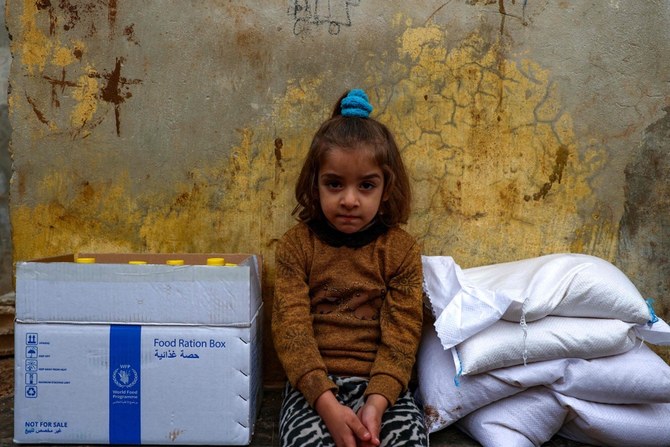
ATME, Syria: Displaced people in camps in northeast Syria have expressed fears about their future after the World Food Programme announced the end of food assistance across the war-torn country.
“Stopping aid to the camps will exponentially increase suffering,” said Ali Farahat, the director of the Maram camp for the displaced in the town of Atme near the border with Turkiye.
“Some have told me ‘if aid stops, we will die of hunger’,” he told AFP on Wednesday.
In a statement issued on Monday, the WFP said it “regrets to announce the end of its general food assistance across Syria in January 2024 due to lack of funding.”
The United Nations’ food aid agency said it would “continue supporting families affected by emergency situations and natural disasters across the country through smaller and more targeted emergency response interventions.”
It told AFP the “decision is based on funding, which is a global issue that WFP faces.”
In September, the WFP had warned that insufficient funds had forced it to reduce assistance in various parts of the world, pushing an estimated 24 million people to the brink of famine.
In July, 45 percent of aid recipients in Syria were cut from assistance, it said.
“WFP’s activities by nature are fully scalable meaning they can be reduced or increased based on needs and available resources,” the agency told AFP.
Around three million people live in areas controlled by the Hayat Tahrir Al-Sham (HTS) militant group in Idlib province.
Roughly half live in camps for the displaced, while others reside in abandoned buildings or caves, or even in old buildings and rusty buses.
Camps for the displaced are often overcrowded and lack basic needs, with residents depending principally on food, medical and other aid provided by international organizations.
Residents of those camps in northeastern Syria, including Maram in Atme, are likely to be the hardest hit by the WFP decision.
Maram’s residents could be seen queuing up to receive some of the last of their aid rations of the year.
“Stopping assistance will lead to the death of those who subsisted on them because they don’t have money to buy food,” said Ahmed Adla, 40, who was displaced 11 years ago from the village of Kurin in Idlib’s countryside.
Khaled Al-Masri, 45, displaced nearly 13 years ago from the nearby village of Hass along with 11 family members, said: “I hope they come to see our conditions and how we spend the winter. We can’t keep our children warm.”


As aid runs out, Syria’s displaced fear dying of hunger
https://arab.news/j5sks
As aid runs out, Syria’s displaced fear dying of hunger

- The WFP said it “regrets to announce the end of its general food assistance across Syria in January 2024 due to lack of funding.”


Algeria inaugurates strategic railway to giant Sahara mine
- The mine is expected to produce 4 million tons per year during the initial phase, with production projected to triple to 12 million tons per year by 2030
- The project is financed by the Algerian state and partly built by a Chinese consortium
ALGEIRS: Algerian President Abdelmadjid Tebboune on Sunday inaugurated a nearly 1,000-kilometer (621-mile) desert railway to transport iron ore from a giant mine, a project he called one of the biggest in the country’s history.
The line will bring iron ore from the Gara Djebilet deposit in the south to the city of Bechar located 950 kilometers north, to be taken to a steel production plant near Oran further north.
The project is financed by the Algerian state and partly built by a Chinese consortium.
During the inauguration, Tebboune described it as “one of the largest strategic projects in the history of independent Algeria.”
This project aims to increase Algeria’s iron ore extraction capacity, as the country aspires to become one of Africa’s leading steel producers.
The iron ore deposit is also seen as a key driver of Algeria’s economic diversification as it seeks to reduce its reliance on hydrocarbons, according to experts.
President Tebboune attended an inauguration ceremony in Bechar, welcoming the first passenger train from Tindouf in southern Algeria and sending toward the north a first charge of iron ore, according to footage broadcast on national television.
The mine is expected to produce 4 million tons per year during the initial phase, with production projected to triple to 12 million tons per year by 2030, according to estimates by the state-owned Feraal Group, which manages the site.
It is then expected to reach 50 million tons per year in the long term, it said.
The start of operations at the mine will allow Algeria to drastically reduce its iron ore imports and save $1.2 billion per year, according to Algerian media.


