

Pakistan government says no ‘second thoughts’ on holding general elections on Feb. 8

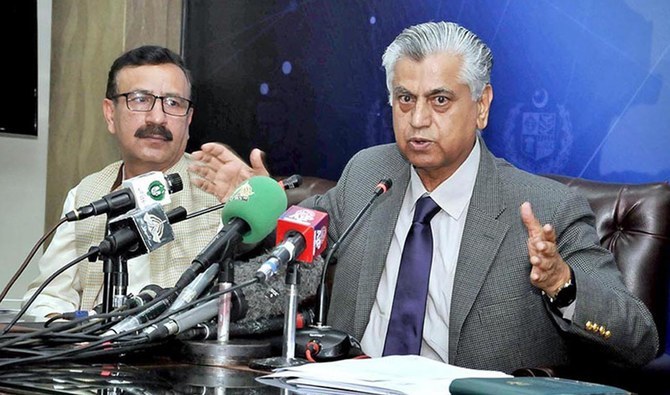
Pakistan Caretaker Minister for Information and Broadcasting Murtaza Solangi speaks with media on September 1, 2023. (APP/File)
Short Url
Updated 07 December 2023
Follow

Pakistan government says no ‘second thoughts’ on holding general elections on Feb. 8

  • Information Minister Murtaza Solangi says Pakistan conducted elections in 2008, 2013 despite severe security issues
  • His statement follows speculation in local media about national elections being delayed beyond February 8

ISLAMABAD: Caretaker Information Minister Murtaza Solangi said on Wednesday that the federal cabinet did not have any “second thoughts” about holding polls in Pakistan on Feb. 8, categorically rejecting speculation that elections would be delayed due to security or weather concerns. 

Elections were originally expected to take place in November after Pakistan’s national and two provincial assemblies were dissolved in August before reaching the end of their tenure. However, Pakistan’s election regulator decided to redraw hundreds of national and provincial constituencies based on a digital census carried out in April before arranging the electoral contest. 

The Election Commission of Pakistan’s (ECP) officials later scheduled the voting process for the last week of January, before announcing Feb. 8 as the final date after consultations with the country’s President Dr. Arif Alvi on the Supreme Court’s instructions.

Given Pakistan’s uncertain political environment, however, local media outlets have continued to speculate about the possibility of elections being delayed beyond Feb. 8. 

“The thing is, problems of security and the weather will always remain,” Solangi told a private news channel. “But in the federal cabinet, there is no doubt, neither is there any worry nor any second thoughts that we would not hold elections on Feb. 8.”

Pakistan has seen a surge in militant attacks across the country’s western regions bordering Afghanistan ever since a fragile truce between Islamabad and the Pakistani Taliban broke down in November 2022. 

Prominent religious party, the Jamiat Ulama-e-Islam Pakistan (JUI-F) urged the ECP last month to delay polls till the security situation in the country improves and the cold in Pakistan’s northern areas dissipates. 

Solangi said Pakistan had held elections in the past despite the threat of militancy when the security situation was far worse. 

“Maybe our memories are a bit weak,” he said. “What was the security situation in 2008 and 2013? If we compare it [to now] then it is nothing. 

Yes, I can’t say what the circumstances will be in the future but right now, the situation has not worsened to the point that we experience any difficulty in holding elections.

Pakistan’s media regulator also issued a directive earlier this week for satellite television channels, warning them that airing speculative news about a delay in elections would be deemed a violation of its laws. 


Pakistan eyes ‘heavy’ Chinese investments in 10 key sectors at Islamabad agriculture summit

Updated 4 sec ago
Follow

Pakistan eyes ‘heavy’ Chinese investments in 10 key sectors at Islamabad agriculture summit

  • More than 300 Chinese and Pakistani firms attended the event focusing on fertilizers, seeds, smart farming and irrigation techniques
  • Islamabad expects the conference to lead to investments in agriculture, food processing, livestock, farm machinery and renewable energy

KARACHI: Pakistan is expecting “heavy” Chinese investments across 10 key sectors, including agriculture, renewable energy and technology, the Pakistani food security minister said on Monday, as officials and business leaders from both countries gathered for a major agriculture investment summit in Islamabad.
The Pakistan-China Agriculture Investment Conference was billed by Pakistan as a platform for deepening bilateral agricultural ties and supporting broader economic engagement between the two countries.
Around 120 Chinese companies and over 190 Pakistani firms participated in the event that focused on fertilizers, seed varieties, machinery, precision farming and smart irrigation systems, according to the organizers.
Speaking at the event, National Food Security Minister Rana Tanveer Hussain said the conference’s objective was to project Pakistan as a place where Chinese enterprises could grow, innovate and succeed alongside Pakistani partners.
“Heavy investments worth millions of dollars are expected, with multiple MoUs [memorandums of understanding] likely to be finalized by the end of the day across 10 key sectors, including agriculture, food processing, livestock, fisheries, agri-inputs, farm machinery, renewable energy, logistics, technology and value-added exports,” Hussain said on Monday evening.
Pakistan’s exports to China reached approximately $2.38 billion in Fiscal Year 2024–25 that ended in June, while imports stood at $16.3 billion, reflecting growing demand on both sides despite global economic headwinds, according to the minister.
This performance demonstrated resilience and expanding opportunities under the China–Pakistan Free Trade Agreement (CPFTA) framework.
Hussain said Islamabad was committed to supporting Chinese investors from regulatory processes to seamless coordination with all government departments and institutions.
“Together, Pakistan and China can push the boundaries of innovation, transform agri-technology, strengthen food security and reshape the economic landscape of the region,” he said.
The completion of the China-Pakistan Economic Corridor (CPEC) Phase I and the launch of CPEC Phase II marked a decisive shift toward industrialization, technology transfer, renewable energy and people-centric development, according to Hussain.
Both sides had signed over 40 MoUs in Sept. 2025, covering modern farming, livestock, fisheries, farm mechanization and advanced technology transfer.
“These initiatives are not just projects; they are lifelines of growth, confidence and mutual trust,” he said, adding that they aim to enhance productivity, expand exports, strengthen food security and ensure sustainable and inclusive economic growth.
Pakistan and China have been expanding cooperation in agriculture under the CPEC framework. Officials say stronger agricultural ties could help Pakistan boost exports, ensure food security and create jobs, while offering Chinese companies access to a large farming market and new investment opportunities.
Addressing the conference, Prime Minister Shehbaz Sharif urged Pakistani and Chinese agriculturists and experts to strengthen their existing partnership, saying that their sustained hard work and productivity gains could turn Pakistan into a surplus agricultural economy.
“Chinese experts are there to assist us and support us all the way to achieve this wonderful target [of becoming a surplus agricultural economy],” he said. “Now it’s up to us to generate this trade surplus through higher yields, comparative cost and, of course, highest quality.”
The prime minister noted that Pakistan’s policy rate was down to 10.5 percent down from 22 percent two years ago, exports were gradually increasing and macroeconomic indicators were stable.
“Now we have to move toward growth,” he said. “But then it requires solid, hard work, untiring efforts, blood and sweat. Without that, you will not be able to achieve your targets.”