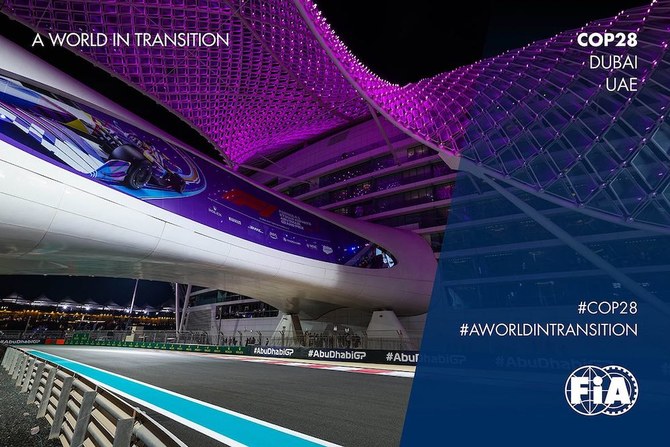
FIA and top US university launch research study to reduce carbon footprint of UAE motorsport events

The FIA and the Massachusetts Institute of Technology study aims to reduce the carbon footprint of major UAE events including the Formula 1 Abu Dhabi Grand Prix. (FIA)
Short Url
Updated 07 December 2023
Follow

FIA and top US university launch research study to reduce carbon footprint of UAE motorsport events

  • World governing body and Massachusetts Institute of Technology to analyze urban mobility patterns in the UAE, focusing on events such as the Formula 1 Abu Dhabi Grand Prix

DUBAI: World motorsport’s governing body, the FIA, is working with the Massachusetts Institute of Technology’s Senseable Dubai Lab to help reduce the carbon footprint of major UAE events including the Formula 1 Abu Dhabi Grand Prix.

While contributing to tourism and the local economy, major events have a significant impact on their host cities, challenging public transportation and increasing congestion. Improving access to these major events has become an important challenge, according to a press release issued by the FIA on Thursday.

As part of the MIT Senseable Dubai Lab — an initiative with the Dubai Future Foundation — researchers will gather data to build a picture of city-wide mobility patterns around major UAE motorsport events.

This data could then be used to suggest improvements to local mobility planning, including traffic management and public transport, ultimately reducing congestion and carbon emissions during these events.

The FIA and MIT will work with stakeholders including Formula One Management, the Yas Marina Circuit, and local governments, which will play a pivotal role in data collection efforts and future implementation.

“We are delighted to support this exciting new research project, in collaboration with MIT Senseable City Lab,” FIA President Mohammed Ben Sulayem said. “This comes at a moment of enormous growth for the UAE, and we look forward to joining forces with our stakeholders to make major events more eco-friendly, efficient, and enjoyable for attendees through enhanced mobility solutions.”

In the future, the FIA and MIT will share their findings and lessons learned with other cities, event organizers, and FIA members.

Umberto Fugiglando, research manager and partnerships lead at MIT Senseable City Lab, said: “We are proud to welcome the FIA to join our MIT Senseable Dubai Lab, where together with their stakeholders they will support our research on urban sustainable mobility in the UAE.

“In a region where cities are evolving very fast, we have the possibility to study urban mobility at large, and scientifically explore and anticipate future paradigms that need to be more socially, environmentally, and economically sustainable.”


Lando Norris says F1 cars gone from best to ‘probably the worst’

Updated 07 March 2026
Follow

Lando Norris says F1 cars gone from best to ‘probably the worst’

  • Norris’ title defense comes amid sweeping changes to the cars
  • The 26-year-old British driver has endured a tough weekend at Albert Park so far

MELBOURNE: Formula 1 champion Lando Norris is struggling with his new era McLaren car and frustrated to line up only sixth in Sunday’s season-opening Australian Grand Prix.
Norris’ title defense comes amid sweeping changes to the cars, and the 26-year-old British driver has endured a tough weekend at Albert Park so far.
F1’s new cars are complex, with unprecedented changes across the chassis and power unit, which now feature an almost 50:50 output split between the turbo 1.6-liter V6 engine and electrical energy harvested from the brakes — one that requires a new, often counterintuitive driving style.
“We’ve come from the best cars ever made in Formula 1, and the nicest to drive, to probably the worst,” he said after Saturday’s qualifying.
He’s not just coming to grips with his car’s complex energy management systems, but also in getting out on track — with the Briton losing significant time in Friday’s two practice sessions.
“Just getting into the rhythm of lifting everywhere to go quicker and using gears you don’t want to use and just understanding that when you lift more, you brake later but you have to brake less,” Norris said.
“That’s why laps are more valuable than ever. In the past, miss P1, not too bothered. Now, you miss five laps, not only do you as a driver have to figure things out quicker, the engine doesn’t learn what it needs to learn and then you’re just on the back foot.”