

Houthi court sentences Yemeni women’s rights activist to death

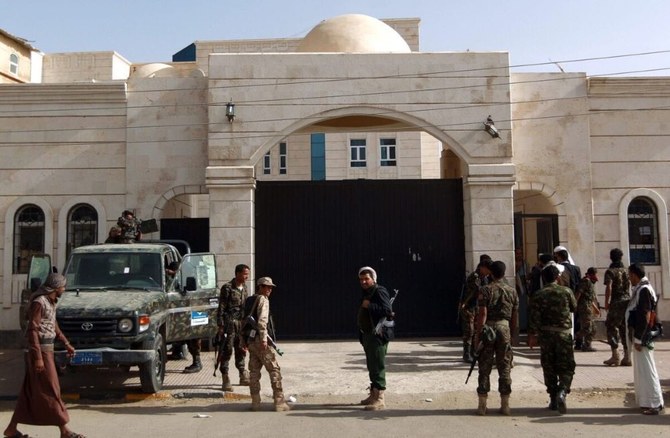
Houthi security personnel outside a court in Sanaa, Yemen, Jan. 13, 2015. (AFP)
Short Url
Updated 06 December 2023
Follow

Houthi court sentences Yemeni women’s rights activist to death

  • Fatema Saleh Mohammed Al-Arwali, an activist and head of the Yemeni branch of the Arab League’s Arab Women Leadership Council, sentenced to death for gathering military intelligence
  • Yemeni officials, as well as local and international rights organizations and activists, severely denounced the death sentence and urged the militia to release Al-Arwali

AL-MUKALLA: A court in Houthi-held Sanaa on Tuesday condemned a women’s rights rights activist to death for spying, sparking an uproar in Yemen and abroad against the Iran-backed militia.

Abdul Majeed Sabra, a Yemeni lawyer, told Arab News that the Specialized Criminal Court of First Instance in Sanaa sentenced Fatema Saleh Mohammed Al-Arwali, an activist and head of the Yemeni branch of the Arab League’s Arab Women Leadership Council, to death for gathering military intelligence and sending key Houthi locations to the Coalition to Restore Legitimacy in Yemen to be bombed.

The militia had kidnapped Al-Arwali while she was traveling to the southern city of Aden from Houthi-controlled Taiz. She was abducted and family requests to know her whereabouts were ignored.

The Houthis put Al-Arwali on trial early this year, but barred her from receiving legal representation.

Yemeni officials, as well as local and international rights organizations and activists, severely denounced the death sentence and urged the militia to release Al-Arwali and end its harassment of activists.

Dozens of Yemeni activists, lawyers and academics signed an online petition demanding that the Houthis release the activist, adding that her lawyer was barred from the courtroom during the first trial session and Al-Arwali was condemned to a lightless underground detention facility for almost a year.

“We urge that the death sentence imposed on her be overturned. We urge human rights and civil society groups to unite in opposition to this unfair sentencing that undermines justice,” the Yemeni activists said in the petition.

Amnesty International and the Geneva-based SAM Organization for Rights and Liberties also released separate statements criticizing the death sentence and urging the Houthis to free Al-Arwali.

“Amnesty International opposes the death penalty in all cases, without exception, and calls on the Houthis to immediately quash Al-Arwali’s death sentence and ensure she promptly receives a fair trial in line with international standards or is immediately released,” the organization said on X.


Baghdad traders protest new customs tariffs

Iraqi traders protest against the imposition of customs duties on imported goods in Baghdad, Iraq, Sunday, Feb. 8, 2026. (AP)
Updated 4 sec ago
Follow

Baghdad traders protest new customs tariffs

  • The demonstrators gathered outside the General Customs Directorate on Sunday, chanting slogans against corruption and rejecting the new fees

BAGHDAD: Hundreds of traders and owners of customs clearance companies protested in central Baghdad on Sunday, demanding that Iraq’s government reverse recently imposed customs tariffs they say have sharply increased their costs and disrupted trade.
The new tariffs that took effect on Jan. 1 were imposed to reduce the country’s debt and reliance on oil revenues, as oil prices have fallen.
Iraq faces a debt of more than 90 trillion Iraqi dinars ($69 billion) — and a state budget that remains reliant on oil for about 90 percent of revenues, despite attempts to diversify.
But traders say the new tariffs — in some cases as high as 30 percent — have placed an unfair burden on them. Opponents have filed a lawsuit aiming to reduce the decision, which Iraq’s Federal Supreme Court is set to rule on Wednesday.
The demonstrators gathered outside the General Customs Directorate on Sunday, chanting slogans against corruption and rejecting the new fees.
“We used to pay about 3 million dinars per container, but now in some cases they ask for up to 14 million,” said Haider Al-Safi, a transport and customs clearance company owner. 
“Even infant milk fees rose from about 495,000 dinars to nearly 3 million.”
He said that the new tariffs have caused a backlog of goods at the Umm Qasr port in southern Iraq and added that electric vehicles, previously exempt from customs duties, are now subject to a 15 percent fee.
“The main victim is the citizen with limited income, and government employee whose salary barely covers his daily living, those who have to pay rent, and have children with school expenses — they all will be affected by the market,” said Mohammed Samir, a wholesale trader from Baghdad.
Protesters also accused influential groups of facilitating the release of goods in exchange for lower unofficial payments, calling it widespread corruption. 
Many traders, they said, are now considering routing their imports through the Kurdistan region, where fees are lower.
The protests coincided with a nationwide strike by shop owners, who closed markets and stores in several parts of Baghdad to oppose the tariff increase. 
In major commercial districts, shops remained shut and hung up banners reading “Customs fees are killing citizens.”
