

Saudi wood sculptor creates odes to nature, wildlife, ancient history

1 / 4
Sultan Al-Mrshood currently works at the Ministry of Culture as an instructor, passing on his knowledge to young Saudis through wood carving classes. (AN photos by Huda Bashatah)
2 / 4
Seven years ago, Al-Mrshood sold a crutch to Prince Sultan who gifted it to the Minister of Foreign Affairs of Bahrain. (Supplied)
3 / 4
Al-Mrshood has won third place in carving wood products at the Souq Okaz competition. (Supplied)
4 / 4
Sultan Al-Mrshood said ‘The snake crutch, which embodies the story of the staff of Moses, is the secret of my fame and was sold to Prince Sultan bin Salman.’ (Supplied)
Short Url
Updated 06 December 2023
Follow

Saudi wood sculptor creates odes to nature, wildlife, ancient history

  • Award-winning artist Sultan Al-Mrshood inspired by childhood on Buraidah farm
  • Work includes ‘snake’ cane, rosaries from coconut wood, pits of olives and dates

RIYADH: Award-winning artist Sultan Al-Mrshood — who is currently presenting his work at the Saudi Feast Food Festival — has mastered the art of sculpting hyper-realistic representations of nature from wood, inspired by his childhood living on a farm.

Al-Mrshood has a booth at the festival’s Olive Exhibition — showcasing the fruit’s use as food and cosmetics — where he says his artwork often has admirers gathering for long periods.

The sculptor has an assortment of work on display including an eagle, a wooden cane entwined by a snake, and several handcrafted rosaries made from coconut wood, and the pits of olives and dates.


In his stand, the sculptor presents his collection of carved sculptures resembling an eagle, a snake crutch, carved canvases, and a variety of hand-made rosaries made of olive and date pits and coconut wood. (AN photos by Huda Bashatah)

Al-Mrshood has crafted three snake canes, with each taking about three months to complete. He sold the latest one, facilitated by the Ministry of Culture at the festival, for SR30,000 ($8,000). Seven years ago, Al-Mrshood sold a cane to Prince Sultan bin Salman who gifted it to Bahrain’s foreign minister at the time, Khalid bin Ahmad Al-Khalifa.

“Each of my pieces is mixed with an event or ancient history in Saudi civilization … the snake (cane), which embodies the story of the staff of Moses, is the secret of my fame and was sold to Prince Sultan bin Salman,” he noted.
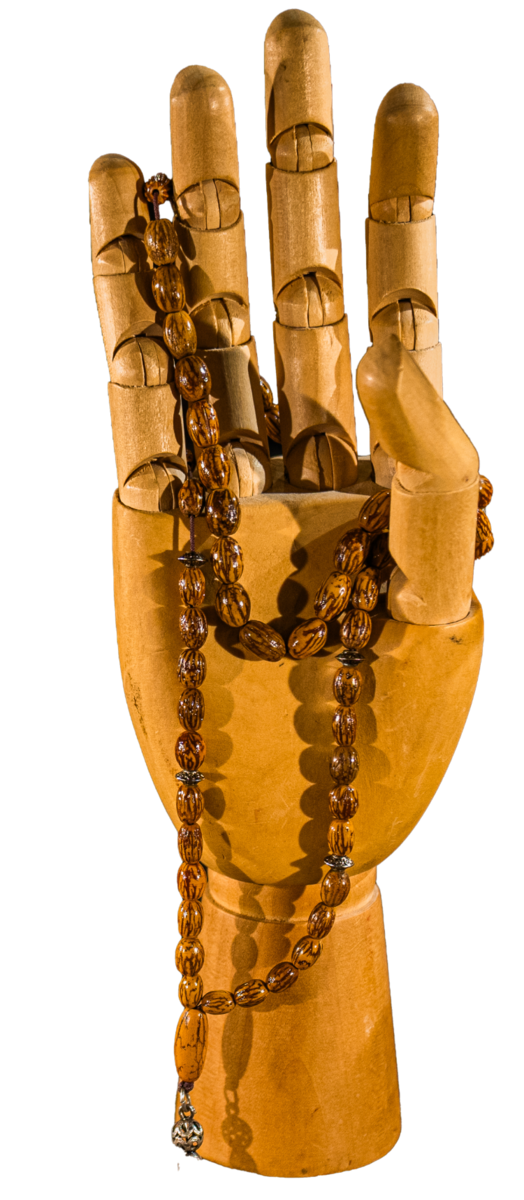


Saudi artist sultan Al-Mrshood carves rosaries from pits of olives and dates. (AN photos by Huda Bashatah)

He has also sold one to a well-known cane collector in Al-Qassim province.

Al-Mrshood previously won third place for his wood sculptures in a Souq Okaz competition. Souq Okaz is a part of Taif Season which showcases Arab culture through food, art and goods from the UAE, Kuwait, Bahrain, Oman, Iraq, Egypt, Jordan, Lebanon, Morocco and Tunisia.

Al-Mrshood says that he has received positive feedback from the community on his snake canes. “It is classified as one of the rarest canes found in Saudi Arabia … The fact that there are not many sculptors in Saudi Arabia makes it very important and relevant. All the visitors’ responses are admiration and amazement.”


Sultan Al-Mrshood said ‘The snake crutch, which embodies the story of the staff of Moses, is the secret of my fame and was sold to Prince Sultan bin Salman.’ (Supplied)

He is inspired by images of a farm in Buraidah where he was raised. “I lived part of my life on a simple farm. My childhood at the farm was filled with adventures and I would always play with the wooden sticks and create shapes out of them. I would try to make masterpieces out of whatever was around me even though I didn’t know I would be an artist.”

“I have been an artist since childhood, and I was a painter before I was a sculptor. The art of sculpture is a complex process that relies on geometry, imagination, sculpting skill, and the use of many methods.”

Al-Mrshood says he is inspired when in “a mixture of calm solitude, meditation, and walking.”

He currently works at the Ministry of Culture as an instructor, passing on his knowledge to young Saudis through wood carving classes.

On challenges he faces as a wood sculptor, Al-Mrshood noted the “lack of availability to purchase manual machines to help me work accurately and quickly.”

While he caters for a niche market, which has its difficulties, there is also the appeal of its exclusivity. “If there are many wood carvers in Saudi Arabia, the price would decrease, but since the number of wood carvers in Saudi Arabia is very low, the prices of our handcrafted producers increase. This makes individuals like us very important and valued.”


CNN suggests ‘false information’ could be behind UAE-KSA tensions

Updated 06 January 2026
Follow

CNN suggests ‘false information’ could be behind UAE-KSA tensions

  • Abu Dhabi mobilized STC after being falsely informed that Riyadh asked for sanctions on UAE

RIYADH: Tensions between Riyadh and Abu Dhabi could have been sparked by false information provided to the UAE about the Saudi Crown Prince’s recent visit to Washington, CNN has reported.

The American news channels says it has learned from its sources that Saudi Arabia believes Abu Dhabi mobilized the separatist Southern Transitional Council (STC) forces, which it backs, in provinces bordering the kingdom after being falsely informed that Saudi Crown Prince Mohammed bin Salman had asked US President Donald Trump during a White House visit in November to impose sanctions on Abu Dhabi over its alleged support for a warring party in Sudan’s civil war.

CNN’s reporting also suggests that Riyadh has reached out to the UAE to explain that it made no such request.

Meanwhile, the American channel says the UAE official who spoke to it on the condition of anonymity didn’t directly address the matter when asked about the false information claims.

During the November visit, President Trump did publicly announce that he had instructed his government to intervene in a bid to resolve the ongoing, bloody conflict in Sudan, based on a request from the Saudi Crown

Prince. However, neither the statements of the president, the crown prince, nor any reports published by Saudi or US media made any reference to the UAE at the time.

On 30 December, Riyadh launched airstrikes on what it says was a UAE military equipment shipment to Yemen, which was uncoordinated with the Coalition.

The Kingdom also backed the Yemeni government’s call for UAE forces to leave the country, which Abu Dhabi has agreed to honor, issuing a statement that insinuates it has done so of its own will.

The UAE statement also claimed an unwavering commitment on the part of Abu Dhabi to Saudi Arabia’s security and sovereignty, rejecting any actions that could threaten the Kingdom or undermine regional stability.

Meanwhile, CNN said it also understands that further Saudi strikes targeting the STC remain on the table should the separatists not withdraw. After the UAE pulled its troops from Yemen last week, the STC moved toward secession, but under intense military pressure from Riyadh and its local allies, it lost territory, and it now claims it is happy to enter a dialogue with other Yemeni parties.

The Kingdom, for its part, has reaffirmed numerous times its belief that the Southern cause is a just one and has called for it to be discussed among the various parties at the negotiation table and away from the battlefield. Saudi Arabia has called for a dialogue to occur in Riyadh to discuss the Southern separation issue, and its call has been welcomed by the Yemeni government, various Yemeni factions — including the STC itself, as mentioned — and the majority of Arab and Muslim countries.

A problematic figure in the equation is Aidarous Al-Zubaidi, President of the STC, who is believed to have dual citizenship, and many Yemenis on social media have been posting images of his UAE passport and renouncing him as unfit for governing, claiming he serves a foreign agenda. Others also posted videos of him making statements that he would be happy to establish ties with Israel, should Southern Yemen gain its independence. Most recently as well, a post by Yemen’s Media Minister Moammar Eryani has accused the STC of allowing the theft and spread of weapons in Eastern provinces.

Eryani added that the STC has been deliberately causing chaos and “using Al Qaeda as a scarecrow to achieve its own political gains at the expense of Yemeni people”. CNN also says it has learned that

Saudi concerns extend beyond UAE involvement in Yemen and Sudan. Riyadh, according to the report, is also wary of the UAE’s policies in the Horn of Africa and in Syria, where it believes Abu Dhabi has cultivated ties with elements of the Druze community, some of whose leaders have openly discussed secession.

While no Saudi source was mentioned in the reporting, CNN’s narrative is in line with several public Saudi statements, which have objected to the recent Israeli recognition and endorsement of Somaliland’s separation from Somalia, Israeli attempts to undermine and attack the new Syrian government, and any attempt to impose a Southern Yemeni state by military means.

Israel maintains a close relationship with Abu Dhabi and an even closer one since the signing of the 2020 Abraham Accords, while Saudi Arabia has refused normalization with Tel Aviv until it recognizes a Palestinian State and adheres to a credible and irreversible path to achieving a Two-State Solution. This Saudi position has been reiterated yet again during the Crown Prince’s November visit to Washington.