

Pakistani PM tasks authorities to prepare emergency polio eradication plan for 2024 

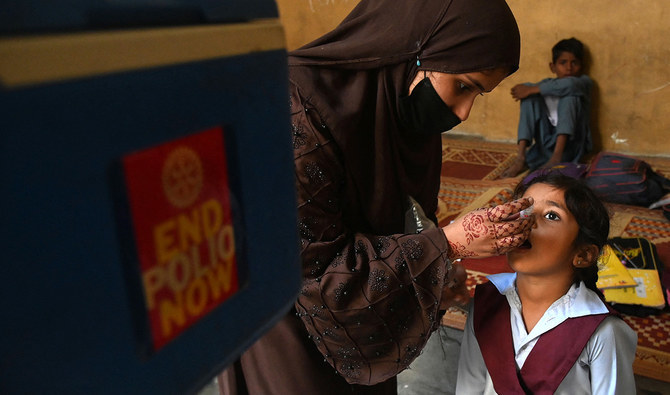
A health worker administers polio vaccine drops to a child during a vaccination campaign in Lahore on October 24, 2022. (AFP/File)
Short Url
Updated 06 December 2023
Follow

Pakistani PM tasks authorities to prepare emergency polio eradication plan for 2024 

  • Caretaker PM Anwaar-ul-Haq Kakar chairs high-level meeting of Pakistan’s task force on polio eradication 
  • PM notes recent cases of polio reported in Pakistan, calls for integrated anti-polio campaigns in high-risk areas 

ISLAMABAD: Caretaker Prime Minister Anwaar-ul-Haq Kakar tasked authorities on Wednesday to prepare an emergency polio eradication plan for the next year to target high-risk areas, the Prime Minister’s Office (PMO) said. 

Polio is a highly infectious disease caused by poliovirus mainly affecting children under the age of ten years. It invades the nervous system and can cause paralysis or even death. 

Pakistan and Afghanistan are the only two countries in the world where polio continues to threaten the health and well-being of children, with Pakistani authorities reporting six polio cases this year. 

Kakar chaired a meeting of Pakistan’s task force on polio eradication during which he stressed monitoring polio vaccination campaigns through technology, the PMO said in a statement. 

“The prime minister gave directions [to authorities] to prepare an anti-polio emergency plan for next year,” the statement said. 

Kakar called for the resumption of regular polio immunization campaigns across the country, emphasizing that best international practices and research be adopted for the use of Inactivated Polio Virus (IPV) vaccines. 

The prime minister said integrated anti-polio programs should be adopted in high-risk areas, the PMO said. Kakar said important stakeholders of Pakistani society such as parents, religious scholars and teachers should be included in polio awareness campaigns as well. 

He issued directions that a Ulema Convention should be held to shed light on the importance of the role of ulema in anti-polio campaigns, the statement added. 

Participants of the meeting were told polio teams are administering vaccines to children at Afghan repatriation camps in Peshawar, Nowshera, and Chaman cities. They were also briefed that Punjab, Balochistan, Azad Kashmir, and Gilgit-Baltistan were polio-free areas, whereas some union councils in southern Khyber Pakhtunkhwa province were more affected, the PMO said. 

Pakistan’s efforts to eradicate polio have encountered difficulties as many Pakistanis harbor suspicions about foreign entities that fund vaccination campaigns. Many believe in the conspiracy theory that polio vaccines are part of a plot by Western outsiders to sterilize Pakistan’s population. 

The masses’ doubts regarding polio campaigns were exacerbated in 2011 when the US Central Intelligence Agency set up a fake hepatitis vaccination program to gather intelligence on former Al-Qaeda chief Osama bin Laden. 


Pakistan to promote mineral sector at Saudi forum this month with 13 companies

Updated 02 January 2026
Follow

Pakistan to promote mineral sector at Saudi forum this month with 13 companies

  • Delegation will take part in the Future Minerals Forum in Riyadh from Jan. 13-15
  • Petroleum minister will lead Pakistan, participate in a 90-minute country session

ISLAMABAD: Around 13 Pakistani state-owned and private companies will attend the Future Minerals Forum (FMF) in Saudi Arabia from Jan. 13 to 15, an official statement said on Friday, as the country seeks to ramp up global engagement to develop its mineral resources.

The FMF is an international conference and investment platform for the mining sector, hosted by mineral-rich countries to attract global investors, companies and governments.

Petroleum Minister Ali Pervaiz Malik confirmed Pakistan’s participation in a meeting with the Saudi envoy, Nawaf bin Said Al-Malki.

Pakistan hosts one of the world’s largest copper-gold zones. The Reko Diq mine in southwestern Balochistan, with an estimated 5.9 billion tons of ore, is partly owned by Barrick Gold, which calls it one of the world’s largest underdeveloped copper-gold deposits. Its development is expected to boost Pakistan’s struggling economy.

“Upon an invitation of the Government of the Kingdom of Saudi Arabia, the Federal Minister informed the Ambassador that Pakistan will fully participate in the upcoming Future Minerals Forum (FMF), scheduled to be held in Riyadh later this month,” Pakistan’s Press Information Department (PID) said in an official statement.

The Pakistani minister will lead his country’s delegation at the FMF and take part in a 90-minute country showcase session titled “Unleashing Potential: Accelerating Pakistan’s Mineral Revolution” along with local and foreign investors.

Pakistan will also establish a dedicated pavilion to highlight the vast potential of its rich geological landscape to the global mineral community.

The Saudi envoy welcomed Pakistan’s decision to participate in the forum and discussed enhancing bilateral cooperation in the minerals and energy sectors during the meeting.

According to the statement, he highlighted the potential for cooperation between Saudi Arabia and Pakistan in the minerals and energy sectors, expressing confidence that the FMF would provide a platform to expand collaboration.
Pakistan’s mineral sector, despite its rich reserves of salt, copper, gold and coal, contributes only 3.2 percent to the country’s GDP and just 0.1 percent to global mineral exports.

However, many countries, including the United States, have shown interest in Pakistan’s underdeveloped mineral sector, particularly in copper, gold and other critical resources.

In October, Pakistan dispatched its first-ever shipment of rare earth and critical minerals to the United States, according to a Chicago-based US public relations firm’s report.