

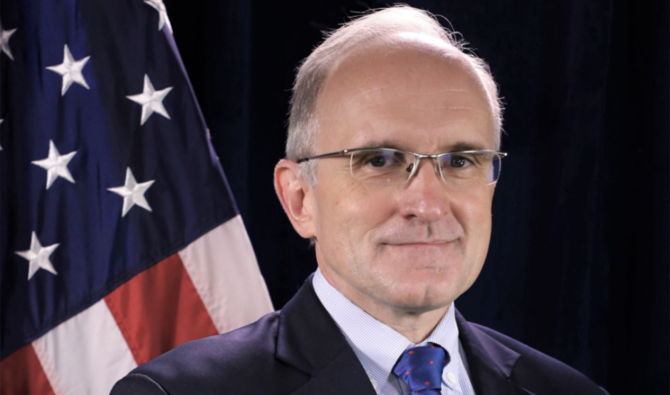

CHICAGO: The war against terror group Daesh has expanded into other regions outside of the Middle East, a leading US counterterrorism official said on Tuesday.
Ian J. McCary, who works at the State Department as its Counterterrorism Bureau’s deputy special envoy for the Global Coalition to Defeat ISIS, conceded that the fight against Daesh (another name for which is ISIS) is now being affected by other conflicts in the region, including Israel’s war against Hamas in the Gaza Strip.
When the international battle against the terror group began in 2014, its efforts mainly focused on Syria and Iraq, where the group’s leaders established a foothold and declared a caliphate. Since then, however, fresh conflicts have reenergized Daesh’s activities in Syria and Iraq, McCary added, but the coalition is now also targeting the group’s affiliates in sub-Saharan Africa and Central Asia.
The 40 member nations, including several from Africa, that took part in the coalition’s recent annual meeting in Italy discussed this strategy of “regionalization” in response to the spread and expansion of terrorist groups in these parts of the world, he said during a media briefing.
“In terms of regionalization, what we mean by that is obviously when the coalition started, all of the focus was on defeating the so-called territorial caliphate which Daesh had created in northeastern Syria and Iraq, and all of the attention was on that particular theater, and the threat has evolved significantly,” he explained.
“The challenges in northeastern Syria, and particularly and also in Iraq, persist but they are of a very different nature than they were back in 2014 to 2019, roughly. And then we have worked over the past few years to increase the coalition’s focus on sub-Saharan Africa and also Central Asia.
“The challenges on the African continent alone are so dispersed, geographically, that it made sense to break the problem apart and deal with it more piece by piece.”
He acknowledged that despite the strong support provided by coalition partners, including Turkiye, the expansion of Daesh into other regions requires more and better coordination of resources and counterterrorism efforts.
This spread of the group in Africa, Central Asia, and also Afghanistan, is in part the result of the support it receives from Iran, and the coup in Niger in July this year also played a part, McCary acknowledged. Turkiye has played a significant role in efforts to combat the Daesh expansion in sub-Saharan Africa, he added.
“We have been outspoken in (our) rejection of the very unconstructive role, or malignant role, that Iran and its proxies have been playing in northeastern Syria, as well as in other parts of the Middle East,” he said.
“We are also absolutely determined that we will not be deterred in conducting our (anti-Daesh) operations in northeastern Syria. We are applying the resources and implementing the tactics necessary both to defend our forces against any such attacks and continue our campaign against the remnants of Daesh in that region.”
The war in Gaza and conflicts in other regions have resulted in a resurgence of Daesh terrorism in Syria and Iraq, where the group’s activities began.
“We have an extraordinary partnership with Iraqi special forces and we have a lot of confidence in their capabilities to defend Iraqi sovereignty and to defend their people against any threats from remnants of Daesh in Iraq,” McCary said.
“We are also continuing undeterred (in our efforts) to defeat the Daesh elements that remain in northeastern Syria … We do believe Daesh is seeking opportunities to exploit the violence in the conflict between Israel and Hamas for its own purposes. But, again, we are determined that we are going to remain steadfast in our operations to defeat Daesh.”
He stressed that despite the many complex challenges “crowding the global agenda today, there is still a very strong international will not to be distracted in our efforts to defeat (Daesh), and to continue to refine our tactics and deploy whatever tools we need to deploy to ensure Daesh can’t threaten international security in the future.”
McCary took up his current position as deputy special envoy in September 2022. From August 2021 to August 2022 he served as charge d’affaires for the US mission to Afghanistan, also known as the Afghanistan Affairs Unit, based in Doha, Qatar.


