

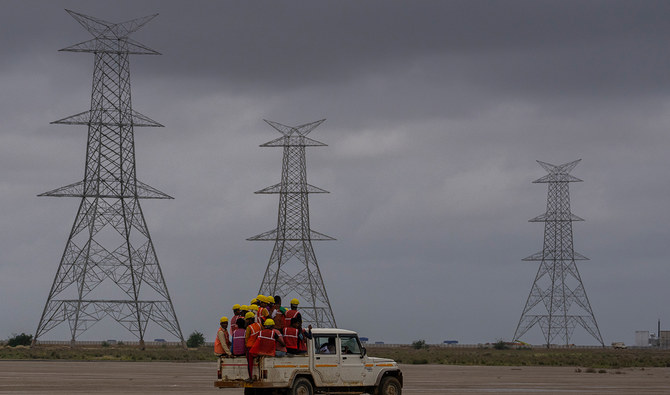

KHAVDA, India: Rising from the bare expanse of the large salt desert that separates India from Pakistan is what will likely be the world’s largest renewable energy project when completed three years from now.
The solar and wind energy project will be so big that it will be visible from space, according to developers of what is called the Khavda renewable energy park, named after the village nearest to the project site.
At the site, thousands of laborers install pillars on which solar panels will be mounted. The pillars rise like perfectly aligned concrete cactuses that stretch as far as the eye can see. Other workers are building foundations for enormous wind turbines to be installed; they also are transporting construction material, building substations and laying wires for miles.
When completed, the project will be about as large as Singapore, spreading out over 726 square kilometers (280 square miles). The Indian government estimates it will cost at least $2.26 billion.
Shifting to renewable energy is a key issue at the ongoing COP28 climate summit. Some leaders have voiced support for a target of tripling renewable energy worldwide in any final agreement while curbing use of coal, oil and natural gas, which spew planet-warming gases into the atmosphere.
What makes this heavy industrial activity peculiar is that it’s taking place in the middle of the Rann of Kutch in western India’s Gujarat state. The Rann is an unforgiving salt desert and marshland at least 70 kilometers (43.5 miles) from the nearest human habitation but just a short army truck ride away from one of the world’s most tense international borders separating the two South Asian nations.
GROUND ZERO OF INDIA’S CLEAN ENERGY TRANSITION
When The Associated Press visited the renewable energy park, two days of unseasonal heavy rains had left the ground muddy and water logged since the only escape for water in this rough terrain is evaporation. This made it even harder for the workers to do their job.
Notwithstanding the tough conditions, an estimated 4,000 workers and 500 engineers have been living in makeshift camps for the better part of the past year toiling to get this project up and running.
Once completed, it will supply 30 gigawatts of renewable energy annually, enough to power nearly 18 million Indian homes.
As India aims to install 500 gigawatts of clean energy by the end of the decade and to reach net zero emissions by 2070, this project site will likely contribute significantly to the world’s most populous country’s transition to producing energy from non-carbon spewing sources.
As things stand, India is still mostly powered by fossil fuels, especially coal, which generate more than 70 percent of India’s electricity. Renewable energy currently contributes about 10 percent of India’s electricity needs. The country is also currently the third-largest emitter of planet-warming gases behind China and the United States.
“There are people working here from all over India,” said KSRK Verma, project head for Adani Green Energy Limited, the renewable energy arm of the Adani Group, which the Indian government has contracted to build 20 gigawatts of the project. Verma, with over 35 years of experience building dams across turbulent South Asian rivers and enormous natural gas tanks under the Bay of Bengal, says this is one of the most difficult projects he’s undertaken.
“It’s not at all (an) easy site to work at, there is no habitation, the land is marshy, there are a lot of high winds, rains and this is a high earthquake prone area,” said Vneet Jaain, managing director of Adani Green at its headquarters in the city of Ahmedabad.
Jaain who has overseen multiple ambitious projects for the Adani Group said the first six months were spent just building basic infrastructure. “From April this year is when we started working on the actual project,” he added.
The Adani Group has been in the limelight this year ever since the US-based short-selling Hindenburg Research firm accused the Group and its head, Gautam Adani, of “brazen stock manipulation” and “accounting fraud.” Adani Group has called the allegations baseless.
Jaain of Adani Green says the allegations have had little impact on its ongoing projects including work at the Khavda renewable energy park.
AN EXAMPLE TO EMULATE
“Twenty years ago, India was exactly where a vast expanse of (the) developing world was,” Ajay Mathur, director general of the International Solar Alliance, said of the country’s renewable energy production. The alliance has 120 member countries and promotes renewable energy — primarily solar — across the world.
About 200 kilometers (124 miles) away in the industrial city of Mundra, also located along the Gujarat state’s coastline, the Adani Group is manufacturing the solar and wind energy parts needed for the project. It’s one of the few locations in India where most solar energy components are made from scratch. Some of the factories are run like laboratories, with protective gear, face masks and head covers required to avoid dust particles that can compromise solar cells.
The nearby wind energy factory aims to produce 300 turbines a year, with each blade stretching nearly 79 meters (86 yards) and weighing 22 metric tons (24 tons). Each wind turbine generator is capable of producing 5.2 megawatts of clean energy. They will be India’s biggest.
As Mathur of the solar alliance said, “India has traveled a long way,” and its largescale renewable energy projects including the Khavda park will be inspiring for other developing countries. “Here is a country that was exactly where they are today and was able to make the change,” he said.
ENVIRONMENTAL IMPACT
While acknowledging the importance of transitioning to renewable energy, environmental experts and social activists say India’s decision to allow clean energy projects without any environmental impact assessments is bound to have adverse consequences.
“The salt desert is a unique landscape” that is “rich in flora and fauna,” including flamingos, desert foxes and migratory bird species that fly from Europe and Africa to winter in this region, according to Abi T Vanak, a conservation scientist with the Bengaluru-based Ashoka Trust for Research in Ecology and the Environment. Vanak has overseen multiple environment-related research projects in the Kutch region.
Kutch and other similar regions are classified as “wastelands,” by the Indian government — and Vanak says this is extremely unfortunate. “They are not recognized as valid ecosystems,” he said.
With renewable energy projects exempt from environmental impact assessments, “There is no system in place” to determine the best places for them, according to Sandip Virmani, an environmentalist based in Kutch.
At a little over 45,000 square kilometers (17,374.5 square miles), the Kutch district is as big as Denmark and is India’s largest district. Given this, Virmani said there is enough land in Kutch for various renewable energy projects. But he fears that dairies and other local businesses in the region might be impacted by large-scale projects. “It has to be in the context of not compromising on another economy,” he said.
Meanwhile, longtime residents are still waiting to see how this huge project near their village will affect them.
Hirelal Rajde, 75, who has spent most of his life in Khavda, is mindful of the upcoming energy project as well as the increase in tourism in recent years in this otherwise desolate region. “I think these developments are both good and bad,” said Rajde.
“I think overall though it will benefit more than it will cause problems,” he said. “I tell everyone who lives here to hold onto their land, don’t sell it. In a few years, I tell them they’ll have so much business that they won’t be able to rest even at night.”


