


ISLAMABAD: Pakistan’s Finance Division said on Tuesday it had released Rs17.4 billion to the country’s election regulator so that it can hold polls in the country, with the development taking place amid reports of a delay in the upcoming national elections scheduled for February 8.
On Monday, Information Minister Murtaza Solangi said the Election Commission of Pakistan (ECP) had approached the government to release funds worth Rs17.4 billion, adding that there was no “crisis on meeting the financial needs of the ECP.”
The government allocated Rs42 billion for the upcoming general elections in this year’s budget, but it had only issued Rs.10 billion to the Election Commission of Pakistan in July. Pakistani media widely reported on Monday there had been a delay in the disbursement of the remaining amount, at which the ECP summoned the finance secretary.
“Finance Division has released Rs. 17.4 billion to the Election Commission of Pakistan in addition to Rs. 10.0 billion released in July 2023 for conduct of general elections in the country,” the Finance Division said in a statement on social media platform X. It said the total amount disbursed to the ECP since July now totaled Rs27.4 billion.
“Finance Division remains committed to provision of funds as and when required by the Election Commission of Pakistan,” the statement said.
Pakistan, following more than a year of political turmoil since the ouster of ex-prime minister Imran Khan in Aprill 2022, is finally headed to general elections in February next year, with many analysts expecting the polls to lead to some stability in the South Asian country.
The ECP last week put to rest rumors of a delay in election and its top official said the regulator would release a schedule in December for the upcoming general election.
“Count 54 days backwards from February 8,” Chief Election Commissioner Sikandar Sultan Raja said in an informal chat with journalists, which means the announcement could be expected in the third week of December.
The outgoing Pakistani government had amended the Elections Act to empower the ECP to fix and announce the election date and specifying the timeline for the announcement of election schedule, which needs to be done about 54 days before the polling day.
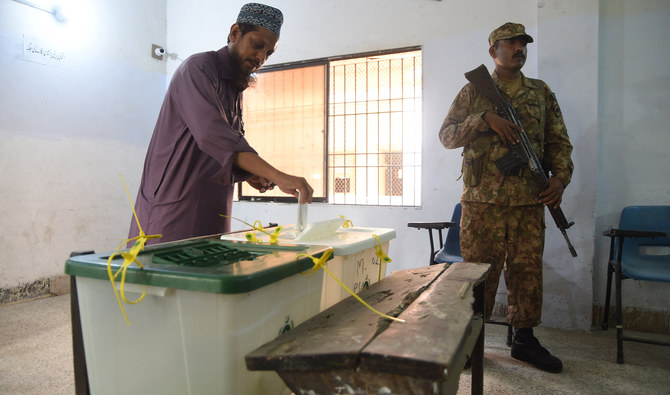
On Monday, ECP Secretary Omar Hamid Khan requested the interior ministry for the deployment of armed forces and other law enforcement agencies personnel at polling stations to ensure foolproof security arrangements, citing a shortfall of police personnel across the country as Pakistan heads toward elections.
“Keeping in view, the deficiency of Police personnel indicated by the Provinces and the Federal Capital, the Election Commission of Pakistan has decided that in view of the clear shortfall of 277,558 personnel, the services of Pakistan Army and Civil Armed Forces (CAFs) shall have to be requisitioned in static mode in terms of Article 220 of the Constitution of the Islamic Republic of Pakistan at the Polling Stations to ensure smooth elections,” Khan wrote in a letter to the interior ministry.
“This is all the more relevant in the context of fragile security cum law-and-order situation prevalent in country.”
Khan said as per reports from the Inspector Generals of Police (IGPs) of all four provinces and Islamabad, there is a shortfall of around 4,500 police personnel in the capital city, 169,110 in Punjab, 56,717 in KP, 33,462 in Sindh, and 13,769 in Balochistan.
The regulator said as per Article 220 of Pakistan’s constitution, all executive authorities of the administration and the provinces are bound to assist the ECP in its task of holding free, fair and transparent elections.
“While the ECP takes all necessary steps to organize an election in accordance with the Constitution and the relevant Election Laws, it also expects the same commitment from the executive authorities and law enforcement agencies to maintain law and order in the area of the constituencies during the conduct of elections,” the letter read.


