

Israel presses ground offensive in southern Gaza, air strikes intensify

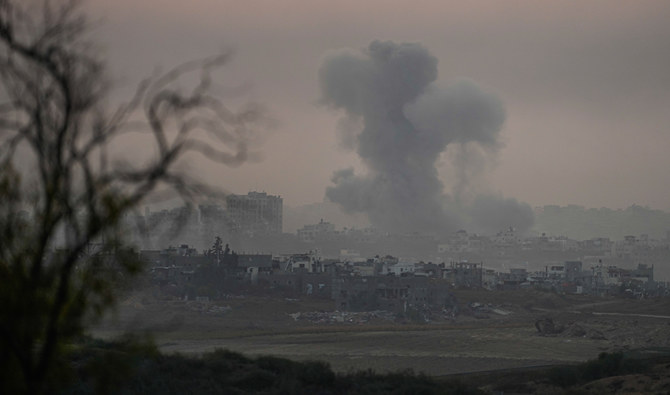
Smoke rises following an Israeli bombardment in the Gaza Strip, as seen from southern Israel on December 4, 2023. (AP)
Short Url
Updated 05 December 2023
Follow

Israel presses ground offensive in southern Gaza, air strikes intensify

  • Intense Israeli air strikes hit the south of the Gaza Strip, killing and wounding dozens of Palestinians
  • Operation has transformed much of the north, including large parts of Gaza City, into a rubble-filled wasteland

Intense Israeli air strikes hit the south of the Gaza Strip on Monday, killing and wounding dozens of Palestinians, including in areas where Israel had told people to seek shelter, residents and journalists on the ground said.

Israeli troops and tanks also pressed the ground campaign against Hamas in the south of the enclave after having largely gained control of the now-devastated north.

Early on Monday, Israel ordered Palestinians to leave parts of Gaza’s main southern city, Khan Younis. But residents said that areas which they had been told to go to were also coming under fire.

Israel’s military posted a map on social media platform X with around a quarter of Khan Younis marked off in yellow as territory that must be evacuated at once.

Three arrows pointed south and west, telling people to head toward the Mediterranean coast and toward Rafah, a major town near the Egyptian border.

Desperate Gazans in Khan Younis packed their belongings and headed toward Rafah. Most were on foot, walking past ruined buildings in a solemn and silent procession.

But the head of the United Nations agency for Palestinian refugees in Gaza (UNRWA), Thomas White, said people in Rafah were themselves being forced to flee.

“People are pleading for advice on where to find safety. We have nothing to tell them,” he said on X.

In the territory’s northern part, the official Palestinian news agency WAFA said at least 50 people were killed in an Israeli air strike that hit two schools sheltering displaced people in the Daraj neighborhood of Gaza City.

The Gaza health ministry could not be reached for comment on the report and it was not immediately possible to verify it independently. A spokesperson for the Israeli army said it was looking into the report.

Separately, the health ministry said at least 15,899 Palestinians, 70 percent of them women or under 18s, have now been killed in Israeli bombardments of the Hamas-ruled enclave in eight weeks of warfare. Thousands more are missing and feared buried in rubble.

Israel launched its assault to wipe out Hamas in retaliation for an Oct. 7 cross-border attack by its gunmen. They killed 1,200 people and seized 240 hostages, according to Israeli tallies — the deadliest single day in Israel’s 75-year history.

BIG CRATER

Bombing at one site in Rafah overnight had torn a crater the size of a basketball court out of the earth. A dead toddler’s bare feet and black trousers poked out from under a pile of rubble. Men struggled with their bare hands to move a chunk of the concrete that had crushed the child.

Later they chanted “God is greatest” and wept as they marched through the ruins carrying the body in a bundle, and that of another small child wrapped in a blanket.

“We were asleep and safe,” said Salah Al-Arja, owner of one of the houses destroyed at the site. “There were children, women and martyrs,” he said. “They tell you it is a safe area, but there is no safe area in all of the Gaza Strip.”

Israel accuses Hamas of putting civilians in danger by operating from civilian areas, including in tunnels which can only be destroyed by large bombs. Hamas denies it does so.

As many as 80 percent of Gaza’s 2.3 million people have fled their homes in the Israeli bombing campaign that has reduced much of the crowded coastal strip to a desolate wasteland.

Israeli forces largely captured the northern half of Gaza in November, and since a week-long truce collapsed on Friday they have swiftly pushed deep into the southern half.

Tanks have driven into Gaza from the border fence and cut off the main north-south route, residents say. The Israeli military said the central road out of Khan Younis to the north “constitutes a battlefield” and was now shut.

Hamas said its fighters clashed with Israeli forces in northern Khan Younis overnight.

ISRAEL’S GOALS IN NORTH ALMOST MET

The commander of Israel’s armored corps, Brig.-General Hisham Ibrahim, told Army Radio the military had almost achieved its goals in northern Gaza.

“We are beginning to expand the ground maneuver to other parts of the Strip, with one goal — to topple the Hamas military group,” he said.

The military released footage of troops patrolling in tanks and on foot, in fields and in badly damaged urban areas, and firing from weapons, without specifying the location in Gaza.

Israel says its evacuation orders are aimed at protecting civilians from harm, and called on international organizations to help encourage Gazans to move to the areas labelled safe on Israeli maps.

The United Nations said the areas in the south that Israel has ordered evacuated in the three days since the truce ended had housed over 350,000 people before the war — not counting the hundreds of thousands now sheltering there from other areas.

In Khan Younis, many of those taking flight on Monday were already displaced from other areas. Abu Mohammed told Reuters it was now the third time he had been forced to flee since abandoning his home in Gaza City in the north.

“Why did they eject us from our homes in Gaza (City) if they planned to kill us here?” he said.

Israel’s closest ally the United States has called on it to do more to safeguard civilians in the southern part of Gaza than in last month’s campaign in the north.

But about 900 people have been killed in Israeli air strikes since the truce ended on Friday, Gaza health authorities said.

Omar Shakir, Israel and Palestine Director at Human Rights Watch, told Reuters: “All indications and reports suggest that the same pattern – of dropping heavy-duty bombs and using artillery in densely populated areas – is continuing.”


Syrian military tells civilians to evacuate contested area east of Aleppo amid rising tensions

Updated 15 January 2026
Follow

Syrian military tells civilians to evacuate contested area east of Aleppo amid rising tensions

  • Syria’s military has announced it will open a “humanitarian corridor” for civilians to evacuate from an area in Aleppo province
  • This follows several days of intense clashes between government forces and the Kurdish-led Syrian Democratic Forces

DAMASCUS: Syria’s military said it would open a corridor Thursday for civilians to evacuate an area of Aleppo province that has seen a military buildup following intense clashes between government and Kurdish-led forces in Aleppo city.
The army’s announcement late Wednesday — which said civilians would be able to evacuate through the “humanitarian corridor” from 9 a.m. to 5 p.m. Thursday — appeared to signal plans for an offensive in the towns of Deir Hafer and Maskana and surrounding areas, about 60 kilometers (40 miles) east of Aleppo city.
The military called on the Kurdish-led Syrian Democratic Forces and other armed groups to withdraw to the other side of the the Euphrates River, to the east of the contested zone.
Syrian government troops have already sent troop reinforcements to the area after accusing the SDF of building up its own forces there, which the SDF denied. There have been limited exchanges of fire between the two sides, and the SDF has said that Turkish drones carried out strikes there.
The government has accused the SDF of launching drone strikes in Aleppo city, including one that hit the Aleppo governorate building on Saturday shortly after two Cabinet ministers and a local official held a news conference there.
The tensions in the Deir Hafer area come after several days of intense clashes last week in Aleppo city that ended with the evacuation of Kurdish fighters and government forces taking control of three contested neighborhoods. The fighting killed at least 23 people, wounded dozens more, and displaced tens of thousands.
The fighting broke out as negotiations have stalled between Damascus and the SDF, which controls large swaths of northeast Syria, over an agreement to integrate their forces and for the central government to take control of institutions including border crossings and oil fields in the northeast.
Some of the factions that make up the new Syrian army, which was formed after the fall of former President Bashar Assad in a rebel offensive in December 2024, were previously Turkiye-backed insurgent groups that have a long history of clashing with Kurdish forces.
The SDF for years has been the main US partner in Syria in fighting against the Daesh group, but Turkiye considers the SDF a terrorist organization because of its association with the Kurdistan Workers’ Party, or PKK, which has waged a long-running insurgency in Turkiye. A peace process is now underway.
Despite the long-running US support for the SDF, the Trump administration has also developed close ties with the government of interim Syrian President Ahmad Al-Sharaa and has pushed the Kurds to implement the integration deal. Washington has so far avoided publicly taking sides in the clashes in Aleppo.
The SDF in a statement warned of “dangerous repercussions on civilians, infrastructure, and vital facilities” in case of a further escalation and said Damascus bears “full responsibility for this escalation and all ensuing humanitarian and security repercussions in the region.”
Adm. Brad Cooper, commander of US Central Command, said in a statement Tuesday that the US is “closely monitoring” the situation and called for “all parties to exercise maximum restraint, avoid actions that could further escalate tensions, and prioritize the protection of civilians and critical infrastructure.” He called on the parties to “return to the negotiating table in good faith.”
Al-Sharaa blasts the SDF
In a televised interview aired Wednesday, Al-Sharaa praised the “courage of the Kurds” and said he would guarantee their rights and wants them to be part of the Syrian army, but he lashed out at the SDF.
He accused the group of not abiding by an agreement reached last year under which their forces were supposed to withdraw from neighborhoods they controlled in Aleppo city and of forcibly preventing civilians from leaving when the army opened a corridor for them to evacuate amid the recent clashes.
Al-Sharaa claimed that the SDF refused attempts by France and the US to mediate a ceasefire and withdrawal of Kurdish forces during the clashes due to an order from the PKK.
The interview was initially intended to air Tuesday on Shams TV, a broadcaster based in Irbil — the seat of northern Iraq’s semi-autonomous Kurdish region — but was canceled for what the station initially said were technical reasons.
Later the station’s manager said that the interview had been spiked out of fear of further inflaming tensions because of the hard line Al-Sharaa took against the SDF.
Syria’s state TV station instead aired clips from the interview on Wednesday. There was no immediate response from the SDF to Al-Sharaa’s comments.