

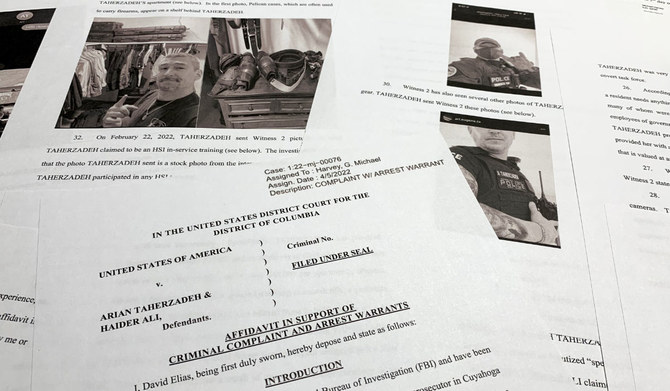

WASHINGTON: A man accused of pretending to be a federal agent and offering gifts and free apartments to Secret Service officers has been sentenced to nearly three years in prison.
Arian Taherzadeh, 41, was sentenced to 33 months in prison Friday. He and a second man, Haider Ali, were indicted in April 2022, accused of tricking actual Secret Service officers, offering expensive apartments and gifts to curry favor with law enforcement agents, including one agent assigned to protect the first lady, prosecutors said.
Ali, 36, was sentenced in August to over five years. Attorneys for the two did not immediately respond to messages seeking comment Monday.
Prosecutors alleged Taherzadeh falsely claimed, at various times, to be an agent with the Department of Homeland Security, a former US Air Marshal, and a former US Army Ranger. He used his supposed law-enforcement work to trick owners of three apartment complexes into letting him use multiple apartments and parking spaces for fake operations, the Justice Department said in a statement.
Taherzadeh pleaded guilty to conspiracy, a federal offense, as well as two District of Columbia offenses: unlawful possession of a large-capacity ammunition feeding device and voyeurism. He was also ordered to pay restitution of more than $700,000.
The case was thrust into the public spotlight when more than a dozen FBI agents raided a luxury apartment building in southwest Washington in April 2022. They found a cache of gear, including body armor, guns and surveillance equipment, as well as a binder with information about the building’s residents, prosecutors said. Taherzadeh also installed surveillance cameras in his apartment and made explicit content that he showed to others, prosecutors said.
Taherzadeh provided Secret Service officers and agents with rent-free apartments — including a penthouse worth over $40,000 a year — as well as electronics, authorities said. In one instance, Taherzadeh offered to purchase a $2,000 assault rifle for a Secret Service agent who is assigned to protect the first lady, prosecutors said.
The plot unraveled when the US Postal Inspection Service began investigating an assault involving a mail carrier at the apartment building and the men identified themselves as being part of a phony Homeland Security unit they called the US Special Police Investigation Unit.
Taherzadeh’s lawyer has previously said he provided the luxury apartments and lavish gifts because he wanted to be friends with the agents, not try to compromise them.


