

COP28: Saudi Arabia’s Red Sea economy shifts to regeneration

Short Url
Updated 04 December 2023
Follow

COP28: Saudi Arabia’s Red Sea economy shifts to regeneration

DUBAI: Saudi Arabia’s push toward sustainability has evolved as large corporations aim for regeneration in the Red Sea, according to the person in charge of one of the Kingdom’s giga-projects.

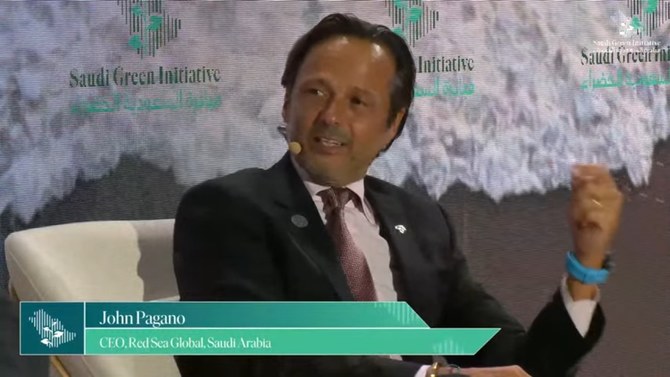
During a panel discussion at the 2023 UN Climate Change Conference in Dubai, John Pagano, CEO of Red Sea Global, highlighted how the company has shifted from sustaining its natural landscape to healing and recovering what has been damaged.  

“When we started our journey six years ago, we talked about setting new standards in sustainability and we came to realize fairly quickly that sustainability is no longer enough, and we coined the term regeneration,” Pagano said.  

He further underscored that maintaining the status quo is no longer adequate, stating: “We are on a terrible trajectory.”  

Moreover, Pagano urged global leaders to take action and “change course,” emphasizing the current bleak outlook of the future.

Accompanying Pagano, Carlos Duarte, professor and marine scientist at King Abdullah University of Science and Technology, supported the call for action.  

“We have a commitment to our youth not to hand over a planet that is crippled, but a planet with oceans and a Red Sea that can support generations to come,” Duarte said.  

“The bold decision that we are taking globally is that we are no longer content with conservation; we need to go into regeneration,” he added.

Both speakers highlighted the concept of “natural capital” and how this will be used as a global metric for investors to measure a country’s economic performance. Natural capital refers to the stock of renewable and non-renewable natural resources that aid citizens. The term highlights the importance of maintaining and managing ecosystems and their services for the long-term benefit of society.

“The private sector is key to the future of biodiversity and the future of climate and without the involvement from the private sector, we will not meet our goals. That is where concepts like natural capital are very important. Now, natural capital is the new real estate,” Duarte said.

Pagano further added that aside from a country’s gross domestic product, investors will use natural capital as a measure for investment analysis.

RSG has become one of Saudi Arabia’s leading sustainable tourism developments with projects that bring together luxury and clean energy.

“We’ve delivered on the promises that we made dating back to six years ago but we’re doing it sustainably. Six Senses Southern Dunes is totally renewable energy-powered, 24 hours a day, completely off-grid,” Pagano said during the panel discussion.

“We are able to literally push the boundaries of what is possible today,” he added.


Kuwait to boost Islamic finance with sukuk regulation

Updated 05 February 2026
Follow

Kuwait to boost Islamic finance with sukuk regulation

  • The move supports sustainable financing and is part of Kuwait’s efforts to diversify its oil-dependent economy

RIYADH: Kuwait is planning to introduce legislation to regulate the issuance of sukuk, or Islamic bonds, both domestically and internationally, as part of efforts to support more sustainable financing for the oil-rich Gulf nation, Prime Minister Sheikh Ahmad Abdullah Al-Ahmad Al-Sabah said on Wednesday.

Speaking at the World Governments Summit in Dubai, Al-Sabah highlighted that Kuwait is exploring a variety of debt instruments to diversify its economy. The country has been implementing fiscal reforms aimed at stimulating growth and controlling its budget deficit amid persistently low oil prices. Hydrocarbons continue to dominate Kuwait’s revenue stream, accounting for nearly 90 percent of government income in 2024.

The Gulf Cooperation Council’s debt capital market is projected to exceed $1.25 trillion by 2026, driven by project funding and government initiatives, representing a 13.6 percent expansion, according to Fitch Ratings.

The region is expected to remain one of the largest sources of US dollar-denominated debt and sukuk issuance among emerging markets. Fitch also noted that cross-sector economic diversification, refinancing needs, and deficit funding are key factors behind this growth.

“We are about to approve the first legislation regulating issuance of government sukuk locally and internationally, in accordance with Islamic laws,” Al-Sabah said.

“This enables us to deal with financial challenges flexibly and responsibly, and to plan for medium and long-term finances.”

Kuwait returned to global debt markets last year with strong results, raising $11.25 billion through a three-part bond sale — the country’s first US dollar issuance since 2017 — drawing substantial investor demand. In March, a new public debt law raised the borrowing ceiling to 30 billion dinars ($98 billion) from 10 billion dinars, enabling longer-term borrowing.

The Gulf’s debt capital markets, which totaled $1.1 trillion at the end of the third quarter of 2025, have evolved from primarily sovereign funding tools into increasingly sophisticated instruments serving governments, banks, and corporates alike. As diversification efforts accelerate and refinancing cycles intensify, regional issuers have become regular participants in global debt markets, reinforcing the GCC’s role in emerging-market capital flows.

In 2025, GCC countries accounted for 35 percent of all emerging-market US dollar debt issuance, excluding China, with growth in US dollar sukuk issuance notably outpacing conventional bonds. The region’s total outstanding debt capital markets grew more than 14 percent year on year, reaching $1.1 trillion.