COP28: Saudi Arabia’s Red Sea economy shifts to regeneration

Short Url
Updated 04 December 2023
Follow

COP28: Saudi Arabia’s Red Sea economy shifts to regeneration

DUBAI: Saudi Arabia’s push toward sustainability has evolved as large corporations aim for regeneration in the Red Sea, according to the person in charge of one of the Kingdom’s giga-projects.

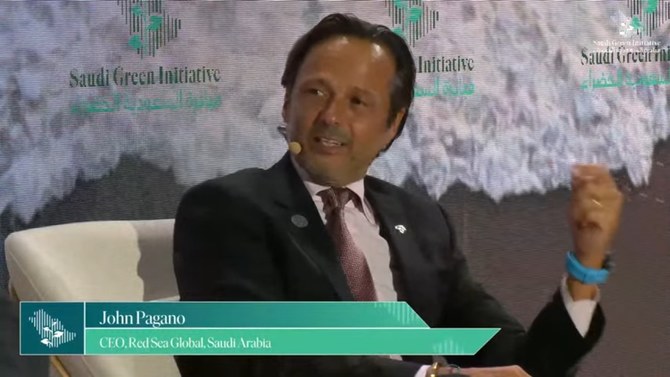
During a panel discussion at the 2023 UN Climate Change Conference in Dubai, John Pagano, CEO of Red Sea Global, highlighted how the company has shifted from sustaining its natural landscape to healing and recovering what has been damaged.  

“When we started our journey six years ago, we talked about setting new standards in sustainability and we came to realize fairly quickly that sustainability is no longer enough, and we coined the term regeneration,” Pagano said.  

He further underscored that maintaining the status quo is no longer adequate, stating: “We are on a terrible trajectory.”  

Moreover, Pagano urged global leaders to take action and “change course,” emphasizing the current bleak outlook of the future.

Accompanying Pagano, Carlos Duarte, professor and marine scientist at King Abdullah University of Science and Technology, supported the call for action.  

“We have a commitment to our youth not to hand over a planet that is crippled, but a planet with oceans and a Red Sea that can support generations to come,” Duarte said.  

“The bold decision that we are taking globally is that we are no longer content with conservation; we need to go into regeneration,” he added.

Both speakers highlighted the concept of “natural capital” and how this will be used as a global metric for investors to measure a country’s economic performance. Natural capital refers to the stock of renewable and non-renewable natural resources that aid citizens. The term highlights the importance of maintaining and managing ecosystems and their services for the long-term benefit of society.

“The private sector is key to the future of biodiversity and the future of climate and without the involvement from the private sector, we will not meet our goals. That is where concepts like natural capital are very important. Now, natural capital is the new real estate,” Duarte said.

Pagano further added that aside from a country’s gross domestic product, investors will use natural capital as a measure for investment analysis.

RSG has become one of Saudi Arabia’s leading sustainable tourism developments with projects that bring together luxury and clean energy.

“We’ve delivered on the promises that we made dating back to six years ago but we’re doing it sustainably. Six Senses Southern Dunes is totally renewable energy-powered, 24 hours a day, completely off-grid,” Pagano said during the panel discussion.

“We are able to literally push the boundaries of what is possible today,” he added.


Acwa signs key terms to develop 5GW of renewable energy capacity in Turkiye

Updated 23 February 2026
Follow

Acwa signs key terms to develop 5GW of renewable energy capacity in Turkiye

JEDDAH: Saudi utility giant Acwa has signed key investment agreements with Turkiye’s Ministry of Energy and Natural Resources to develop up to 5 gigawatts of renewable energy capacity, starting with 2GW of solar power across two plants in Sivas and Taseli.

Under the investment agreement, Acwa will develop, finance, and construct, as well as commission and operate both facilities, according to a press release.

The program builds on the company’s first investment in Turkiye, the 927-megawatt Kirikkale Independent Power Plant, valued at $930 million, which offsets approximately 1.8 million tonnes of carbon dioxide annually, the statement added.

A separate power purchase agreement has been concluded with Elektrik Uretim Anonim Sirketi for the sale of electricity generated by each facility.

Turkiye aims to boost solar and wind capacity to 120GW by 2035, supported by around $80 billion in investment, while recent projects have already helped prevent 12.5 million tonnes of CO2 emissions and reduced reliance on imported natural gas.

Turkiye’s energy sector has undergone a rapid transformation in recent years, with renewable power emerging as a central pillar of its strategy.

Raad Al-Saady, vice chairman and managing director of ACWA, said: “The signing of the IA (implementation agreement) and PPA key terms marks a pivotal moment in Acwa’s partnership with Turkiye, reflecting the country’s strong potential as a clean energy leader and manufacturing powerhouse.”

He added: “Building on our long-standing presence, including the 927MW Kirikkale Power Plant commissioned in 2017, this step elevates our partnership to a new level,” Al-Saady said.

In its statement, Acwa said the 5GW renewable energy program will deliver electricity at fixed prices, enhancing predictability for grid planning and supporting long-term industrial investment.

By replacing imported fossil fuels with domestically generated clean energy, the initiative is expected to reduce Turkiye’s exposure to global energy market volatility, strengthening energy security and lowering long-term power costs.

The company added that the economic impact will extend beyond the anticipated investment of up to $5 billion in foreign direct investment, with thousands of jobs expected during the construction phase and hundreds of high-skilled roles created during operations.

The energy firm concluded that its existing progress in Turkiye reflects a strong appreciation for Turkish engineering, construction, and manufacturing capacity, adding that localization has been a strategic priority, and it has already achieved 100 percent local employment at its developments in the country.