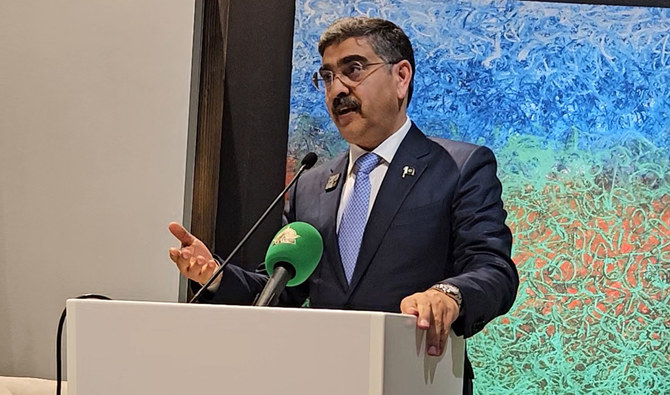
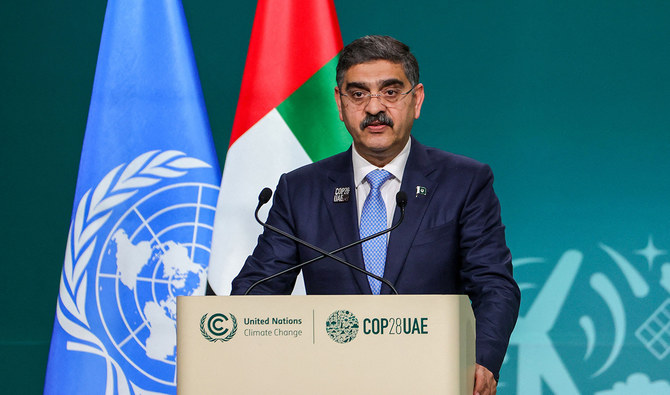
ISLAMABAD: Caretaker Prime Minister Anwaar-ul-Haq Kakar told a gathering on the margins of the United Nations climate conference in Dubai on Sunday Pakistan needed up to $17 billion for the next 15 years to work on the ecological restoration of the Indus River.
The giant waterway, nurturing the ancient Indus Valley Civilization, one of the world’s earliest urban cultures, has been a lifeline for the region for millennia, fostering agricultural prosperity and cultural development.
It continues to remains crucial to Pakistan’s sustenance, ensuring its food security, providing vital water resources and driving economic growth through hydroelectric power and other industries.
The prime minister, who is currently on a week-long visit to the Middle East and leading his country’s delegation at the 28th UN Conference of Parties (COP28) that began on Nov. 30, raised the issue at a ceremony organized by Living Indus, the largest climate initiative in Pakistan.
“Pakistani government is clear on its priorities with Living Indus, and we will work together to tackle the challenges, especially now that climate changes are aggravating,” he said.
“This initiative suggests that we need a minimum indicative investment of $11-17 billion over the next 15 years to mobilize from the public and private sector, citizens and communities,” he added.
Launched last September with UN support, the Living Indus initiative aims to protect and restore the vital river. The project aims to address challenges such as water scarcity, pollution, and habitat degradation through conservation and sustainable management.
The Indus Basin is home to 90 percent of Pakistan’s population and contributes to over three-quarters of its economy.
Despite its historical and ecological significance, however, the Indus is said to be the world’s second most polluted river.
Kakar thanked the World Wildlife Fund, United States Agency for International Development, Coca-Cola Foundation and Green Climate Fund for successfully developing “Recharge Pakistan” that aims to reduce climate vulnerability, calling it the first step toward Living Indus.
The project is designed to increase water storage and recharge through wetlands, floodplains and hill-torrents management.
“This will come in pieces, we understand, especially as Pakistan is facing a financial challenge,” he said, adding the flagship project with an international commitment to climate finance of nearly $78 billion was central to the country’s efforts in reducing future flooding and drought impacts.
The prime minister said flood and water resource management under the Living Indus framework would not only benefit millions of citizens but also serve as a model for climate innovation on a global scale.
“But more important is that the Living Indus initiative seeks to mobilize a movement that repairs and restores a healthy Indus for today and tomorrow,” he added.


Pakistan PM stresses $17 billion Indus River restoration need at Dubai’s COP28 sideline event
https://arab.news/48nat
Pakistan PM stresses $17 billion Indus River restoration need at Dubai’s COP28 sideline event

- Ninety percent of Pakistan’s people and more than three-quarters of its economy reside in the Indus Basin
- Kakar applauds project to increase water storage and recharge through wetlands, hill-torrents management

Pakistan face USA in their second T20 World Cup clash today
- Pakistan suffered a shock defeat at the hands of the USA in the 2024 T20 World Cup tournament
- Pakistan will then head on to play against arch-rivals India in high-octane clash in Colombo on Feb. 15
ISLAMABAD: Skipper Salman Ali Agha will be wary of the challenge a spirited USA can pose for his side on Tuesday as Pakistan face the minnows for their second T20 World Cup clash in Colombo tonight.
Pakistan will look to avenge their shock 2024 World Cup loss to USA when the latter beat the Asian giants in a thriller that went down to the Super Over. Pakistan lost their other fixture against India after the shock defeat, crashing out of the 2024 World Cup in the early stage.
Agha’s side were headed for yet another World Cup upset on Saturday against the Netherlands if it were not for Faheem Ashraf’s penultimate over heroics, who sealed the game for the Green Shirts with stellar power hitting. The USA, on the other hand, gave a tough time to India in their opening World Cup fixture last week. The defending champions were struggling at 77-6 at one point in time before skipper Suryakumar Yadav rescued them with an unbeaten 84-run knock.
“Another exciting day of #T20WorldCup cricket,” the International Cricket Council (ICC) wrote on social media platform X.
Apart from the Pakistan fixture, New Zealand take on UAE while Namibia face the Netherlands in the World Cup fixtures today.
USA leg-spinner Mohammad Mohsin said on Monday that the pressure will be on Pakistan when the two sides take the field on Tuesday.
“The pressure of losing the last game will be on Pakistan,” he said. “I have played with most of the players in this Pakistan team, so I have given my input to the team and we are a more skilled and confident team.”
The match is scheduled to begin at 6:30 p.m. Pakistan Standard Time.
After the USA fixture, Pakistan will face India on Feb. 15 for a high-octane World Cup clash after the Pakistani government announced it was ending its boycott and would face their arch-rivals on the cricket field.
The decision was taken after Pakistan Prime Minister Shehbaz Sharif spoke with Sri Lankan President Anura Kumara Dissanayake on Monday and was briefed on negotiations between Pakistan’s cricket board, the International Cricket Council (ICC) and other stakeholders on Sunday.
Pakistan had announced on Feb. 1 it was pulling out of its World Cup match against India due to the ICC’s decision of replacing Bangladesh with Scotland. Bangladesh had said it would not play its World Cup matches in India owing to security fears and requested different venues. The ICC refused, drawing sharp protests from Pakistan and Bangladesh.
The Bangladesh Cricket Board (BCB) earlier thanked the PCB, ICC and all others for their positive roles in trying to “overcome recent challenges,” particularly thanking PCB Chairman Mohsin Naqvi and Pakistani cricket fans for demonstrating “exemplary sportsmanship and solidarity.”
An India-Pakistan fixture is the sport’s most lucrative asset, generating a massive share of global broadcasting and sponsorship revenue.


