

Rising human activity threatens space sustainability, warn experts at COP28

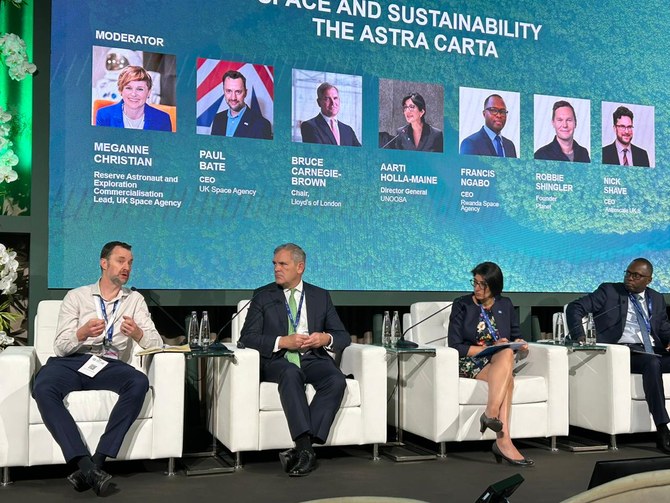
During a panel on “Sustainability in Space,” the speakers noted that while space exploration programs were traditionally exclusively led by governments, the entry of the private sector has added complexity to the situation, with a significantly increased number of satellites being launched each year. AN Photo
Short Url
Updated 03 December 2023
Follow

Rising human activity threatens space sustainability, warn experts at COP28

DUBAI: A threat to space sustainability has been underscored by experts at COP28 in Dubai, shedding light on the escalating impact of increased human activity. 

During a panel on “Sustainability in Space,” the speakers noted that while space exploration programs were traditionally exclusively led by governments, the entry of the private sector has added complexity to the situation, with a significantly increased number of satellites being launched each year. 

Bruce Carnegie-Brown, chairman, of LIoyd’s of London, a leading insurance firm, said: “We have seen some 9,000 satellites now in Low Earth Orbit, and that has doubled just in the last two years. So, the risks are going up, the frequency of potential collisions is going up, and the debris as a result is hugely on the rise.”  

He added: “We need to put in place things at the outset that force people to clean up after themselves, rather than think about it as an afterthought.”  

According to Nick Shave, CEO of Astroscale, a British space firm, the problem is even more severe. “There are 40,000 objects in space that are anything bigger than about a grapefruit. As you can see, there’s quite a difference in those numbers. And that’s because there’s a lot of fragmentation. We’ve seen different pieces of debris or debris and satellites hit each other and create fragmentation,” Shave explained. 

The increasing incidents of space collisions are even more concerning as the debris simply stays in orbit for decades or even longer, and it is difficult, if not impossible, to remove, warned another expert. 

“If you are in the ocean, or you’re on land or in the air, if something breaks, it kind of comes down, and then you can easily pick it up. If something breaks in space, it’s up there for hundreds of years,” said Robbie Schingler, founder of Planet Labs PBC. 

However, experts added that technologies were being developed to solve the problem. “There are a number of companies, including my company Astroscale, developing what we call active debris removal technology,” said Shave.  

He explained that these technologies go into orbit to assess the debris up close, capture it with robotics or other technologies, bring it down into a lower orbit, and dispose of it in the Earth’s atmosphere.  

Shave added: “There are other ways we are looking to dispose of that forward. So, there are a number of technologies that we’re in the technology proving phase at the moment.” 

Even astronauts, who are currently the only inhabitants of space, believe that more — much more — should be done to protect space. 

“When I am asked about whether I, we are, part of the problem or part of the solution to anthropogenic climate change, I want to be guilty of nothing more than being an ambassador for sustainability. What more can we do? What more should we do to show, not merely say, that our sector is doing to space sustainability for a sustainable Earth?” said Meganne Christian, reserve astronaut and exploration commercialization lead at the UK Space Agency. 

Related


PIF-backed AviLease achieves revenue of $664m and 19% growth in 2025

Updated 27 February 2026
Follow

PIF-backed AviLease achieves revenue of $664m and 19% growth in 2025

RIYADH: Saudi Arabia’s Public Investment Fund-backed AviLease achieved exceptional performance and sustainable business growth during 2025, supported by the strategic expansion of its global platform.

According to its financial results for 2025, AviLease recorded total revenues of $664 million, an annual increase of 19 percent, driven by disciplined growth in its asset portfolio and strong performance in aircraft remarketing amid sustained global demand for modern, fuel-efficient aircraft, the Saudi Press Agency reported.

Profit before tax doubled compared to the previous year, reaching $122 million. The year witnessed an expansion in AviLease’s portfolio, reaching 202 owned and managed aircraft, leased to over 50 airline companies in more than 30 countries. 

The total value of the company’s assets stabilized at $9.3 billion. AviLease maintained a 100 percent fleet utilization rate, reflecting the resilience of its business model, the efficiency of its asset management, and the strength of its strategic relationships with airlines around the world.

AviLease concluded purchase agreements for aircraft from Airbus, including the A320neo family and A350F, and Boeing 737 aircraft, aiming to enhance its future asset portfolio with modern, fuel-efficient aircraft. This step will contribute to supporting future growth and meeting increasing customer demand for the latest aircraft, aligning with the Kingdom’s ambitions to become a leading global aviation hub.

AviLease strengthened its prestigious credit standing by obtaining a strong Baa2 credit ratings from Moody’s and BBB from Fitch, reflecting its financial solidity, managerial discipline, and efficiency in managing leverage. The company also successfully issued senior unsecured bonds worth $850 million last November under Regulation 144A/RegS. This issuance contributed to diversifying its funding sources and enhancing its financial flexibility.

Commenting on the results, AviLease CEO Edward O’Byrne said: “This exceptional performance reflects the quality of the company’s investment portfolio, the strength of its partnerships with airlines, and its strategic focus on responsibly deploying capital into highly sought-after, efficient, modern aircraft assets.”

He added: “As aviation markets continue to grow, AviLease is strategically positioned to continue its expansion plans and deliver sustainable long-term value for shareholders, contributing to the Kingdom’s ambitions.”

Throughout 2025, AviLease continued to play a pivotal role in the Kingdom’s growing aviation sector and contributed directly to the launch and scaling of the new national carrier, Riyadh Air, by completing a sale and leaseback transaction for a Boeing 787-9 aircraft, which thereby became the first aircraft to join the airline’s fleet.

AviLease also established a strategic partnership with Hassana Investment Co. This partnership aims to provide an opportunity for local and international investors to enter the aircraft financing asset class and benefit from AviLease’s technical expertise and operational capabilities to support partnership growth and enhance performance. 

Hassana Investment Co. has agreed to acquire an initial portfolio of 10 modern aircraft from AviLease.