

Major aftershocks jolt Philippines after magnitude 7.6 quake

1 / 2
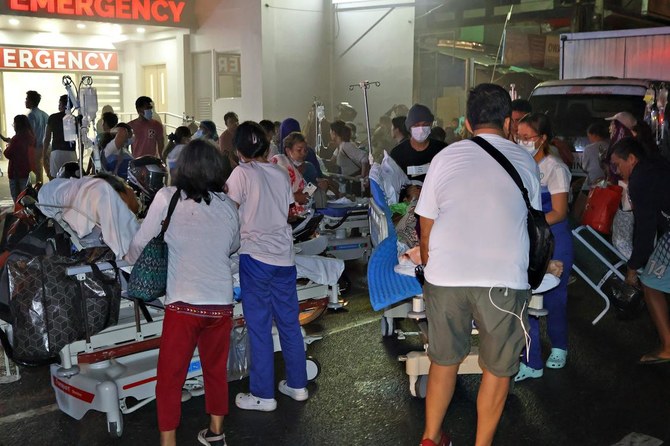
Residents and medical personnel evacuate patients from inside a hospital after a 7.6 earthquake struck Butuan City, in southern island of Mindanao late Dec. 2, 2023. (AFP)
2 / 2
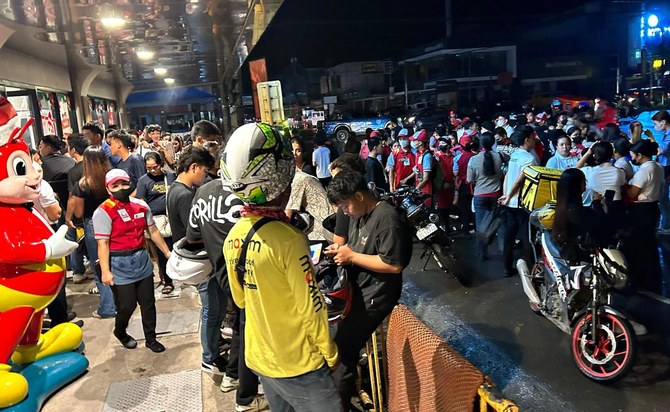
People gather along a street after evacuating from inside buildings after a 7.6 earthquake struck Butuan City, in southern island of Mindanao late Dec. 2, 2023. (AFP)
Short Url
Updated 03 December 2023
Follow

Major aftershocks jolt Philippines after magnitude 7.6 quake

  • The Pacific Tsunami Warning Center initially said that based on the magnitude and location, it expected tsunami waves to hit the southern Philippines
  • In Japan, authorities issued evacuation orders in various parts of Okinawa Prefecture

MANILA: A powerful magnitude 7.6 earthquake struck the southern Philippines on Saturday, the US Geological Survey reported, followed by four major aftershocks that sent residents fleeing from coastal areas amid fears of a tsunami.
The initial quake struck off the coast of the country at a depth of 32 kilometers (20 miles) at 10:37 p.m. local time (1437 GMT) about 21 kilometers northeast of Hinatuan municipality on Mindanao island, the USGS said.
Early on Sunday, over the span of several hours, four powerful aftershocks of magnitudes 6.4, 6.2, 6.1 and 6.0 rumbled through the region, the USGS said.
The initial quake triggered tsunami warnings — which were later downgraded — across the Pacific region and sent residents in northeast Mindanao fleeing buildings, evacuating a hospital and seeking higher ground.
“Destructive tsunami is expected with life threatening wave heights,” the Philippine Institute of Volcanology and Seismology said on X, formerly Twitter.
The Pacific Tsunami Warning Center in Hawaii also issued an alert but later posted that the danger had passed.
“There is no longer a tsunami threat from this earthquake,” it said in a message.
The Philippines seismology institute said in a bulletin at 3:23 am (1923 GMT) local time that the highest waves generated by the seismic activity were .64 meters (25 inches) tall on Mawes Island, but that the tsunami warning had ended.
Small swells were reported as far as Japan’s eastern Pacific coast, where a tsunami warning was also briefly in effect. Palau, a western Pacific archipelago some 900 kilometers (560 miles) off Mindanao, reported no impact.
Hinatuan police Sergeant Joseph Lambo said the quake was “very strong” but that there were no reports of casualties or major property damage.
“Appliances fell off the shelves at the police office and two TV sets were broken. The motorcycles parked outside also tumbled down,” Lambo told AFP.
“Right now we don’t have reports of damage or casualties but people are evacuating because of the tsunami alert.”
Lambo said the 45,000 residents in the municipality had been ordered to leave their homes and many were going on foot or in vehicles to higher ground.
A video posted on social media and verified by AFP showed bottles of drinks and other products falling off shelves in a convenience store as staff fled outside.
Another video, shot by Dennis Orong, showed people screaming as they ran along a street in Lianga, a coastal municipality of Surigao del Sur.
“I was shaking in fear, mainly because of exploding electric poles,” the 26-year-old hairdresser told AFP.
“It was very traumatic.”

Social media reports of a tsunami hitting Lingig municipality, about 35 kilometers south of Hinatuan, were “fake news,” said police Master Sergeant Robert Quesada.
“We’re at low tide,” he said.
“People evacuated away from the coast soon after. We can’t say how many at this point, but pretty much the entire town is along the coast.”
Many people, including Bethanie Valledor, were asleep when the quake struck.
“I felt like the room we’re staying in would be destroyed,” Valledor, 24, told AFP after fleeing the resort where she had been staying, about 20 kilometers southwest of Hinatuan.
“Our place is very near the sea. The resort owner asked us to evacuate immediately. Honestly, I was screaming. I panicked.”
In Butuan City, northwest of Hinatuan, orderlies evacuated patients on gurneys and in wheelchairs from a hospital, their drip and IV bags hanging from support stands.
The quake came nearly two weeks after a 6.7 magnitude quake hit Mindanao, killing at least nine people, shaking buildings and causing part of the ceiling of a shopping mall to collapse.
Quakes are a daily occurrence in the Philippines, which sits along the Pacific “Ring of Fire,” an arc of intense seismic and volcanic activity that stretches from Japan through Southeast Asia and across the Pacific basin.
Most are too weak to be felt by humans, but strong and destructive quakes come at random with no technology available to predict when and where they will happen.


Philippines eyes closer cooperation on advanced defense tech with UAE

Updated 7 sec ago
Follow

Philippines eyes closer cooperation on advanced defense tech with UAE

  • Philippine-UAE defense agreement is Manila’s first with a Gulf country
  • Philippines says new deal will also help modernize the Philippine military

MANILA: The Philippines is seeking stronger cooperation with the UAE on advanced defense technologies under their new defense pact — its first such deal with a Gulf country — the Department of National Defense said on Friday.

The Memorandum of Understanding on Defense Cooperation was signed during President Ferdinand Marcos Jr.’s visit to Abu Dhabi earlier this week, which also saw the Philippines and the UAE signing a comprehensive economic partnership agreement, marking Manila’s first free trade pact with a Middle Eastern nation.

The Philippines-UAE defense agreement “seeks to deepen cooperation on advanced defense technologies and strengthen the security relations” between the two countries, DND spokesperson Assistant Secretary Arsenio Andolong said in a statement.

The MoU “will serve as a platform for collaboration on unmanned aerial systems, electronic warfare, and naval systems, in line with the ongoing capability development and modernization of the Armed Forces of the Philippines,” he added.

It is also expected to further military relations through education and training, intelligence and security sharing, and cooperation in the fields of anti-terrorism, maritime security, and peacekeeping operations.

The UAE’s Ministry of Foreign Affairs has described security and defense as “very promising fields” in Philippine-UAE ties, pointing to Abu Dhabi being the location of Manila’s first defense attache office in the Middle East.

The UAE is the latest in a growing list of countries with defense and security deals with the Philippines, which also signed a new defense pact with Japan this week.

“I would argue that this is more significant than it looks on first read, precisely because it’s the Philippines’ first formal defense cooperation agreement with a Gulf state. It signals diversification,” Rikard Jalkebro, associate professor at the Anwar Gargash Diplomatic Academy in Abu Dhabi, told Arab News.

“Manila is widening its security partnerships beyond its traditional circles at a time when strategic pressure is rising in the South China Sea, and the global security environment is (volatile) across regions.”

Though the MoU is not an alliance and does not create mutual defense obligations, it provides a “framework for the practical stuff that matters,” including access, training pathways, procurement discussions and structured channels” for security cooperation, he added.

“For the UAE, the timing also makes sense, seeing that Abu Dhabi is no longer only a defense buyer; it’s increasingly a producer and exporter, particularly in areas like UAS (unmanned aerial systems) and enabling technologies. That opens a new lane for Manila to explore capability-building, technology transfer, and industry-to-industry links,” Jalkebro said.

The defense deal also matters geopolitically, as events in the Middle East and the Indo-Pacific region have ripple effects on global stability and commerce.

“So, a Philippines–UAE defense framework can be read as a pragmatic hedge, strengthening resilience and options without formally taking sides,” Jalkebro said.