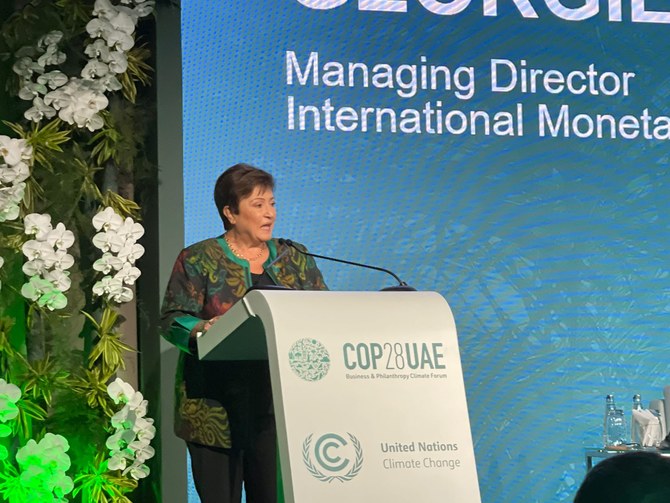

DUBAI: The US should participate, rather than being a “loud opponent,” in carbon pricing, urged the director of the International Monetary Fund.
Addressing the Business and Philanthropy Climate Forum alongside the UN Climate Conference, Kristalina Georgieva affirmed that the US must not hinder the world from “moving in the right direction.” Instead, the country should explore the standards and regulatory fees it needs to implement carbon pricing into its economic model.
The director deemed carbon pricing a “wonderful instrument” due to its dual role in revenue generation and addressing inequality. The principle is straightforward: the more emissions one creates, the more one consumes, resulting in a proportional payment.
According to Georgieva, revenues generated from carbon pricing can be strategically directed to compensate the most vulnerable parts of the global population. Assessments by the IMF indicate that allocating 20 percent of these revenues significantly support the 30 percent most vulnerable areas, providing them with the “much-needed” backing.
The IMF chief emphasized that “carbon price is a very strong incentive, much stronger than anything else we can invent.”
Addressing concerns about the political feasibility of carbon prices in various places, she expressed disagreement, asserting that carbon pricing can be implemented in diverse ways.
She added: “It can be a tax, and when it is a tax, it is the most efficient and impactful way.”
Georgieva pointed out that in countries where carbon tax was gradually introduced, emissions saw a significant reduction of 30 to 40 percent. Furthermore, she highlighted European trading mechanisms that have successfully generated $190 billion in revenue.
Despite the current average carbon price standing at $20 per ton in areas covered by carbon pricing, when amalgamating this figure with 75 percent of the world without carbon pricing, the average carbon price would fall to $5, she noted.
According to the IMF, a package of measures, including carbon pricing, the elimination of harmful subsidies, and policy support, would significantly accelerate decarbonization. The director instilled the idea that adopting such measures could empower the global population to “make this decade one that we take pride in.”
Fossil fuel direct subsidies soared to a record $1.3 trillion in the last year, driven by support measures in response to the cost-of-living crisis, as stated by Georgieva. When factoring in indirect subsidies, such as those arising from the absence of carbon pricing addressing environmental and health damage, the total surges to $7.1 trillion.
“We need to go from $900 million where we are now to $5 trillion to make decarbonization a reality. The question is, is $5 trillion, a lot of money? Well, it’s obviously not a little but put $5 trillion next to $7.1 trillion in direct and indirect subsidies, or next to the size of the world economy, which is over $100 trillion,” the director outlined.
She added: “I think we should be brave and say yes, it can be done, except it will be only done if we get the private sector to move faster and especially move faster in the developing world where emissions are growing. I’m an optimist; I have seen gradually moving on blended finance in a meaningful way.”
Emphasizing the significance of climate finance, the IMF chief affirmed that when considering all nationally determined contributions for this decade, they would result in only an 11 percent reduction in emissions.
To uphold the commitment to limiting the temperature increase to 1.5 degrees Celsius, it would instead require contributions ranging between 25 and 50 percent, as highlighted by Georgieva.
Meanwhile, private funds currently contribute 40 percent to climate finance. To meet emission targets, this figure must escalate to 80 or 90 percent.
Despite climate risks being “macro-critical” and impacting economies, communities, and households, ultimately leading to financial instability, the director highlighted that transitioning to the new climate economy presents “unique opportunities” for green growth and job creation.
While the world economy has demonstrated resilience during challenges such as the pandemic and global conflicts, Georgieva, however, acknowledged that the IMF recognizes the current growth rate as “slow.”
The organization is forecasting a modest 3 percent year-on-year growth rate for the next five years, nearly a full percentage point below the average of 3.8 percent observed in the preceding decade.
The director expressed concerns that geopolitical tensions might exacerbate economic fragmentation amid a global climate crisis. This situation has left the entity “very concerned” about the growing inequality both within and across countries.
There exists a striking contrast between economies with a robust capacity to cope and low-income countries, where many have become “way more vulnerable” to climate devastation while grappling with adaptation challenges.
In response to this disparity, the director emphasized the urgent need for cooperation. She called on companies and global bodies to emulate the proactive approach of the IMF, recognizing the importance of collective efforts in addressing the vulnerabilities and challenges posed by climate change.
The director said, “There is nothing we can do each one of us alone, but we can make a difference working together.”
She highlighted the IMF’s transformative shift in its approach over the last few years, integrating climate considerations into policy engagement. The focus involves mitigation strategies for countries facing high water levels, adaptation support for vulnerable nations, and transition plans for those heavily reliant on hydrocarbon sectors.
“As a financial institution, the IMF has to put our money where our mouth is,” asserted Georgieva. This commitment materialized in the establishment of the $40 billion Resilience and Sustainability Trust.
Concluding her statement, the director expressed gratitude to the UAE for its recent contribution, with 11 countries having already accessed the fund. The UAE, as the newest contributor, provided 200 million dirhams ($54.46 million) as of Dec. 1.