Pakistani school wins $100,000 Zayed Prize for Sustainability at UAE's COP28 conference

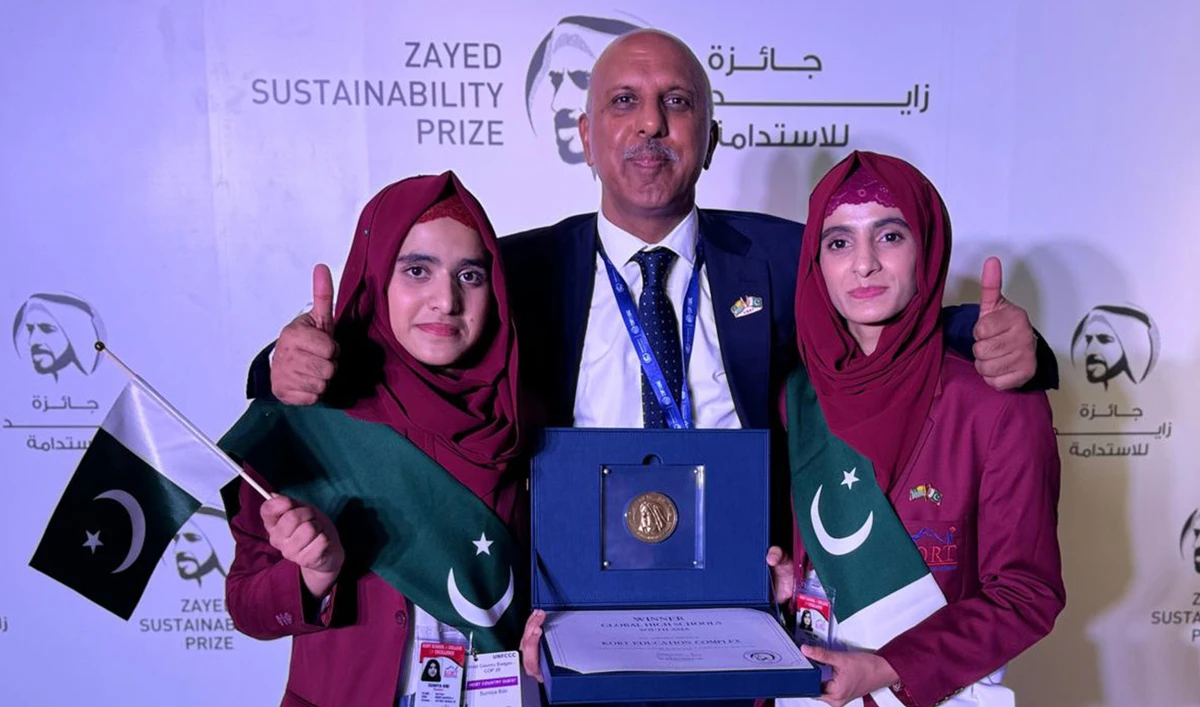
Ch Mohammed Akhtar (center), the Founding Chairman of Kashmir Orphan Relief Trust (KORT) with students Sumaiya Bibi (left) and Kinza Bibi after winning the Zayed Sustainability Prize for the best Global School in South Asia at Expo City in Dubai, UAE on December 1, 2023. (AN Photo)
Short Url
Updated 02 December 2023
Follow

Pakistani school wins $100,000 Zayed Prize for Sustainability at UAE's COP28 conference

  • Located in Azad Kashmir, the school was recognized for water conservation and organic farming
  • Competing with finalists from India and Bangladesh, it was declared the best school in South Asia

DUBAI: A Pakistani school won the prestigious Zayed Sustainability Prize of $100,000 after being declared the best Global School in South Asia for its innovative project on water conservation and organic farming at the UN climate conference in Dubai on Friday.
The school is operated by the Kashmir Orphan Relief Trust (KORT) and was competing for the prize against two other finalists from India and Bangladesh.
Two young representatives of the trust were present at the gathering at the Expo City in Dubai where United Arab Emirates President Sheikh Mohamed bin Zayed presented the award.
The Zayed Sustainability Prize honors the legacy of UAE’s founding father Sheikh Zayed bin Sultan Al Nahyan by rewarding small and medium enterprises, non-profit organizations, and high schools addressing health, food, energy, water and climate-related challenges.
The prize has been awarded to 106 recipients in the last 15 years to positively impact the lives of 384 million people worldwide.
“Our project is on water conservation because, in 2025, clean drinking water will finish in Pakistan,” Sumaiya Bibi, 19, told Arab News after receiving the award on behalf of the trust.
After losing her parents in the 2005 earthquake in Pakistan’s Kashmir region, she found a sense of direction by focusing on climate-related projects.
“We want to set up water filtration plants and sensor taps in our school to minimize water wastage,” she said. “We also want to set up a kitchen garden in our school through organic farming so that the children can get nutrition from the organically grown food.”
KORT School and College of Excellence is based in Azad Kashmir and was set up in 2016 for children who were orphaned in the devastating earthquake. The facility is serving over 500 students.
The trust also opened another school in Swabi this October which can house 450 children. For the past several years, KORT has been supporting and providing orphaned children with education, boarding facilities, food, clothing and medical care.
Kinza Bibi, another 19-year-old student at the education institute in Kashmir who also represented the trust at the event said: “We want the children at the school to learn how to preserve clean water.”
According to the founding chairman of the organization, Chaudhry Mohammed Akhtar, the prize money would be used to undertake projects related to clean water and organic farming in rural areas.
The 11 winners of the prize this year were elected in September by a panel of jury members, who evaluated each submission for its contribution and commitment to delivering impactful, innovative, and inspiring solutions across the six categories of health, food, energy, water, climate action and global high schools.
This year, the 11 winners across all these categories shared a total prize fund of $3.6 million for their pioneering solutions to transform lives and accelerate environmental change around the world.

Return of millions of Afghans from Pakistan and Iran pushes Afghanistan to the brink, UN warns

Updated 14 February 2026
Follow

Return of millions of Afghans from Pakistan and Iran pushes Afghanistan to the brink, UN warns

  • Afghan authorities provide care packages for those returning that include food aid, cash, a telephone SIM card and transportation
  • But the returns have strained resources in a country struggling with a weak economy, severe drought and two devastating earthquakes

GENEVA: The return of millions of Afghans from neighboring Pakistan and Iran is pushing Afghanistan to the brink, the U.N. refugee agency said on Friday, describing an unprecedented scale of returns.

A total of 5.4 million people have returned to Afghanistan since October 2023, mostly from the two neighboring countries, UNHCR’s Afghanistan representative Arafat Jamal said, speaking to a U.N. briefing in Geneva via video link from Kabul, the Afghan capital.

“This is massive, and the speed and scale of these returns has pushed Afghanistan nearly to the brink,” Jamal said.

Pakistan launched a sweeping crackdown in Oct. 2023 to expel migrants without documents, urging those in the country to leave of their own accord to avoid arrest and forcible deportation and forcibly expelling others. Iran also began a crackdown on migrants at around the same time.

Since then, millions have streamed across the border into Afghanistan, including people who were born in Pakistan decades ago and had built lives and created businesses there.

Last year alone, 2.9 million people returned to Afghanistan, Jamal said, noting it was “the largest number of returns that we have witnessed to any single country.”

Afghanistan’s Taliban rulers have criticized the mass expulsions.

Afghanistan was already struggling with a dire humanitarian situation and a poor human rights record, particularly relating to women and girls, and the massive influx of people amounting to 12% of the population has put the country under severe strain, Jamal said.

Already in just the month and a half since the start of this year, about 150,000 people had returned to Afghanistan, he added.

Afghan authorities provide care packages for those returning that include some food aid, cash, a telephone SIM card and transportation to parts of the country where they might have family. But the returns have strained resources in a country that was already struggling to cope with a weak economy and the effects of a severe drought and two devastating earthquakes.

In November, the U.N. development program said nine out of 10 families in areas of Afghanistan with high rates of return were resorting to what are known as negative coping mechanisms — either skipping meals, falling into debt or selling their belongings to survive.

“We are deeply concerned about the sustainability of these returns,” Jamal said, noting that while 5% of those who return say they will leave Afghanistan again, more than 10% say they know of someone who has already left.

“These decisions, I would underscore, to undertake dangerous journeys, are not driven by a lack of a desire to remain in the country, on the contrary, but the reality that many are unable to rebuild their viable and dignified lives,” he said.