DUBAI: A Pakistani school won the prestigious Zayed Sustainability Prize of $100,000 after being declared the best Global School in South Asia for its innovative project on water conservation and organic farming at the UN climate conference in Dubai on Friday.
The school is operated by the Kashmir Orphan Relief Trust (KORT) and was competing for the prize against two other finalists from India and Bangladesh.
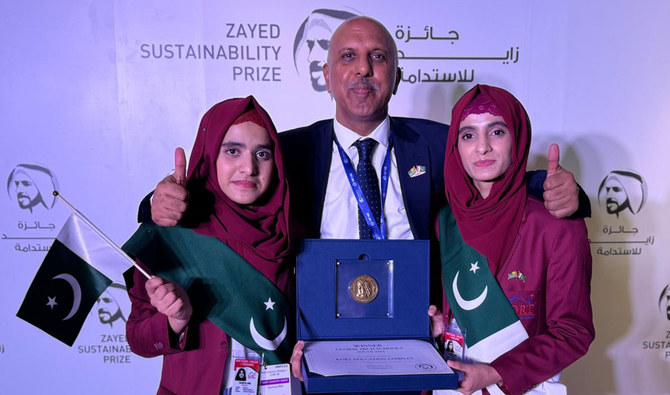
Two young representatives of the trust were present at the gathering at the Expo City in Dubai where United Arab Emirates President Sheikh Mohamed bin Zayed presented the award.
The Zayed Sustainability Prize honors the legacy of UAE’s founding father Sheikh Zayed bin Sultan Al Nahyan by rewarding small and medium enterprises, non-profit organizations, and high schools addressing health, food, energy, water and climate-related challenges.
The prize has been awarded to 106 recipients in the last 15 years to positively impact the lives of 384 million people worldwide.
“Our project is on water conservation because, in 2025, clean drinking water will finish in Pakistan,” Sumaiya Bibi, 19, told Arab News after receiving the award on behalf of the trust.
After losing her parents in the 2005 earthquake in Pakistan’s Kashmir region, she found a sense of direction by focusing on climate-related projects.
“We want to set up water filtration plants and sensor taps in our school to minimize water wastage,” she said. “We also want to set up a kitchen garden in our school through organic farming so that the children can get nutrition from the organically grown food.”
KORT School and College of Excellence is based in Azad Kashmir and was set up in 2016 for children who were orphaned in the devastating earthquake. The facility is serving over 500 students.
The trust also opened another school in Swabi this October which can house 450 children. For the past several years, KORT has been supporting and providing orphaned children with education, boarding facilities, food, clothing and medical care.
Kinza Bibi, another 19-year-old student at the education institute in Kashmir who also represented the trust at the event said: “We want the children at the school to learn how to preserve clean water.”
According to the founding chairman of the organization, Chaudhry Mohammed Akhtar, the prize money would be used to undertake projects related to clean water and organic farming in rural areas.
The 11 winners of the prize this year were elected in September by a panel of jury members, who evaluated each submission for its contribution and commitment to delivering impactful, innovative, and inspiring solutions across the six categories of health, food, energy, water, climate action and global high schools.
This year, the 11 winners across all these categories shared a total prize fund of $3.6 million for their pioneering solutions to transform lives and accelerate environmental change around the world.


![]()

Pakistani school wins $100,000 Zayed Prize for Sustainability at UAE's COP28 conference
Short Url
https://arab.news/cs59w
Pakistani school wins $100,000 Zayed Prize for Sustainability at UAE's COP28 conference
- Located in Azad Kashmir, the school was recognized for water conservation and organic farming
- Competing with finalists from India and Bangladesh, it was declared the best school in South Asia
Latest updates






© 2026 SAUDI RESEARCH & PUBLISHING COMPANY, All Rights Reserved And subject to Terms of Use Agreement.