- Lebanese PM highlights environmental deterioration due to Israeli hostilities
- Use of prohibited weapons including white phosphorus denounced
BEIRUT: Israeli forces and Hezbollah militants exchanged fire across the Israel-Lebanon border on Saturday in a second day of hostilities.
Israeli airstrikes hit multiple border towns as the Israeli army said that it had “retaliated against attacks originating from southern Lebanon.”
Caretaker Prime Minister Najib Mikati said Israeli aggression against Lebanon was not only affecting its people but also causing environmental damage.
“Large areas in Lebanon have been exposed to severe impacts, leading to environmental deterioration resulting from the ongoing Israeli hostilities,” Mikati, who is currently attending the COP28 conference in Dubai, said.
He said Israeli violations included the use of prohibited weapons such as white phosphorus, which killed civilians and caused irreparable damage to more than 5 million square meters of forest, agricultural land, and thousands of olive trees, all of which would lead to the destruction of livelihoods and sources of income and the displacement of tens of thousands of Lebanese.
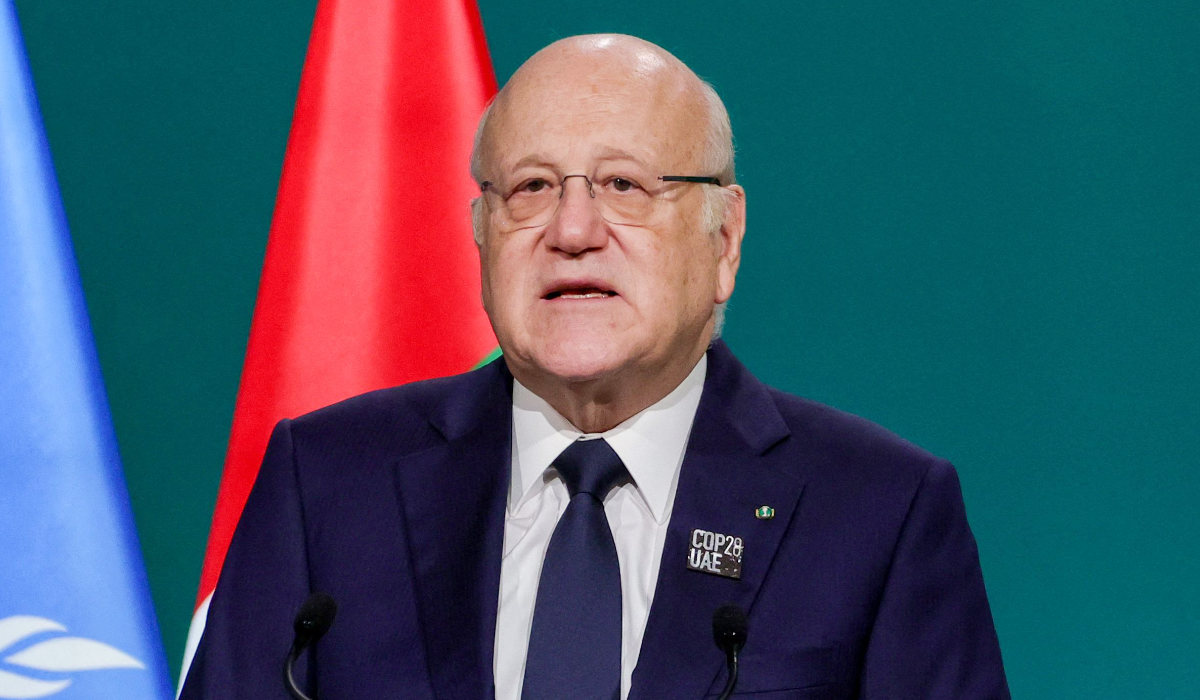
Mikati met with Irish Prime Minister Leo Varadkar at the conference and praised Ireland for its active contribution to the UN’s Interim Force in Lebanon.
Mikati also discussed the situation in Gaza and southern Lebanon with French President Emmanuel Macron on the sidelines of COP28. The results of French special envoy Jean-Yves Le Drian’s visit to Beirut were also explored.
According to local media, during his visit Le Drian had discussed the possibility of amending UN Resolution 1701 at Israel’s request so that Hezbollah had to retreat at least 15 km from the border.
MP Waddah Sadek, who met Le Drian, told Arab News that the envoy “did not tackle the issue, but we announced that we are committed to the resolution and its implementation as it is, in light of Israel’s request to amend it for its benefit.”
He added that Le Drian “did not comment on our stance, and what was said came as part of the discussion regarding the course of the implementation of Resolution 1701.”
Nabil Kaouk — a member of Hezbollah’s central council — said the party “will not allow any Israeli gains or any new Israeli equation at the expense of Lebanese sovereignty, because the Lebanese people have the right to exist and move on any inch of our land in the south.”
He asserted that Hezbollah “was, is, and will remain the biggest supporter of the people of Gaza.”
Speaking on behalf of Hezbollah, Kaouk also said: “Some people are promoting Israeli demands and goals inside and outside the country by requesting the amendment of Resolution 1701 to create a buffer zone on the border to reassure the settlers who are afraid to return to their settlements due to Hezbollah’s presence on the border.”
Kaouk’s remarks came as the Israeli military launched flare shells on Saturday at Wadi Hamoul and Al-Labouneh, located east of Naqoura.
Israeli airstrikes also targeted several valleys in Aita al-Shaab and Ramiya.
Hezbollah has repeatedly declared that it has attacked previously targeted Israeli military locations over the last 50 days, including Khirbet Maar, Ruwaisat Al-Alam in the Kfar Shuba Heights, the 91st Division headquarters in the Branit barracks, and the Al-Raheb military site and its garrison.
On Saturday, Hezbollah held funerals for three of its members who were killed on the border with Israel during confrontations on Friday after the end of the truce in the Gaza Strip:
Khader Salim Abboud, Mohammed Hussein Mazraani, and Wajih Shehada Mishik. Eighty-eight Hezbollah members have reportedly been killed between the opening of the southern Lebanese front on Oct. 8 and Dec. 2.
Nassifa Mazraani, a civilian, and her son were killed on Friday inside their house by an Israeli shell in the town of Hula. Mazraani had survived the July 2006 war, in which she suffered burns, and had been detained by Israeli forces before they withdrew from southern Lebanon in 2000. She was one of those freed in prisoner-exchange agreements.
Israeli media reported that the Israeli military has asked residents of the northern border region near southern Lebanon to refrain from traveling to and from towns that have been evacuated due to a security assessment.
The military advised individuals to limit movement within settlements and remain in protected areas. Israeli authorities have also banned agricultural activity in the area.