

How does climate change affect farming and food security?

Women carry belongings salvaged from their flooded home after monsoon rains in the Qambar Shahdadkot, Pakistan, on September 6, 2022. (AP/File)
Short Url
Updated 01 December 2023
Follow

How does climate change affect farming and food security?

  • As fossil fuel emissions heat the planet, they are driving extreme weather from heavy rains and droughts to heatwaves
  • Such events can affect crops, ruin farmland and make it harder for farmers to work, threatening everyone’s access to food

LONDON: As impacts from prolonged droughts to extreme heat worsen, climate change is threatening the world’s ability to produce enough nutritious food and ensure everyone has access to it. 

At COP28 in Dubai, more than 130 country leaders on Friday called for global and national food systems to be rethought to address climate change — the first such official recognition at a UN climate summit of growing worries about food security and planet-heating emissions from agriculture. 

Here’s how global food systems and climate change affect each other, and what might be done about rising risks: 

How is climate change threatening food security? 

As fossil fuel emissions heat the planet, they are driving more extreme weather — from heavy rains and droughts to heatwaves — as well as gradual sea level rise. All can affect crops, ruin farmland and make it harder for farmers to work. 

A warming climate also is bringing crop diseases and pests into new locations or making infestations more severe, ruining more harvests and reducing yields. 

Such problems, combined with other pressures on food systems — from growing conflict to crop export restrictions by food-producing countries and speculation in markets — mean food is becoming less affordable and more people are going hungry. 

The UN World Food Programme estimates that 333 million people face “acute” food insecurity in 2023 in the 78 countries where it works — a huge boost from about 200 million prior to the COVID-19 pandemic. 
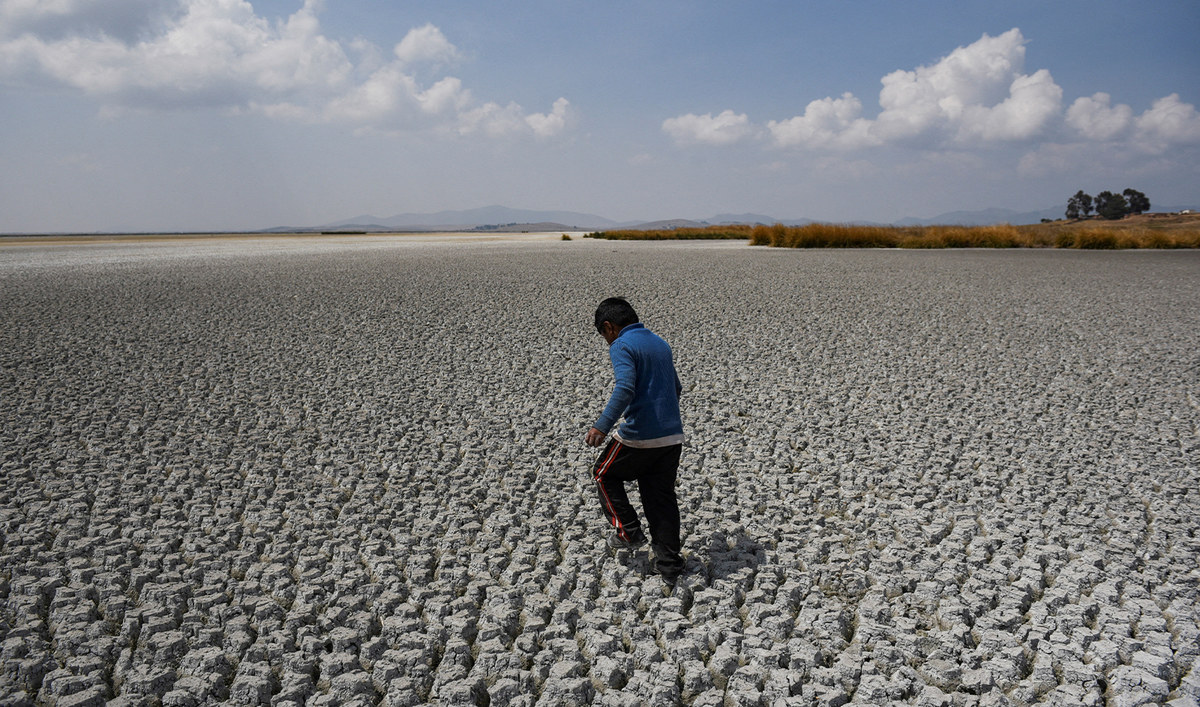


Alex Flores walks on a dry area of Lake Titicaca, Latin America's largest freshwater basin, as it is edging towards record low levels, on Cojata Island, Bolivia on October 26, 2023. (REUTERS/File)

Crop failures are not a new phenomenon, with surpluses in some regions long making up for shortfalls in others, but scientists fear stronger climate impacts could drive simultaneous failures across major global “breadbaskets,” resulting in a swift rise in global hunger. 

What is being done to address these threats? 

Around the world, many farmers are adapting to climate extremes in a variety of ways, from digging irrigation ponds to trap floodwater and store it for dry times, to adopting new climate-smart seeds and bringing back hardy traditional crops. 

But some challenges — such as more frequent and extreme heatwaves that can make it difficult for farmers to work outside — are harder to counter. 

Money to help small-scale farmers — who supply about a third of the world’s food — adapt to climate risks is also falling dramatically short. 

In 2021, they received only about $2 billion, or 0.3 percent of total international climate finance from public and private sources, according to Amsterdam-based think-tank Climate Focus. 

With little outside help available, many such farmers — who have contributed little to the emissions heating up the planet — are paying the costs of climate adaptation themselves. 

The Climate Focus survey of 13 countries in Asia, Africa and Latin America found nearly 440 million small-scale farmer households now spend about $368 billion annually on adaptation costs, or about $838 each per year. 

Analysts say efforts to shore up global food security also need to reach well beyond farms, to try to rein in speculators in food markets, discourage export clampdowns and revamp increasingly overwhelmed humanitarian aid systems. 

Can we find ways to grow more food to make up for the losses? 

Expanding the amount of land being farmed — or boosting the use of fossil-fuel-based fertilizers and developing new crop varieties — have long been accepted ways to grow more food. 

But agricultural land expansion often comes at the expense of forests and other natural ecosystems that are critical to conserve because their vegetation absorbs and stores climate-heating carbon dioxide emissions in order to grow, helping to curb climate change. 

For example nearly 20 percent of the vast Amazon rainforest has now been lost, largely to soybean farming and cattle ranching. 

Scientists fear additional deforestation could over time turn the forest into a dry savanna, imperiling rainfall for agriculture across South America — and sabotaging the world’s climate and biodiversity protection goals. 

Efforts to intensify the amount of food grown on a set land area have shown some success but often require large amounts of expensive fossil fuel-based fertilizers. 

In recent years, however, more environmentally friendly farming methods are gaining new adherents, from the United States to India. 

But food analysts say the best way to increase global supplies is not to grow more but to reduce the huge amount of food wasted each year. 

While the world produces enough food for everyone, about a third of it is lost or wasted along the supply chain from field to fork, according to the United Nations, which says the average person wastes 74 kg (163 lb) of food each year. 


Britain’s Starmer seeks to bolster China ties despite Trump warning

Updated 4 sec ago
Follow

Britain’s Starmer seeks to bolster China ties despite Trump warning

  • “The UK has got a huge amount to offer,” he said in a short speech at the UK-China Business Forum at the Bank of China

SHANGHAI: Visiting Prime Minister Keir Starmer said on Friday Britain has a “huge amount to offer” China, after his bid to forge closer ties prompted warnings from US President Donald Trump.
Starmer’s trip is the first to China by a British prime minister in eight years, and follows in the footsteps of other Western leaders looking to counter an increasingly volatile United States.
Leaders from France, Canada and Finland have flocked to Beijing in recent weeks, recoiling from Trump’s bid to seize Greenland and tariff threats against NATO allies.
Trump warned on Thursday it was “very dangerous” for Britain to be dealing with China.
Starmer brushed off those comments on Friday, noting that Trump was also expected to visit China in the months ahead.
“The US and the UK are very close allies, and that’s why we discussed the visit with his team before we came,” Starmer said in an interview with UK television.
“I don’t think it is wise for the UK to stick its head in the sand. China is the second-largest economy in the world,” he said.
Asked about Trump’s comments on Friday, Beijing’s foreign ministry said “China is willing to strengthen cooperation with all countries in the spirit of mutual benefit and win-win results.”
Starmer met top Chinese leaders, including President Xi Jinping and Premier Li Qiang, on Thursday, with both sides highlighting the need for closer ties.
He told business representatives from Britain and China on Friday that both sides had “warmly engaged” and “made some real progress.”
“The UK has got a huge amount to offer,” he said in a short speech at the UK-China Business Forum at the Bank of China.
The meetings the previous day provided “just the level of engagement that we hoped for,” Starmer said.
He signed a series of agreements on Thursday, with Downing Street announcing Beijing had agreed to visa-free travel for British citizens visiting China for under 30 days, although Starmer acknowledged there was no start date for the arrangement yet.
The Chinese foreign ministry said only that it was “actively considering” the visa deal and would “make it public at an appropriate time upon completing the necessary procedures.”
Starmer hailed the agreements as “symbolic of what we’re doing with the relationship.”
He also said Beijing had lifted sanctions on UK lawmakers targeted since 2021 for their criticism of alleged human rights abuses against China’s Muslim Uyghur minority.
“President Xi said to me that that means all parliamentarians are welcome,” Starmer said in an interview with UK television.
He traveled from Beijing to economic powerhouse Shanghai, where he spoke with Chinese students at the Shanghai International College of Fashion and Innovation, a joint institute between Donghua University and the University of Edinburgh.

- Visas and whisky -

The visa deal could bring Britain in line with about 50 other countries granted visa-free travel, including France, Germany, Australia and Japan, and follows a similar agreement made between China and Canada this month.
The agreements signed included cooperation on targeting supply chains used by migrant smugglers, as well as on British exports to China, health and strengthening a bilateral trade commission.
China also agreed to halve tariffs on British whisky to five percent, according to Downing Street.
British companies sealed £2.2 billion in export deals and around £2.3 billion in “market access wins” over five years, and “hundreds of millions worth of investments,” Starmer’s government said in a statement.
Xi told Starmer on Thursday that their countries should strengthen dialogue and cooperation in the context of a “complex and intertwined” international situation.
Relations between China and the UK deteriorated from 2020 when Beijing imposed a national security law on Hong Kong and cracked down on pro-democracy activists in the former British colony.
However, China remains Britain’s third-largest trading partner, and Starmer is hoping deals with Beijing will help fulfil his primary goal of boosting UK economic growth.
British pharmaceutical group AstraZeneca said on Thursday it would invest $15 billion in China through 2030 to expand its medicines manufacturing and research.
And China’s Pop Mart, makers of the wildly popular Labubu dolls, said it would set up a regional hub in London and open 27 stores across Europe in the coming year, including up to seven in Britain.
Starmer will continue his Asia trip with a brief stop in Japan on Saturday to meet Prime Minister Sanae Takaichi.